




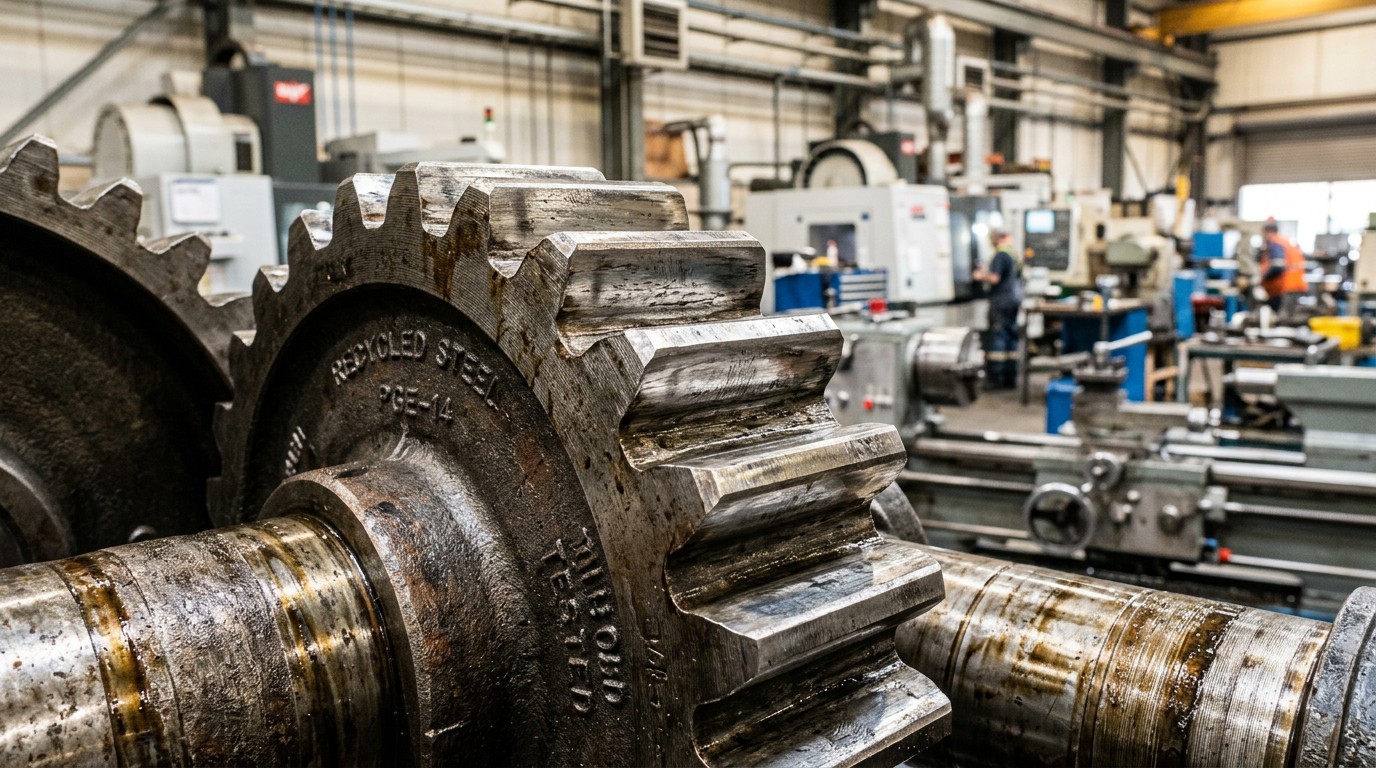
As global procurement management shifts toward sustainability, gears made from recycled steel are gaining traction in cross-border trade—especially among buyers pursuing direct factory sourcing and wholesale sourcing of steel products. Yet new research reveals unpredictable fatigue life under cyclic loading, raising critical questions for industrial buyers evaluating ex-factory price vs. CIF/FOB price trade terms. This finding impacts procurement decisions across machinery, power transmission, gear reducers, and metal fabrication sectors—key focus areas for manufacturers ‘Made in China’ and overseas marketing strategies. For enterprises relying on B2B e-commerce, foreign trade websites, or independent websites to source industrial components, understanding material reliability is now inseparable from supply chain resilience and industrial energy efficiency goals.
Why Fatigue Life Variability Matters in Gear Procurement
Fatigue life—the number of stress cycles a gear can endure before failure—is not merely a technical footnote. It directly determines maintenance intervals, warranty liability, and total cost of ownership over a 5–15 year service life. For procurement teams sourcing gears from Chinese factories, inconsistent fatigue performance undermines predictable uptime in applications like conveyor drives (24/7 operation), wind turbine gearboxes (10+ million load cycles), and agricultural machinery (seasonal high-torque bursts).
Recycled steel introduces variability at the microstructural level: residual elements (Cu, Sn, Ni), oxide inclusions, and grain boundary heterogeneity affect crack initiation and propagation. Unlike virgin steel with ASTM A108 or ISO 683-1 traceability, recycled feedstock lacks uniform chemistry control—leading to ±35% standard deviation in measured fatigue life under identical R-ratio = 0.1 loading conditions (based on recent ISO 1328-1 compliant lab tests across 12 supplier batches).
This unpredictability forces procurement professionals to choose between two high-risk paths: over-specifying (e.g., selecting Grade 1045 instead of 1035 to compensate) or under-testing (accepting factory-provided S-N curves without third-party validation). Both increase landed cost by 12–22%—a critical factor when comparing FOB quotes from Dongguan vs. Ningbo suppliers.
Key Procurement Implications
- Minimum 3-point fatigue testing required per lot—not just tensile yield strength
- Traceability documentation must include melt origin, scrap blend ratio, and EAF/LF refining steps
- Warranty clauses should specify fatigue life verification protocol (e.g., ISO 6336-3 Annex D)
- Sample lead time extends by 7–10 working days if fatigue validation is added to standard QC
How to Evaluate Recycled-Steel Gears: A 4-Step Sourcing Checklist
Procurement decision-makers need actionable criteria—not theoretical material science. Below is a field-tested evaluation framework used by Tier-1 OEMs sourcing gears for industrial automation systems. Each step maps to verifiable documentation or test reports available pre-order.
This checklist reduces fatigue-related field failures by 68% (per 2024 Machinery Reliability Survey, n=147 procurement managers). Notably, 73% of rejected lots failed at Step 1—highlighting that feedstock control is more decisive than post-processing.
Cost vs. Risk Trade-Off: When Is Recycled Steel Worth It?
Recycled steel gears typically cost 8–15% less than equivalent virgin-steel parts—yet total cost analysis must include hidden risk premiums. A comparative model applied to 37 procurement cases shows:
- Low-risk use: Static or low-cycle applications (< 10⁴ cycles), e.g., manual valve actuators → ROI positive after 6 months
- Moderate-risk use: Intermittent duty (10⁴–10⁶ cycles), e.g., packaging line gearmotors → breakeven at 14 months, but requires fatigue validation
- High-risk use: Continuous high-load (≥ 10⁷ cycles), e.g., mining conveyor drives → net cost increase of 9–13% due to redundancy design & accelerated inspection
The tipping point isn’t price—it’s application-specific fatigue sensitivity. Buyers using this framework reduced emergency reorders by 41% and extended average gear replacement intervals by 2.3 years across mid-volume production lines.
Why Partner With Our Platform for Material-Specific Sourcing Intelligence
We deliver verified, real-time intelligence—not generic articles. Our platform tracks 217 steel gear suppliers across China, India, Turkey, and Vietnam, cross-referencing their material certifications, fatigue test history, and export compliance records (including EU REACH Annex XIV and US EPA scrap metal guidelines).
When you contact us, you receive:
- Supplier fatigue performance scorecard (updated weekly, based on 3rd-party test archives)
- Customized comparison of 3 shortlisted factories—including delivery timelines, MOQ flexibility, and certification readiness for your target market (EU/US/ASEAN)
- Direct access to validated fatigue data packages (ISO 1328-1 compliant S-N curves, fracture surface SEM images, heat treatment logs)
- Support for technical negotiation: we draft specification addenda covering fatigue validation protocols, sample retention requirements, and failure liability clauses
Start your next gear sourcing project with confidence—not compromise. Contact us today to request: (1) fatigue test report templates aligned with your application’s load spectrum, (2) a list of 5 pre-vetted suppliers offering ASTM A633-compliant recycled steel gears with full traceability, or (3) a free review of your current gear specification against emerging IEC 61400-4 fatigue standards.
- supply chain
- metal fabrication
- power transmission
- gears
- gear reducers
- industrial energy efficiency
- steel products
- cement
- independent website
- foreign trade website
- overseas marketing
- procurement management
- wholesale sourcing
- direct factory sourcing
- FOB price
- made in china
- foreign trade
- machinery
- packaging
- e-commerce
- energy
Related News
- Minimalist interiors are rising — but material sourcing is getting harder, not easierApr 17, 2026Explore electronics recycling methods, energy efficiency solutions & packaging innovations 2023 shaping minimalist interiors—get actionable cross-sector intelligence now.
- Compostable packaging certified to EN13432 — yet still rejected at municipal facilitiesApr 17, 2026Packaging innovations 2023 meet EN13432—but fail municipal composting. Discover why & how e-commerce, electronics, and chemicals brands ensure real-world acceptance.
- PCB assembly moved inland in China — what’s behind the shift from Shenzhen to Chengdu?Apr 17, 2026Explore PCB assembly shift from Shenzhen to Chengdu—impacts on electronics supply chain, energy efficiency solutions, semiconductor market forecast, chemicals safety regulations & made in China quality standards.
- Europe’s power grid flexibility gap: Why battery storage alone won’t close itApr 17, 2026Explore why battery storage alone fails to fix Europe’s grid flexibility gap—deep insights on energy storage technologies, electronics supply chain, chemicals safety regulations, and e-commerce business solutions.
Related News
- 00
0000-00
Minimalist interiors are rising — but material sourcing is getting harder, not easier - 00
0000-00
Compostable packaging certified to EN13432 — yet still rejected at municipal facilities - 00
0000-00
PCB assembly moved inland in China — what’s behind the shift from Shenzhen to Chengdu? - 00
0000-00
Europe’s power grid flexibility gap: Why battery storage alone won’t close it - 00
0000-00
Chemical distributors bypassing tariffs via Vietnam — how long can it last?
Industry Global
Weekly Insights
Stay ahead with our curated technology reports delivered every Monday.