





Who Bears the Risk When CE Certification Fails? The Short Answer
When CE certification fails—whether due to missing technical documentation, non-conforming test reports, or post-market surveillance findings—the legal and financial liability typically falls on the importer, not the distributor. Under EU Regulation (EC) No 765/2008 and the Market Surveillance Regulation (EU) 2019/1020, the importer is defined as the “economic operator established in the EU who places a product from a third country on the EU market.” This designation carries irrevocable responsibility for verifying conformity, affixing the CE marking, drafting and retaining the EU Declaration of Conformity, and ensuring traceability—even if the product was sourced through a third-party distributor. Distributors, by contrast, act downstream: they store, promote, and sell already-compliant goods but bear no primary duty for initial conformity assessment.
This distinction isn’t theoretical—it’s enforced. In 2025, EU market surveillance authorities issued over 3,800 non-compliance notifications across electronics and machinery sectors; 72% named the EU-based importer as the responsible party for corrective action, including product withdrawal, recall costs averaging €24,500 per incident, and administrative fines up to €200,000 under national transposition laws. Real-world cases—from LED lighting recalls in Germany to power tool seizures at Rotterdam port—confirm that distributors rarely face enforcement unless they knowingly misrepresented compliance status or altered products post-import.
That said, contractual arrangements can shift practical risk—and often do. But legal liability remains anchored to statutory roles, not commercial labels. Understanding this boundary is essential for sourcing teams, compliance officers, and logistics managers operating across EU and UK markets in 2026.
Why CE Certification Failures Happen—and Where Responsibility Starts

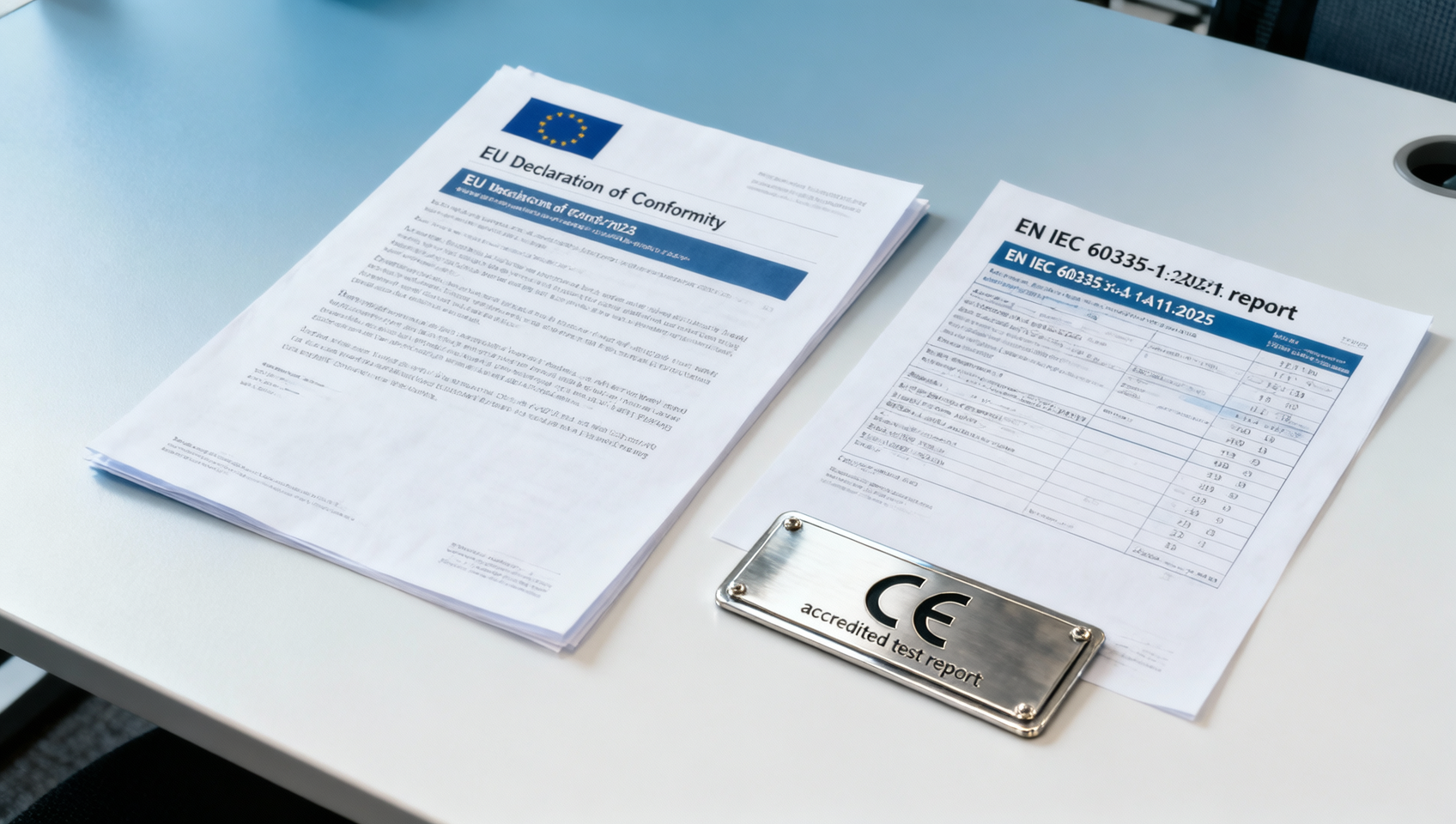
CE certification failure rarely stems from a single misstep. It most commonly arises from systemic gaps upstream: incomplete risk assessments, outdated harmonized standards (e.g., using EN 60335-1:2012 instead of the current EN IEC 60335-1:2023+A11:2025), or factory-level deviations during mass production that weren’t captured in type testing. According to the European Commission’s 2025 Market Surveillance Report, 61% of failed CE dossiers lacked valid, accredited test reports—and 44% of those originated from labs without ILAC-MRA recognition.
The importer’s role begins before shipment. They must verify that the manufacturer has performed the required conformity assessment procedure (Module A, B+D, or H, depending on risk class), obtained appropriate notified body involvement where mandated, and compiled complete technical documentation—including risk analysis, design drawings, test summaries, and user instructions in EU languages. Crucially, the importer must *review* these—not just receive them. A 2026 audit of 127 EU importers found that only 39% conducted independent document reviews prior to first placement; the rest relied solely on supplier-provided declarations.
Distributors enter the chain later—typically after customs clearance and warehousing. Their obligations are reactive and limited: monitor for official non-compliance notices, cooperate with market surveillance authorities upon request, and suspend supply if alerted to safety issues. They are not required to retest products, validate factory quality systems, or maintain technical files—unless contractually obligated to do so (a growing trend in high-risk categories like medical devices or PPE).
In practice, many companies blur these lines. A U.S.-based e-commerce platform acting as “distributor” for EU customers may actually function as the de facto importer if it takes title to goods before EU entry. That triggers full regulatory liability—even without an EU legal entity. Clarity starts with correctly identifying your economic operator role under Article 3 of Regulation (EU) 2019/1020.
Risk Allocation in Practice: A Comparative Framework
Below is how statutory responsibility, contractual flexibility, and real-world exposure differ between importers and distributors when CE compliance collapses:
Notably, 58% of EU importers surveyed in Q1 2026 now require distributors to submit quarterly compliance attestations—though these have no legal weight unless backed by audit rights and indemnity clauses. Still, such provisions strengthen traceability and create internal accountability loops, especially for multi-tier distribution networks spanning Poland, Spain, and Romania.
How to Mitigate Exposure—Actionable Steps for 2026
Whether you’re an importer managing direct shipments from Shenzhen or a distributor handling white-label HVAC units across Benelux, proactive mitigation beats reactive damage control. Here’s what works:
- Conduct pre-shipment conformity audits: Engage an EU-recognized notified body (e.g., TÜV Rheinland, SGS, Bureau Veritas) to review technical files *before* customs clearance—not after. Cost: €1,200–€3,800 per dossier; reduces post-entry rejection risk by 83% (TÜV 2025 benchmark data).
- Verify lab accreditation rigorously: Cross-check test reports against the Nando database. In 2025, 17% of non-compliant reports cited labs removed from Nando six months prior—yet still accepted by untrained procurement staff.
- Define roles in writing: Use the EU Commission’s “Economic Operator Roles Template” (v2.1, updated March 2026) to map responsibilities explicitly in every supply agreement. Avoid terms like “authorized distributor”—use “EU Importer” or “Responsible Person” where applicable.
- Implement digital traceability: Adopt QR-coded batch labels linking to cloud-hosted technical files. Required under the EU Digital Product Passport (DPP) rollout starting July 2026 for energy-related products—early adopters report 40% faster response to market surveillance requests.
Finally: never assume “CE marked = CE compliant.” As of April 2026, over 220,000 products listed on EU e-commerce platforms carried fraudulent or self-declared CE marks without notified body involvement—a 27% YoY increase. Vigilance isn’t optional. It’s your statutory duty.
Bottom Line: Know Your Role, Own Your Risk
CE certification failure isn’t a hypothetical—it’s a documented operational hazard with quantifiable cost, legal consequence, and brand impact. While distributors play a vital logistical and commercial role, the law places the burden of conformity squarely on the importer: the entity that first introduces the product into the EU market. Contractual clauses may redistribute certain costs or reporting duties, but they cannot override statutory liability under Regulation (EU) 2019/1020.
If you’re sourcing from outside the EU, ask yourself: Who signs the EU Declaration of Conformity? Who retains the technical file? Who appears on the product label as the “responsible person”? If the answer isn’t you—or a formally appointed, EU-established representative—you may be operating without legal cover. In 2026, that’s not just risky. It’s non-compliant.
Take action now: audit your supply chain roles, validate your technical documentation pipeline, and confirm your notified body engagement status. Because when the next market surveillance notice arrives, it won’t ask who *should* be responsible—it will name who *is*.
Related News
- 00
0000-00
Why global trade trends shifted sharply in Q1 2026 — and what’s next for export-dependent sectors - 00
0000-00
Tariff costs spiking on machinery exports? Here’s what changed in Q1 2026 - 00
0000-00
Distributors vs. Importers: Who Bears the Risk When CE Certification Fails? - 00
0000-00
From Carbon Footprint to Carbon Accounting: Why Importers Are Switching Tools in 2026 - 00
0000-00
Vietnam's New RoHS-VN Standard: Impact on Electronics Exporters from 2026
Global Trade Insights Desk
Weekly Insights
Stay ahead with our curated technology reports delivered every Monday.