





As demand rises for biodegradable packaging solutions for food industry, businesses are asking which materials can truly extend shelf life while meeting sustainability goals. From plastic resins for sustainable packaging to chemical additives for food packaging, this article explores how packaging innovation, sourcing decisions, and wider policy updates for chemical industry are shaping fresher, safer, and more competitive food supply chains.
For information researchers, commercial evaluators, and corporate decision-makers, the key issue is not whether biodegradable packaging is growing, but which formats deliver measurable performance under real food distribution conditions. Shelf life depends on oxygen transmission, moisture control, sealing quality, temperature fluctuation, and product-packaging compatibility. A compostable tray that works for bakery products may fail for cut fruit, chilled meat, or roasted coffee.
That is why procurement teams now compare biodegradable packaging solutions through a broader lens: barrier performance, machinability, food contact compliance, supply stability, additive selection, and regional disposal infrastructure. In cross-sector industry monitoring, packaging decisions are increasingly linked with resin price movements, chemical input availability, import-export trends, and packaging policy developments.
How food freshness is really affected by biodegradable packaging
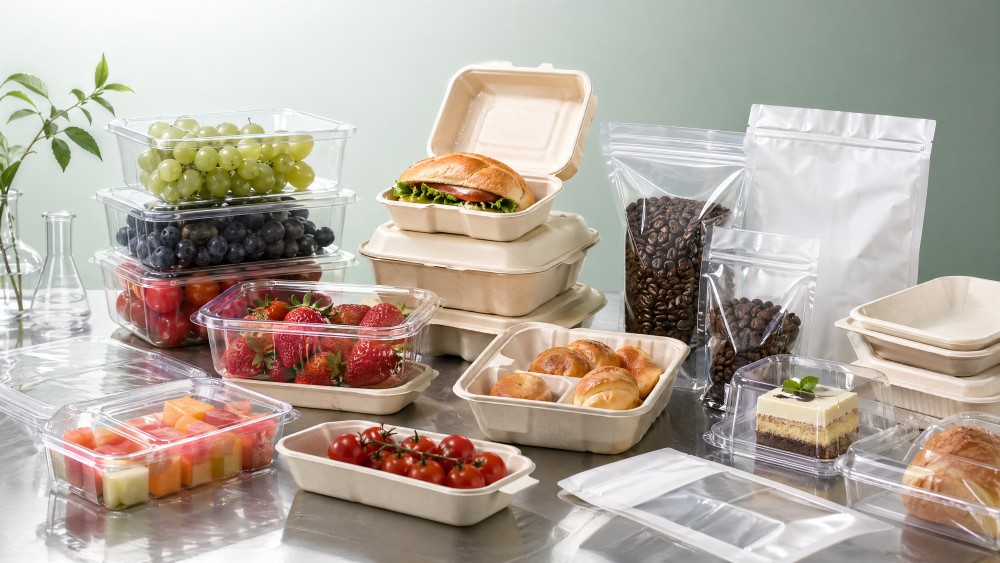
Food freshness is not controlled by one material property alone. In most packaged food systems, shelf life is influenced by 4 core variables: oxygen barrier, water vapor barrier, seal integrity, and resistance to grease or acids. For fresh produce, respiration rate also matters. For dry snacks or cereal products, moisture ingress can be more damaging than oxygen exposure.
Biodegradable packaging solutions often perform well in one area but less strongly in another. PLA, for example, offers good clarity and stiffness, but its heat resistance and moisture barrier may require coating or multilayer design. Molded fiber provides structure and plastic reduction benefits, yet by itself it is usually not enough for foods that need a high barrier over 7–30 days.
In commercial distribution, even a 2% to 5% increase in package failure rate can erase sustainability gains through added food waste, returns, and markdowns. For B2B buyers, the decision should therefore start with the expected storage period, such as 3–5 days for ready-to-eat salads, 10–14 days for bakery items, or 6–12 months for dry ambient foods.
Another practical factor is the packaging line itself. Some biodegradable films run well on existing horizontal flow wrappers, while others require lower sealing temperatures, narrower operating windows, or slower speeds. A material that looks sustainable on paper can become commercially weak if it cuts output by 10%–20% during peak production.
Main freshness risks buyers should map before selecting materials
- Oxygen exposure leading to oxidation, discoloration, and flavor loss in meat, coffee, nuts, and sauces.
- Moisture transfer causing sogginess in bakery items or clumping in powdered foods within 2–8 weeks.
- Weak seals or punctures during transport, especially in cold chain applications below 4°C.
- Poor compatibility with acidic, oily, or high-aroma products that need stronger chemical resistance.
Which biodegradable packaging materials can keep food fresh longer
No single biodegradable packaging solution is best for every food category. The more reliable approach is to match the material family to the shelf-life target and product sensitivity. In practice, buyers often compare PLA, PHA, cellulose-based films, starch blends, bagasse or molded fiber, and coated paper structures. Each has a different trade-off between biodegradability, barrier performance, cost, and converting complexity.
For foods that need a moderate barrier and visual presentation, PLA-based films are commonly used for salad containers, bakery windows, and cold food packs. For stronger grease resistance or marine-biodegradable positioning, PHA may be evaluated, though pricing and supply continuity can still be tighter than more established resins. Cellulose films are often chosen when breathability and premium appearance are priorities.
Molded fiber and bagasse solutions work well for takeaway meals, produce trays, and secondary protection, but they usually rely on coatings or lidding films to maintain freshness. This distinction matters in purchasing reviews: the tray may be biodegradable, but the freshness function often depends on the full system, including the film, adhesive, sealant, and any barrier coating.
The table below compares widely discussed biodegradable packaging solutions from a food shelf-life perspective rather than from sustainability claims alone.
The main conclusion is that biodegradable packaging solutions keep food fresh longer only when they are engineered as a performance system. For foods with shelf-life needs beyond 10–14 days, buyers should generally expect a multilayer approach, coating technology, or controlled-atmosphere design rather than a simple material substitution.
Where each material tends to fit best
Short shelf life: 1–7 days
Fresh bakery, deli items, and cut produce can often use cellulose films, PLA clamshells, or molded fiber paired with vented lidding. Here, condensation control and sealing consistency matter more than extreme barrier values.
Medium shelf life: 7–30 days
Prepared foods, chilled snacks, and some meat alternatives typically require coated bio-films, high-integrity seals, and sometimes oxygen scavenging support. Buyers should test performance after transport vibration and temperature cycling.
Long shelf life: 1–12 months
Coffee, dry powders, and sensitive snacks usually need advanced barrier structures. In many cases, businesses combine renewable content, downgauged layers, or recyclable design goals with selective biodegradable components rather than relying on one fully compostable film.
The role of coatings, additives, and sealing chemistry in shelf-life extension
In many food applications, the answer to longer freshness lies less in the base substrate and more in chemistry. Chemical additives for food packaging can improve flexibility, sealability, anti-fog behavior, grease resistance, and oxygen or moisture control. However, these inputs must be food-contact suitable, process-compatible, and aligned with the intended end-of-life route.
For example, anti-fog systems can matter significantly for chilled produce packs stored at 0–8°C, because water droplets reduce visibility and can accelerate spoilage perception at retail. Bio-based coatings may improve water resistance on paper or molded fiber. Sealant formulations can also widen the operating window on packaging lines, reducing defective seals during high-speed runs.
Another consideration is whether the additive package supports home compostability, industrial compostability, or only biodegradation under specific conditions. Commercial teams should ask not just “is it biodegradable?” but “under what temperature, humidity, and processing environment does the claim remain valid?” This is increasingly relevant as policy updates for chemical industry and packaging labeling become more detailed.
The table below outlines common chemistry-related levers that influence food freshness in biodegradable packaging solutions.
For decision-makers, the practical lesson is clear: when comparing suppliers, request a complete bill of material logic, not just the base film name. A biodegradable packaging solution may depend on 3 to 5 technical layers or treatment steps, each affecting freshness, compliance, price, and disposal claims.
Questions procurement teams should ask suppliers
- What shelf-life range has been tested for the target food category: 3 days, 14 days, or 6 months?
- What sealing temperature window is recommended, and how sensitive is the material to line-speed changes?
- Which coatings or additives are used, and do they affect compostability or recycling compatibility?
- How does the pack perform after cold chain handling, pallet stacking, and e-commerce delivery stress?
How to evaluate suppliers and build a practical sourcing strategy
For B2B buyers, choosing biodegradable packaging solutions is both a technical and supply-chain exercise. Performance data matters, but so do lead time, resin sourcing, conversion capability, and regulatory responsiveness. In industry monitoring, supply conditions can change within 4–12 weeks due to feedstock pricing, export restrictions, or regional packaging rules.
A disciplined sourcing process usually starts with product segmentation. Instead of trying to replace all packaging at once, many firms test 2 or 3 high-visibility product lines first. This lowers switching risk and helps compare spoilage, complaint rate, machine uptime, and packaging cost per unit under live market conditions.
Commercial evaluators should also look beyond unit material cost. If a biodegradable tray costs 8% more but reduces breakage, improves shelf appearance, or supports a premium sustainability claim in export markets, the total commercial effect may still be positive. On the other hand, a low-cost compostable film that increases seal failure by even 1 in 100 packs may become expensive fast.
The following table can be used as a practical decision screen during supplier comparison, especially for teams combining packaging, purchasing, compliance, and product management.
This comparison shows that the best biodegradable packaging solutions are usually those that balance five dimensions at once: freshness, line efficiency, cost visibility, policy fit, and supplier reliability. A strong sourcing decision is rarely based on material type alone.
A 5-step implementation path for companies
- Define the product group by sensitivity: dry, chilled, frozen, oily, acidic, or respiration-active.
- Set a measurable target such as equal shelf life, 10% lower plastic use, or no more than 2% packing loss.
- Shortlist 2–3 material systems and run line trials with real sealing and transport conditions.
- Review compliance, disposal labeling, and export market implications before scale-up.
- Track spoilage, returns, and consumer feedback for at least one replenishment cycle.
Market trends, common mistakes, and what decision-makers should do next
Across manufacturing, chemicals, packaging, e-commerce, and foreign trade, the direction is clear: food packaging decisions are becoming more integrated. Buyers are no longer selecting a film in isolation. They are comparing resin pathways, additive systems, machinery compatibility, regional waste management conditions, and policy movement across multiple markets at the same time.
One of the most common mistakes is assuming that “biodegradable” automatically means better for every food format. If a pack shortens shelf life by 1–3 days and increases food waste, the sustainability case weakens quickly. Another frequent error is relying only on lab claims without testing pallet stacking, puncture resistance, condensation, and seal integrity over actual logistics routes.
A smarter commercial strategy is to treat biodegradable packaging solutions as a phased portfolio. Some categories can switch now with limited risk, especially bakery, produce, takeaway, and selected dry foods. Others may require hybrid structures, additional coatings, or a delayed transition until material economics and barrier technology improve.
For industry researchers and business leaders, the most valuable next step is to monitor material innovation together with policy updates, supplier shifts, and packaging line implications. Freshness performance, compliance, and procurement resilience are moving targets, and businesses that review them quarterly rather than annually are better placed to respond.
FAQ for buyers evaluating biodegradable food packaging
How long should a packaging trial last?
For chilled or short-life foods, 2–4 weeks is often the minimum useful period because it covers production, transport, shelf exposure, and repeat sealing variation. For ambient foods with longer cycles, a pilot may run 6–12 weeks.
Which foods are easier to convert first?
Bakery, produce, takeaway meal trays, and some dry foods are often more practical starting points than high-fat, high-aroma, or long-shelf-life products. The latter usually need stronger barrier engineering.
What should exporters pay special attention to?
Check destination-market labeling rules, compostability definitions, and storage conditions during longer transit windows. Export supply chains can add 2–6 weeks of logistics exposure, which changes freshness risk.
Are biodegradable packaging solutions always more expensive?
Not always in total cost terms. Material price can be higher, but waste reduction, premium positioning, or policy alignment may offset part of the difference. The right benchmark is total delivered cost and commercial impact, not resin price alone.
The biodegradable packaging solutions that keep food fresh longer are the ones selected through product-specific testing, realistic barrier analysis, and disciplined supplier review. For decision-makers across packaging, chemicals, trade, and manufacturing, the winning approach is to combine sustainability targets with measurable shelf-life performance and operational fit.
If you are comparing materials, tracking packaging market developments, or evaluating sourcing options across food categories, now is the time to build a clearer evidence-based selection framework. Contact us to get tailored insights, discuss product details, or explore more packaging and industry solutions that support better freshness, lower risk, and stronger commercial decisions.
- supply chain
- chemical industry
- packaging solutions
- packaging market
- manufacturing
- packaging materials
- biodegradable packaging
- plastic resins
- chemical additives
- foreign trade
- machinery
- chemicals
- packaging
- e-commerce
- policy updates
- policy updates for chemical industry
- chemical additives for food packaging
- plastic resins for sustainable packaging
- biodegradable packaging solutions for food industry
Related News
- Which biodegradable packaging solutions keep food fresh longer?Apr 27, 2026Biodegradable packaging solutions for food industry: discover which materials, coatings, and chemical additives for food packaging help keep food fresh longer while improving sustainable sourcing decisions.
- Plastic resins for sustainable packaging: cost or performance?Apr 27, 2026Plastic resins for sustainable packaging: compare cost, performance, and supply risk with biodegradable packaging solutions for food industry through practical specialty chemicals market analysis.
- Vietnam’s QR Traceability Rule for Chinese Packaging Takes Effect July 2026Apr 27, 2026Vietnam’s QR traceability rule for Chinese packaging takes effect July 2026—mandatory for all imports. Discover compliance steps, affected sectors, and how to avoid customs delays.
- Vietnam Mandates QR Code Traceability for Chinese Packaging Imports from July 2026Apr 26, 2026Vietnam mandates QR code traceability for Chinese packaging imports from July 2026 — ensure compliance, avoid customs delays, and future-proof your supply chain.
Related News
- 00
0000-00
Yangtze River Delta Ports Q1 Throughput Up 7.2% Amid RCEP Stability - 00
0000-00
2026 Beijing Auto Show: AI-Driven Smart Car Export Enters Technical Compliance Phase - 00
0000-00
Tourism Vouchers Fuel Domestic Demand, Signal Export Opportunities - 00
0000-00
Metro China Leadership Reshuffle: Supply Chain Impact - 00
0000-00
Which biodegradable packaging solutions keep food fresh longer?
Packaging Industry Desk
Weekly Insights
Stay ahead with our curated technology reports delivered every Monday.