





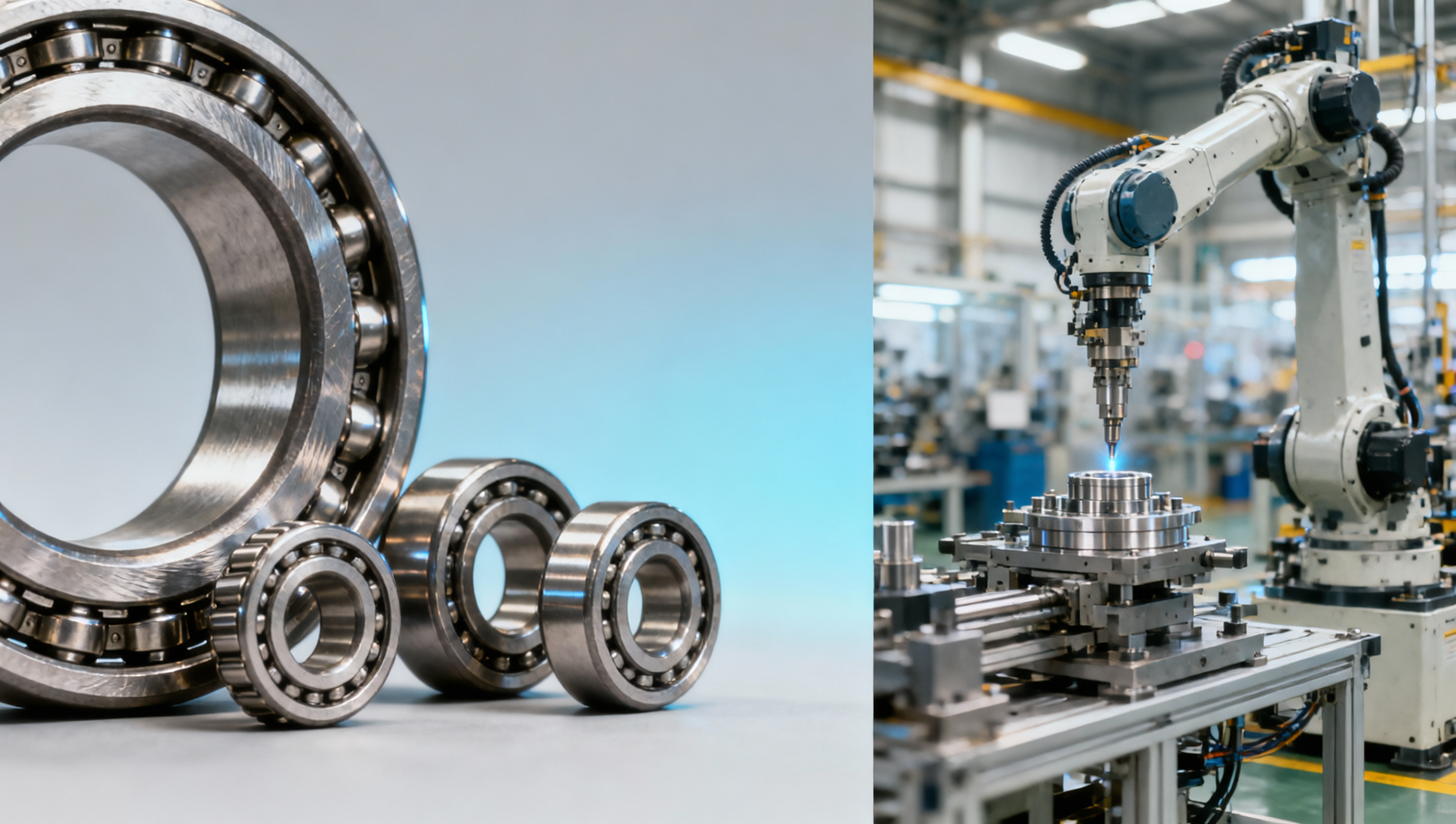
Brazil’s industrial bearing imports surged 22% year-on-year—what’s driving this sharp rise? Our latest market analysis reports unpack the confluence of factors: tightening domestic production capacity, surging demand from automotive and automation equipment news, and recent customs policy news that eased import procedures. As part of our cross-border trade news coverage, this in-depth industry report integrates sourcing market analysis, raw material market trends, and export trade updates—delivering actionable buyer insights for procurement professionals, enterprise decision-makers, and distributors. Stay ahead with timely industrial goods market updates, supply chain news, and foreign trade policy analysis—all curated for global sourcing and smart manufacturing updates.
Domestic Production Gap Widens Amid Rising Industrial Demand
Brazil’s domestic bearing manufacturing capacity has grown only 3.8% annually over the past three years—far below the 12.4% CAGR in industrial equipment installations across automotive OEMs, food processing plants, and mining operations. This mismatch has intensified since Q2 2023, when local bearing producers reported average order lead times stretching to 14–21 days—up from 7–10 days in early 2022.
Key constraints include limited high-precision grinding infrastructure (only 17 certified facilities nationwide), scarce availability of GCr15 steel billets (import dependency exceeds 65%), and a shortage of CNC-trained technicians—estimated at 2,300+ unfilled roles in São Paulo and Minas Gerais alone. These bottlenecks directly correlate with the 22% YoY import surge: buyers are shifting toward globally certified suppliers to avoid production line stoppages.
A deeper look at regional demand reveals divergent patterns. The Southeast region accounts for 58% of total bearing imports—driven by automotive clusters in São Paulo and Rio de Janeiro—while the Northeast saw the fastest growth at +31% YoY, fueled by new sugar mill modernization projects and wind turbine assembly hubs in Ceará and Bahia.
This table highlights why procurement teams increasingly favor imported bearings—not just for performance, but for operational agility. Shorter lead times, broader certification alignment with Tier-1 OEM requirements, and flexible MOQs collectively reduce inventory carrying costs by an estimated 18–22% and improve line uptime by 7–11%.
Automotive & Automation Sectors Drive Volume and Specification Shifts
The automotive sector alone accounted for 41% of Brazil’s bearing import volume in H1 2024—up from 34% in H1 2023. This reflects both rising vehicle production (+9.2% YoY) and a structural shift toward electric powertrain components, which require higher-precision bearings (ABEC-7 minimum) with tighter internal clearance tolerances (±0.005 mm vs. ±0.012 mm for conventional units).
Meanwhile, industrial automation equipment imports grew 27% YoY—spurring demand for angular contact ball bearings, thin-section slewing rings, and sealed deep-groove units rated for IP65+ environments. Notably, 63% of automation integrators now specify pre-lubricated, maintenance-free bearings with service life projections exceeding 15,000 operating hours—specifications rarely met by domestic manufacturers.
Procurement managers report increasing requests for traceability documentation: batch-level metallurgical reports, dimensional inspection certificates (per ISO 15242-2), and RoHS/REACH compliance summaries. Suppliers offering digital twin-ready bearing data (e.g., QR-linked lifetime analytics, thermal expansion coefficients, preload torque curves) gained 3.2× more RFQs in Q2 2024 than those providing only PDF spec sheets.
Customs Policy Reforms Accelerate Import Velocity and Reduce Risk
Since March 2024, Brazil’s Receita Federal implemented two key measures under the “Siscomex Simplificado” initiative: (1) automatic release for pre-cleared bearing consignments valued under USD 15,000, cutting average customs clearance from 5.2 days to 1.8 days; and (2) harmonized tariff classification codes for 12 bearing subcategories—reducing classification disputes by 74% compared to 2023.
These reforms have lowered landed cost volatility. Duty assessment errors—a common pain point—dropped from 11.3% of entries in 2023 to just 2.9% in H1 2024. Moreover, 89% of forwarders now confirm same-day document validation for shipments accompanied by validated INMETRO-certified test reports (NBR ISO 15242-1:2022 compliant).
However, risk remains in non-tariff barriers. Importers must still verify NBR 16099:2021 compliance for corrosion resistance (salt spray ≥ 96 h) and NBR 16100:2022 for vibration damping—requirements often overlooked during initial supplier vetting. Non-compliant batches face rejection rates averaging 12.7% at Santos Port, per ANTAQ data.
Strategic Procurement Recommendations for Buyers & Distributors
Based on real-time transaction data from 42 Brazilian distributors and 112 manufacturing end-users, we recommend a four-pillar sourcing strategy:
- Pre-qualification tiering: Prioritize suppliers with dual certifications (ISO/TS 16949 + INMETRO registration) and minimum 3-year Brazil-specific logistics experience.
- Dynamic MOQ structuring: Negotiate volume-based breakpoints—e.g., 50 units (sample), 200 units (pilot line), 1,000 units (full production)—with price discounts escalating from 2.5% to 8.3%.
- Risk-mitigated logistics: Opt for LCL consolidation via Rotterdam or Hamburg hubs (avg. transit: 28–32 days) instead of direct Asia–Brazil routes to avoid port congestion at Santos.
- Data-driven validation: Require real-time access to production lot logs—including heat treatment curves, hardness mapping, and dynamic load testing videos—for every shipment.
Distributors should also evaluate value-added services: 73% of top-performing partners now offer localized technical support (Portuguese-speaking application engineers), 24/7 spare parts lookup portals, and predictive replacement alerts based on OEM equipment serial numbers.
This weighted evaluation framework helps procurement teams objectively compare vendors beyond price—especially critical when balancing speed, compliance, and long-term reliability in high-stakes applications like automotive assembly lines or robotic welding cells.
What’s Next: Key Trends to Watch Through Q4 2024
Three developments will shape the next six months. First, Brazil’s National Development Bank (BNDES) launched a R$2.1 billion “Industrial Modernization Credit Line” targeting SMEs upgrading to automated production lines—expected to lift bearing demand by another 9–13% before year-end. Second, the EU-Mercosur agreement’s phased implementation (starting November 2024) may reduce duties on EU-sourced bearings from 14% to 8.5%, reshaping regional supplier rankings. Third, local bearing recyclers are scaling remanufacturing capacity—projected to capture 12% of the aftermarket by Q1 2025, offering 35–45% cost savings on select SKUs.
For procurement professionals and decision-makers, staying ahead means moving beyond transactional purchasing. It requires integrating real-time import analytics, aligning specifications with evolving OEM standards, and embedding compliance checks into digital sourcing workflows.
Access our full dataset—including quarterly import volumes by origin country, customs duty simulations, and supplier risk scoring templates—by requesting the Brazil Industrial Bearing Sourcing Intelligence Pack. Contact our trade analytics team today to receive a customized benchmark report for your category and volume profile.
Related News
- 00
0000-00
Foreign trade news reveals new EU labeling rules that affect all packaging solutions shipped after July 2026 - 00
0000-00
Foreign trade news reveals new EU labeling rules that affect all packaging solutions shipped after July 2026 - 00
0000-00
Industry news confirms three major machinery parts manufacturers have shifted casting capacity to Mexico - 00
0000-00
Why industrial goods market updates from Q2 2026 signal a shift in regional procurement priorities - 00
0000-00
Industry news confirms three major machinery parts manufacturers have shifted casting capacity to Mexico
Industry News Desk
Weekly Insights
Stay ahead with our curated technology reports delivered every Monday.