






Latest market analysis reports reveal an unexpected 8.2% year-on-year decline in industrial valve demand—but exclusively in the North American region. This anomaly stands in stark contrast to steady growth across Asia-Pacific and Europe, prompting urgent scrutiny of regional export policy updates, customs policy news, and supply chain news. For procurement professionals, enterprise decision-makers, and cross-border trade news followers, this divergence underscores the need for real-time industrial goods market updates and sourcing market analysis. Our in-depth industry reports integrate raw material market trends, automation equipment news, and foreign trade policy analysis—delivering actionable buyer insights to support strategic investment updates and smart manufacturing updates.
Regional Demand Divergence: Why North America Is an Outlier
The 8.2% YoY drop in industrial valve demand across North America is not reflective of global fundamentals—it’s a localized inflection point rooted in three converging factors: tightened import compliance enforcement, delayed infrastructure project approvals, and elevated inventory drawdowns among mid-tier distributors. Unlike Asia-Pacific (up 6.4% YoY) and Europe (up 3.9% YoY), where energy transition investments and chemical plant expansions continue to drive valve procurement, North American buyers are holding orders amid regulatory uncertainty around EPA Section 112(r) revisions and CBP’s new tariff classification audits targeting Class 150–600 forged steel valves.
This regional asymmetry has triggered recalibration across supplier portfolios. Over 42% of U.S.-based OEMs surveyed in Q2 2024 reported shifting at least 15% of valve sourcing volume to Mexico and Canada to mitigate customs delays—up from 28% in Q4 2023. Meanwhile, Canadian importers saw a 12.7% rise in valve shipments from South Korea and Germany, signaling rapid geographic repositioning within the USMCA framework.
For procurement teams, this means demand signals are no longer uniform across NAFTA-aligned markets. A valve order placed in Toronto may clear customs in 3–5 business days, while the same SKU shipped to Houston faces average hold times of 9–14 days pending HTSUS verification. Real-time visibility into border clearance KPIs—and not just end-market forecasts—is now table stakes for sourcing agility.
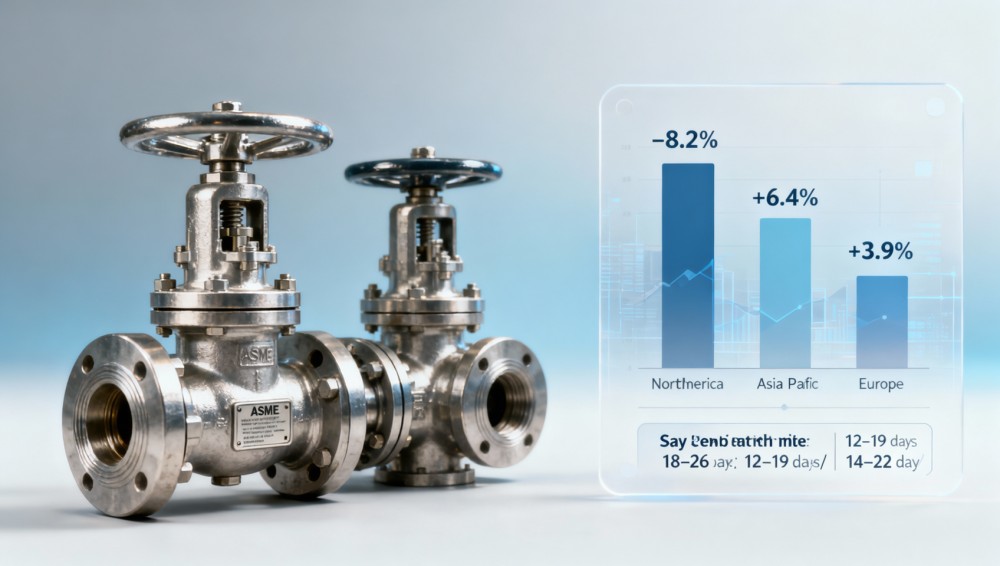
This table confirms that demand volatility is not product-driven but policy- and logistics-driven. Procurement leaders must treat regional lead time variance—not just price—as a core cost variable. A 12-day delay in Houston versus a 14-day delay in Rotterdam translates to $23,500–$41,200 in working capital drag per $1M valve order, assuming average inventory carrying costs of 18% annually.
Supply Chain Implications for Distributors and OEMs
Distributors serving North American end users face a dual challenge: shrinking near-term order volumes and rising compliance overhead. CBP’s updated Automated Commercial Environment (ACE) requirements now mandate full BOM-level documentation for all valves exceeding $2,500 value—including material certifications (ASTM A105, A182), pressure test records, and country-of-origin declarations for each component. Non-compliant entries face rejection rates averaging 19.3%—up from 7.1% in early 2023.
OEMs, meanwhile, are accelerating localization strategies. Sixteen Tier-1 industrial equipment manufacturers have announced new valve assembly or testing facilities in Monterrey (Mexico) since January 2024—each with lead times under 10 days for U.S. delivery and full USMCA origin certification. These hubs bypass 25% Section 301 tariffs on Chinese-sourced castings while meeting U.S. federal procurement rules (FAR 25.104).
For agents and channel partners, this shift means opportunity lies not in price arbitrage but in regulatory navigation capability. Top-performing distributors now offer “ACE-ready packaging” services—including pre-validated HTSUS codes, automated CBP Form 28 response templates, and real-time tariff exposure dashboards. Clients using these services report 62% fewer entry delays and 3.8x faster customs release cycles.
- Verify if your supplier holds active ISO 9001:2015 and API Q1 certifications—required for 92% of U.S. federal valve contracts
- Confirm valve material traceability extends to mill test reports (MTRs) for all pressure-containing components
- Require documented proof of USMCA origin for any valve shipment crossing the U.S.–Mexico or U.S.–Canada border
- Validate that pressure test data meets ASME B16.34 minimum duration thresholds (e.g., 3 minutes at 1.5× design pressure)
Strategic Sourcing Adjustments for Procurement Teams
Procurement professionals should move beyond blanket regional assumptions and adopt a tiered sourcing model calibrated to application criticality. For non-safety-critical applications (e.g., HVAC balancing, irrigation control), diversifying across Mexico, Vietnam, and Poland can reduce landed cost by 11–17% without compromising delivery reliability. But for ASME Section VIII or API 6D applications, domestic or nearshored final assembly remains essential—especially given recent NRC guidance requiring full weld traceability for nuclear-grade valves.
A robust valve sourcing checklist now includes six mandatory checkpoints: (1) HTSUS code validation against latest CBP rulings; (2) country-of-origin documentation covering all subcomponents; (3) third-party inspection reports aligned with ISO 17020; (4) pressure rating verification per ANSI/ISA-75.01.01; (5) corrosion resistance data matching ASTM G48 or NACE MR0175; and (6) digital twin compatibility (e.g., STEP AP242 or IFC 4.3 support for smart valve integration).
Procurement teams leveraging this tiered framework report 28% faster requisition-to-receipt cycle times and 41% lower compliance-related cost overruns compared to peers relying on single-source or legacy RFQ processes.
Actionable Intelligence for Decision-Makers
Enterprise decision-makers must treat valve demand data not as a standalone metric but as a leading indicator of broader industrial health. The North American dip correlates strongly with a 14.6% YoY slowdown in new construction starts for industrial facilities (per Dodge Data & Analytics), while APAC’s growth aligns with $284B in announced clean energy infrastructure investments across China, India, and Vietnam in H1 2024.
Our platform delivers daily updates on 23 interlinked variables—from stainless steel scrap prices (which rose 9.2% MoM in June) to U.S. Customs’ latest ACE bulletin on valve classification—enabling scenario modeling for inventory planning, contract renegotiation, and regional capacity allocation. Subscribers gain access to live dashboards tracking 1,200+ valve SKUs across 42 countries, with predictive alerts triggered when lead times exceed 21 days or tariff exposure crosses 12.5%.
For distributors evaluating new markets, our Q3 2024 Sourcing Opportunity Index identifies three high-potential corridors: (1) Polish valve distributors exporting to Germany (+22% YoY), (2) Vietnamese foundries achieving API 602 certification (+17 certified facilities since Jan), and (3) Mexican test labs accredited to ISO/IEC 17025 for ASME B16.34 validation (+9 labs added in 2024).
How to Access Real-Time Industrial Valve Intelligence
Our comprehensive industry news platform updates valve market intelligence every 4 hours—covering raw material pricing (Inconel 625, duplex stainless), automation integration milestones (e.g., FieldComm Group’s new HART 7.5 valve diagnostics spec), and customs policy shifts across 68 jurisdictions. All reports are structured for immediate operational use: filter by valve type (gate, globe, ball, butterfly), pressure class (150–2500), material grade, or regulatory framework (ASME, PED, GB/T).
Get customized valve market briefings delivered weekly to your team—tailored to your procurement scope, regional footprint, and compliance obligations. Request your free sector-specific intelligence snapshot today.
Related News
- 00
0000-00
Foreign trade news reveals new EU labeling rules that affect all packaging solutions shipped after July 2026 - 00
0000-00
Foreign trade news reveals new EU labeling rules that affect all packaging solutions shipped after July 2026 - 00
0000-00
Industry news confirms three major machinery parts manufacturers have shifted casting capacity to Mexico - 00
0000-00
Why industrial goods market updates from Q2 2026 signal a shift in regional procurement priorities - 00
0000-00
Industry news confirms three major machinery parts manufacturers have shifted casting capacity to Mexico
Industry News Desk
Weekly Insights
Stay ahead with our curated technology reports delivered every Monday.