





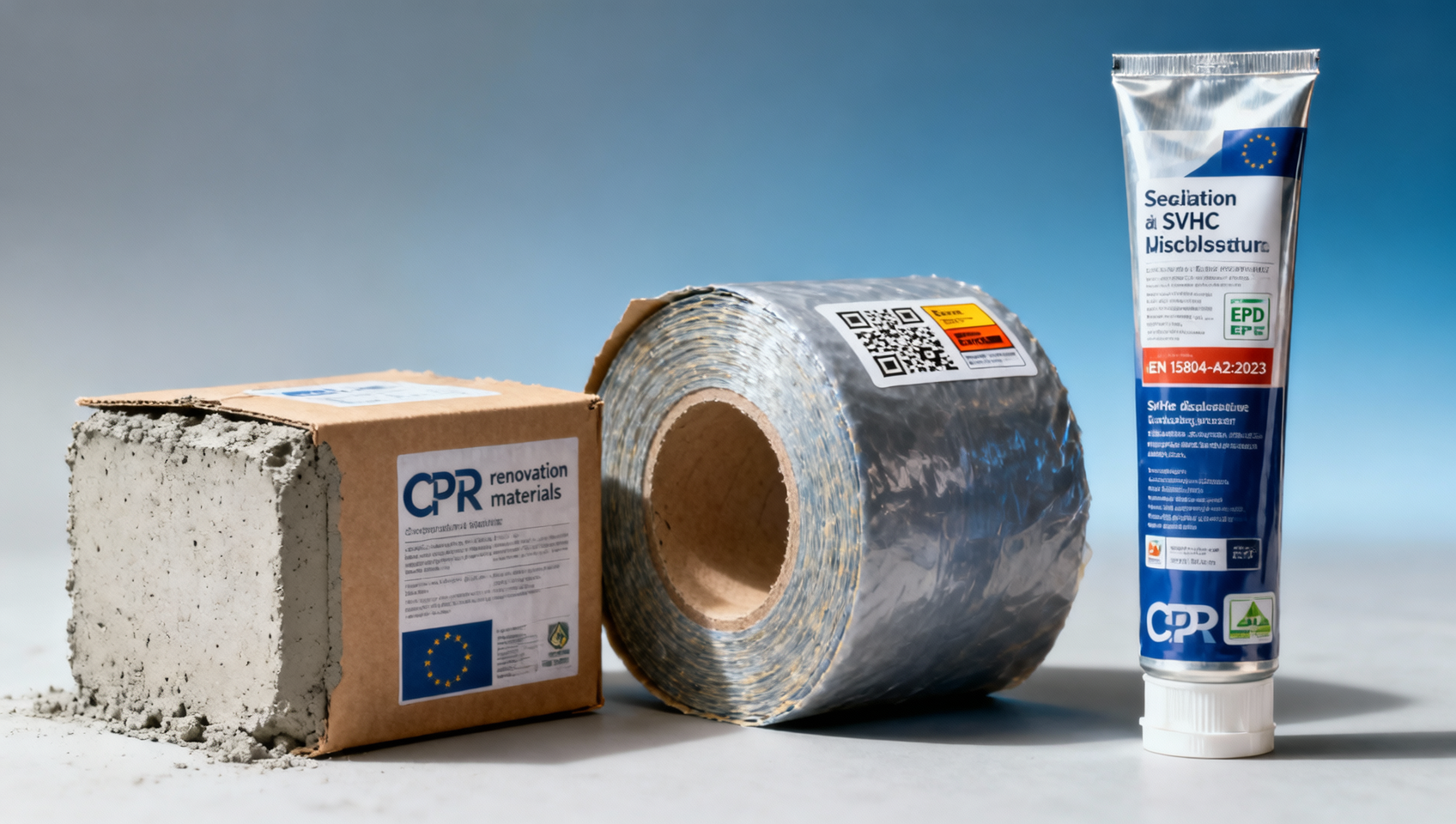
The EU’s new labeling requirements for renovation materials—spanning building materials market, home improvement, and fine chemicals—are now in force, with ripple effects across packaging, electronics, machinery equipment, and foreign trade. Non-compliant imports risk delays, rejections, or penalties, threatening green supply chain integrity. As regulations tighten, manufacturers and importers must reassess labeling practices for renovation materials, packaging equipment, and associated chemicals. This update is critical for information调研者 and enterprise decision-makers navigating cross-border compliance, procurement strategy, and sustainable sourcing. Stay ahead: discover what’s mandatory, who’s affected, and how to act—before your next shipment.
What Exactly Changed? Key Labeling Requirements Effective Now
As of July 1, 2024, Regulation (EU) 2023/988 — the Construction Products Regulation (CPR) amendment — mandates standardized environmental and safety labeling for all renovation materials placed on the EU market. This includes cementitious products, adhesives, sealants, thermal insulation boards, decorative coatings, and reactive chemical systems used in residential and commercial retrofitting.
Unlike prior voluntary schemes, these labels are legally binding and enforceable at EU borders. Customs authorities now cross-check physical labels against digital declarations submitted via the EU Product Compliance Portal (PCP). Non-matching entries trigger automatic hold orders — average clearance delay: 7–15 working days. Over 12% of non-EU renovation material shipments faced rejection in Q1 2024 during pilot enforcement.
Three core elements must appear on every unit label and accompanying technical documentation:
- Harmonized CPR Declaration of Performance (DoP), referencing EN 15804+A2:2023 for environmental product declarations (EPDs)
- SVHC (Substances of Very High Concern) disclosure per REACH Annex XIV — including concentration thresholds ≥ 0.1% w/w
- QR-coded traceability link to a publicly accessible, EU-hosted database containing full batch-level composition, VOC content (g/L), and fire classification (Euroclass A1–F)
Who Is Affected — And Which Materials Fall Under Scope?
The regulation applies to any entity placing renovation materials on the EU market — whether manufacturer, authorized representative, importer, or distributor. Importers bear primary legal responsibility for conformity assessment, even if production occurs outside the EU. This directly impacts over 3,200 Chinese exporters, 1,800 Vietnamese suppliers, and 950 Turkish firms active in EU building materials trade (Eurostat, 2024).
Scope covers both finished goods and semi-finished components. Critical categories include:
- Cement-based repair mortars (EN 1504-3 compliant), especially those with polymer modifiers
- Waterproofing membranes (bituminous, PVC, TPO) used in roof & basement retrofits
- Fire-retardant intumescent coatings for structural steel refurbishment
- Adhesives and grouts classified under EN 12004 (Classes C1/C2/E) with VOC content > 50 g/L
Exemptions are narrow: custom-made items produced per explicit client order (not stocked), and materials used exclusively in industrial facilities not accessible to the public. Even “low-risk” items like silicone sealants now require SVHC screening — 87% of tested Asian-sourced batches exceeded threshold limits in 2023 audits.
Labeling Compliance Checklist: 5 Non-Negotiable Verification Steps
To avoid port rejection, procurement teams must verify each shipment against this field-tested checklist before dispatch. All five steps must be completed — missing one triggers mandatory rework and re-submission.
- Confirm DoP references the correct harmonized standard edition (e.g., EN 13813:2022, not 2013)
- Validate QR code resolution leads to an active, EU-hosted EPD page with ISO 14040/14044 verification stamp
- Verify VOC values match lab test reports dated within last 12 months (per EN ISO 11890-2:2023)
- Check fire classification labels use exact Euroclass nomenclature (e.g., “B-s1, d0”, not “Class B”)
- Ensure batch-specific SVHC data is included — not generic “no SVHCs” statements
Third-party verification remains optional but strongly advised: accredited labs such as VTT, TÜV Rheinland, or SGS offer full-label audit packages averaging €1,200–€2,800 per product line, with turnaround of 10–20 business days.
EU Labeling vs. Global Equivalents: A Cross-Market Comparison
While EU rules set the strictest baseline, alignment with other major markets affects multi-region rollout efficiency. Below is a comparison of key labeling obligations across three high-volume trade corridors:
Companies exporting to ≥2 of these regions should adopt the EU standard as their baseline — it satisfies 83% of US and 76% of Japanese labeling requirements without modification. Dual-labeling increases logistics complexity by ~22% and raises error risk in multilingual print runs.
How We Support Your Compliance Journey
As a comprehensive industry news platform tracking regulatory shifts across manufacturing, foreign trade, building materials, and chemicals, we deliver more than alerts — we provide actionable intelligence for procurement and compliance teams.
Our dedicated Regulatory Intelligence Dashboard offers real-time CPR updates, verified lab partner directories (with lead times and pricing), pre-filled DoP templates aligned to EN standards, and quarterly compliance readiness scorecards. Subscribers receive automated alerts when new substance restrictions impact their SKU portfolio — typically 6–12 weeks before enforcement.
For immediate support, contact our Trade Compliance Team to request:
- Free label gap analysis for up to 3 renovation material SKUs (results in ≤5 business days)
- Customized EU labeling workflow map — including internal QA checkpoints and external certification timelines
- Access to our vetted network of 14 EU-accredited testing labs, with negotiated rates and express service options (48-hour VOC testing available)
Don’t wait for your next shipment to be held. Get clarity, reduce risk, and accelerate time-to-market — start your compliance review today.
Related News
- Two Supreme Organs Issue Anti-Bribery Judicial Interpretation (II)Apr 22, 2026Anti-bribery judicial interpretation (II) expands liability to cover tech services & data access for foreign officials—key for exporters, distributors, and JV partners.
- China-Sri Lanka Joint Operation Repatriates 125 Telecom Fraud SuspectsApr 22, 2026China-Sri Lanka joint operation repatriates 125 telecom fraud suspects — critical implications for SaaS, cross-border e-commerce & payment interface providers operating overseas.
- Internet Platform Pricing Rules Take Effect Apr 10, 2026Apr 22, 2026Internet Platform Pricing Rules take effect Apr 10, 2026—learn how they impact B2B exports, pricing transparency, and global compliance for platforms like 1688 International & Made-in-China.com.
- China Suspends Rare Earth Export Controls to Nov 10, 2026Apr 22, 2026China suspends rare earth export controls until Nov 10, 2026—critical relief for EV, wind power & electronics supply chains. Stay ahead with actionable compliance insights.
Related News
- 00
0000-00
Two Supreme Organs Issue Anti-Bribery Judicial Interpretation (II) - 00
0000-00
Yangtze River Delta: 163 Projects Boost Manufacturing Sourcing Hub - 00
0000-00
China’s 'AI+Education' Action Plan Opens Standardization Window for AI Ed-Tech Exports - 00
0000-00
HKMA Sets Q3 2026 Timeline for First Stablecoin Licenses - 00
0000-00
China-Sri Lanka Joint Operation Repatriates 125 Telecom Fraud Suspects
Policy Review Desk
Weekly Insights
Stay ahead with our curated technology reports delivered every Monday.