





Canada's Latest Electronic Subassembly Traceability Policy and Its Impact on Industrial Supply Chains
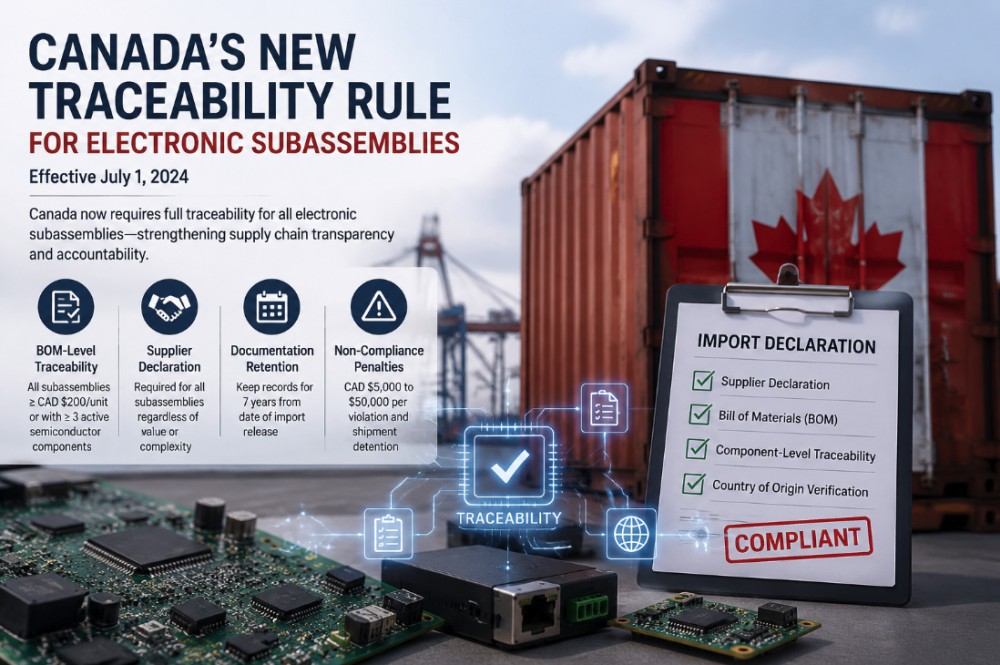
Effective July 1, 2024, the Canada Border Services Agency (CBSA) expanded its traceability requirements to cover all electronic subassemblies imported into Canada, regardless of value, origin, or end-use. This includes PCB assemblies, sensor interface modules, motor drivers, and embedded logic boards used in industrial automation systems. Industrial equipment manufacturers and importers now face the challenge of ensuring traceability for every electronic module sourced globally.
Core Requirements of the Policy
- Full Component Traceability: All subassemblies must retain supplier declarations, Bill-of-Materials (BOM), and country-of-origin documentation for at least seven years.
- Validation Frequency:
- BOM-level traceability: Subassemblies ≥ CAD $200/unit or containing ≥3 active semiconductor components must be submitted pre-arrival.
- Supplier declaration: Required for all subassemblies; updated if BOM changes exceed 5%.
- Documentation retention: All cleared subassemblies must be audit-accessible within 48 hours.
- Penalties: Non-compliance can result in CAD $5,000–$50,000 fines and potential shipment detention. Three repeated violations within 24 months may lead to refusal of entry.
Impact on Industrial Supply Chains
The policy has significant implications for sectors like automation equipment, HVAC control systems, and material handling machinery, where electronic subassemblies represent 35%–60% of total BOM costs. Key challenges include:
- Fragmented data ownership: Tier-2 suppliers often do not share detailed component origin information.
- Inconsistent documentation formats: PDFs, XML, and ERP exports are not standardized.
- Absence of unique identifiers: Without standardized IDs, CBSA cannot link physical shipments to digital records.
Lead times for compliant imports have increased by an average of 9.2 days, affecting just-in-time production and causing costly line stoppages.
Implementation Recommendations
Industrial firms can achieve compliance through a structured three-phase rollout:
- Subassembly Inventory Mapping (2–4 weeks): Assign unique, scannable identifiers to active subassemblies.
- Supplier Documentation Standardization (3–6 weeks): Ensure ≥80% of Tier-1 and Tier-2 suppliers submit compliant BOMs within 5 business days.
- System Integration and Pre-Clearance (8–12 weeks): Enable digital manifests and automated CBSA filing with average processing time ≤11 minutes.
Success factors include assigning traceability responsibility to procurement teams and requiring suppliers to embed standardized serial numbers (e.g., GS1 EPCglobal) in subassembly labels.
Strategic Sourcing Adjustments
- Supplier Consolidation: Reduce subassembly vendors from an average of 14.3 to ≤7 to lower traceability complexity and improve quality consistency.
- Nearshoring: Shift mid-complexity subassemblies to the U.S. or Mexico under USMCA frameworks to streamline cross-border documentation.
- Traceability-Ready Product Design: Standardize connectors, limit component variants, and add QR-coded labels to reduce post-production documentation effort by up to 65%.
Next Steps for Industrial Organizations
Regulatory alignment is essential for supply chain continuity. Manufacturers and importers should immediately:
- Map risk exposure
- Engage suppliers
- Deploy scalable traceability infrastructure
Our platform offers real-time CBSA policy monitoring, supplier compliance dashboards, and customizable traceability templates aligned with CSA Z243.1-23 standards. Over 1,200 industrial firms have used our automated BOM validation, supplier onboarding workflows, and audit-response playbooks, cutting average implementation time by 47% compared to in-house builds.
Action Recommendation: Schedule a 45-minute subassembly traceability diagnostic session to receive a tailored implementation roadmap for your product portfolio and supplier network.