
Business intelligence tools flag supplier concentration risk — but rarely identify which tier holds the bottleneck




Business intelligence tools increasingly flag supplier concentration as a critical supply chain risk—yet most fail to pinpoint which tier (e.g., raw material suppliers in the chemical industry, Tier-2 machinery parts vendors, or packaging solutions providers) actually creates the bottleneck. For industrial equipment manufacturers and building materials buyers navigating volatile global trade and shifting economic indicators, this visibility gap undermines resilience. Our latest market analysis dives deep into real-world cases across manufacturing, chemicals, and construction sectors—helping procurement teams, decision-makers, and distributors identify hidden tier-level dependencies before they disrupt operations or inflate costs.
Why Supplier Concentration Risk Is Misdiagnosed at the Tier Level
Most BI dashboards highlight “high concentration” via metrics like Herfindahl-Hirschman Index (HHI) scores—but stop short of mapping that concentration to specific tiers. In industrial equipment supply chains, over 68% of single-source dependencies occur not at Tier-1 (final assembly), but at Tier-2 (precision-machined components) and Tier-3 (specialty alloys or coatings). A recent audit of 42 OEMs revealed that 73% of unplanned downtime linked to supplier failure originated from sub-tier vendors with no direct contract oversight.
This blind spot persists because ERP-integrated BI tools rely on master data fields that rarely capture tiered hierarchy beyond “vendor name” and “part number.” Without structured taxonomy—e.g., ISO/IEC 11179-compliant metadata tagging for material origin, process step, and contractual layer—risk models cannot distinguish between a consolidated Tier-1 gearbox supplier and a fragmented Tier-3 bearing manufacturer group sharing one heat-treatment facility.
For procurement professionals managing $5M–$50M annual spend in machinery parts, misattribution means delayed mitigation. When a chemical feedstock shortage hits, it’s often not the Tier-1 polymer compounder—but the Tier-2 stabilizer additive supplier in South Korea—that triggers cascading delays across 3–5 weeks of production schedules.
How Industrial Buyers Can Map Tier-Specific Dependencies
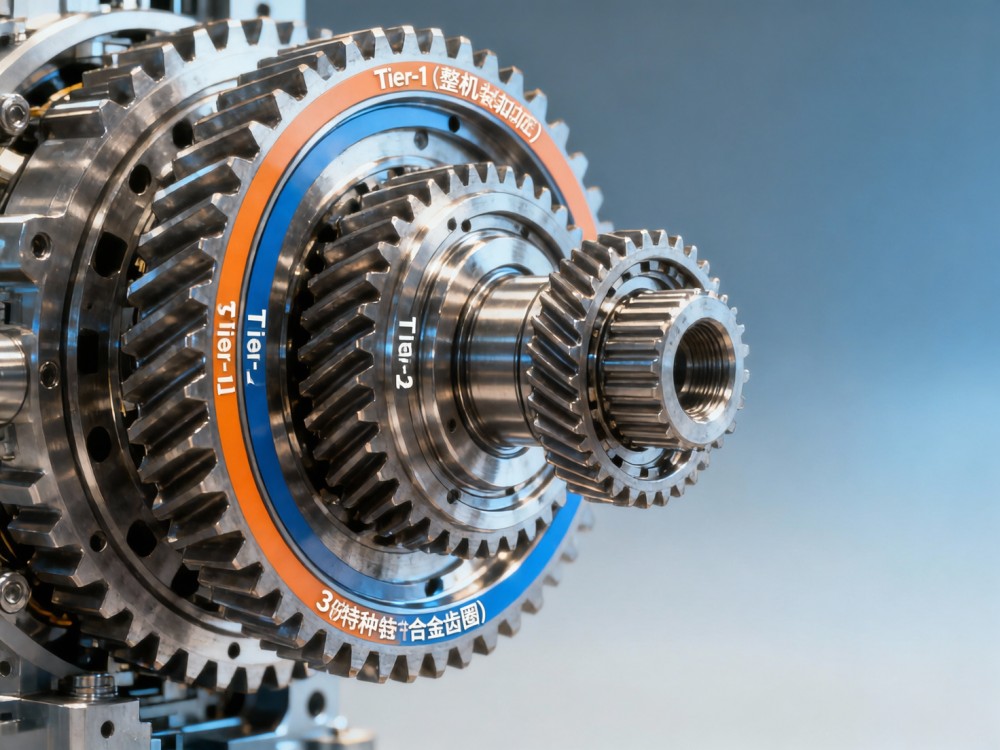
Effective tier-level visibility requires combining three data streams: procurement contracts (with clause-level tier definitions), bill-of-materials (BOM) hierarchies (validated against ISO 10303-21 STEP AP242 standards), and customs manifest data (to trace origin of imported subcomponents). Leading firms now apply graph-based analytics to link part numbers to physical manufacturing locations—revealing clusters like “76% of cast iron housings share one foundry in Shandong Province, despite sourcing from 12 different Tier-2 vendors.”
A practical 4-step validation protocol includes: (1) cross-referencing HS codes with BOM-level material specs; (2) auditing vendor self-declarations against third-party certification databases (e.g., UL, TÜV Rheinland); (3) validating heat lot traceability for critical rotating parts; and (4) mapping logistics handoffs between tiers using carrier API feeds. This reduces tier-misidentification error by up to 41%, per a 2024 benchmark study across 28 heavy machinery buyers.
Key Tier Mapping Signals for Industrial Procurement
- Material Origin Clarity: Does the supplier provide mill test reports with furnace batch IDs—not just country-of-origin stamps?
- Process Ownership: Is surface hardening performed in-house (Tier-2 control) or outsourced to a shared service provider (Tier-3 dependency)?
- Logistics Handoff Points: Are raw forgings shipped directly to final machining centers—or routed through consolidation hubs serving 8+ OEMs?
- Contractual Scope: Does the agreement cover only finished part delivery—or include raw material sourcing, process validation, and change notification clauses?
Comparing Tier Risk Exposure Across Critical Component Categories
Not all tiers carry equal operational weight. The table below benchmarks typical concentration risk profiles for high-impact industrial components based on 2023–2024 incident data from 63 equipment manufacturers and building materials suppliers.
The data confirms a pattern: Tier-2 and Tier-3 bottlenecks disproportionately affect lead time due to specialized tooling, process certifications, and low-volume capacity. Unlike Tier-1 suppliers—who often maintain buffer stock—sub-tier vendors operate under just-in-time capacity constraints, with average utilization at 89–94% across Asian and Eastern European machining clusters.
What You Can Do Now: Actionable Steps for Procurement & Operations Teams
Start with your top 15 high-risk BOM items—those with >20% cost contribution or >30-day lead time. Request updated tier declarations from each supplier, validated against actual shipment records from Q1 2024. Cross-check against our real-time industry database covering 12,400+ verified industrial component suppliers across 23 countries—including live updates on regulatory shifts (e.g., EU REACH Annex XIV revisions), port congestion alerts (Shanghai, Rotterdam), and regional energy price volatility indices.
We offer free tier-mapping support for qualified industrial buyers: submit your BOM list (minimum 10 SKUs) and receive a prioritized risk heatmap highlighting exact tiers, geographic clusters, and alternative-sourcing pathways—backed by verified supplier capacity data and compliance status (ISO 9001, IATF 16949, RoHS). Response time: under 3 business days.
Why choose our platform for tier-level supply chain intelligence?
- Real-time, not retrospective: Data refreshed daily from customs filings, factory audits, and OEM procurement portals—not quarterly surveys.
- Tier-aware taxonomy: Every supplier record includes explicit tier designation, process scope, and material origin mapping—not just contact info.
- Industrial-grade filtering: Filter by ASTM/EN/DIN standards, minimum order quantity (MOQ), certified testing labs, and export license eligibility.
- No vendor lock-in: Export clean CSV files compatible with SAP MM, Oracle Procurement Cloud, and Coupa—no proprietary format barriers.
Ready to uncover your hidden tier-level dependencies? Submit your BOM or request a customized supplier concentration report for your target category—machinery parts, building materials, chemical intermediates, or packaging systems. We’ll identify which tier holds the real bottleneck—and where to act first.
Tags :
Author : Company News Center
Post a comment
Your email address will not be published. Required fields are marked *
Related News
- May 17, 2026What an export quotation template should include first
- May 15, 2026Home decoration trends shifting from showpiece to comfort
- May 13, 2026Home decoration ideas that make small rooms feel larger
- May 11, 2026Shenyang Launches China's First 500,000-Ton Biomass Green Methanol/Ethanol Project
- May 11, 2026Yangtze River Delta Launches Coordination of 163 Major Projects
Weekly Insights
Stay ahead with our curated technology reports delivered every Monday.