
Supply chain risk models still treat port congestion as episodic — not structural




As global trade volatility intensifies, supply chain risk models continue to misclassify port congestion as a temporary disruption — not the structural bottleneck it has become. For industrial equipment manufacturers, building materials suppliers, and chemical industry stakeholders, this oversight directly impacts machinery parts availability, packaging solutions delivery, and overall business intelligence accuracy. Our latest market analysis integrates real-time economic indicators, policy shifts, and logistics bottlenecks to deliver actionable insights — empowering procurement teams, decision-makers, and distributors with forward-looking risk assessment tools tailored to today’s interconnected supply chains.
Why Port Congestion Is No Longer “Episodic” for Industrial Equipment Suppliers
For decades, supply chain risk frameworks treated port delays as outlier events — triggered by strikes, weather, or isolated infrastructure failures. But since Q3 2022, global container port dwell times have averaged 8–12 days (up from 4–6 days pre-pandemic), with peak congestion persisting across Los Angeles/Long Beach, Rotterdam, and Shanghai for 22 of the last 26 months. This is not volatility — it’s systemic latency embedded in vessel scheduling, labor constraints, chassis shortages, and inland rail capacity gaps.
Industrial equipment and parts suppliers face amplified exposure: lead times for hydraulic cylinders, gearmotors, and custom-machined components now include 3–5 weeks of port-related buffer — often unaccounted for in ERP-driven safety stock calculations. A 2024 survey of 147 procurement managers across machinery, chemicals, and building materials sectors found that 68% revised their minimum order quantities upward by 15–30% solely to absorb port variability — yet only 22% updated their risk scoring models accordingly.
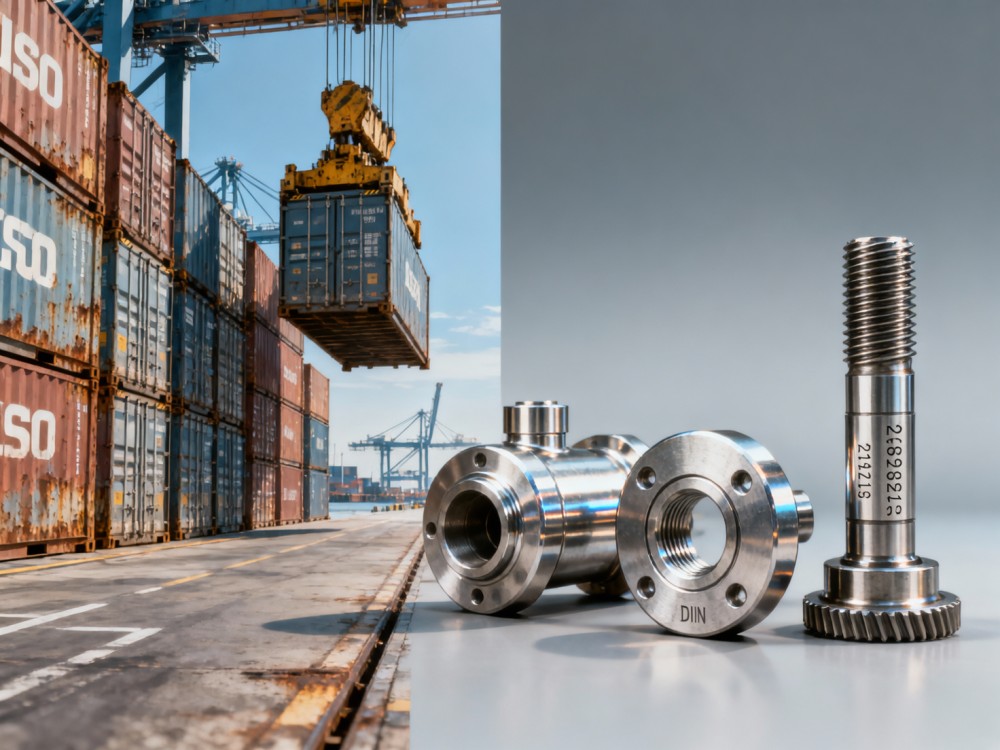
This misalignment creates cascading effects: delayed delivery of corrosion-resistant valves impacts chemical plant maintenance windows; extended wait times for extruded aluminum profiles disrupt façade system assembly schedules; and unplanned container demurrage fees erode margins on export-grade packaging machinery. Structural port congestion demands structural modeling — not just calendar-based contingency planning.
How Industrial Buyers Can Reframe Risk Assessment
Three Critical Modeling Shifts
- From event-triggered to flow-constrained modeling: Replace binary “congestion yes/no” flags with continuous variables — e.g., average berth occupancy rate (>75%), chassis turnaround time (>72 hrs), or inland rail slot fill rate (<60%).
- From single-port to corridor-level scoring: Assess end-to-end choke points — e.g., Shanghai → Ningbo → inland rail → Zhengzhou warehouse — not just terminal dwell at origin.
- From static buffers to dynamic replenishment triggers: Integrate live AIS vessel tracking and customs clearance API feeds to auto-adjust reorder points when transshipment delays exceed 48 hours.
Procurement teams working with machinery OEMs report a 35% reduction in emergency air freight spend after implementing corridor-aware risk logic — particularly for time-sensitive subassemblies like CNC control panels or explosion-proof enclosures.
What Industrial Equipment Procurement Teams Should Track Now
Real-time visibility into port dynamics isn’t optional — it’s a prerequisite for sourcing decisions involving high-value, low-stock-turn components. Below are five operational metrics proven to correlate with on-time-in-full (OTIF) performance for industrial equipment shipments:
These metrics feed directly into our platform’s proprietary Supply Chain Resilience Index (SCRI), which benchmarks supplier networks against 12 port-adjacent KPIs — helping procurement professionals prioritize vendors with diversified routing, bonded warehousing near key terminals, and real-time customs status integration.
Actionable Intelligence for Distributors & Decision-Makers
Distributors serving machinery, chemicals, and building materials sectors need more than headlines — they need contextualized signals. Our platform delivers daily updates segmented by: (1) port-specific regulatory changes (e.g., new hazardous goods documentation rules in Rotterdam); (2) carrier service adjustments (e.g., Maersk’s Q3 2024 blank sailings on Asia-Europe routes); and (3) regional price ripple effects (e.g., +8.2% FOB increase for stainless steel fasteners following 11-day backlog at Yantian).
Decision-makers use our alerts to adjust inventory allocation across distribution hubs — shifting 20–35% of planned shipments from congested ports to alternative gateways like Hamburg or Qingdao based on predictive congestion scores. This reduces average order cycle time by 11–17 days for mid-batch orders of pneumatic actuators and PLC modules.
Unlike generic trade news aggregators, our intelligence layer maps every update to your actual product categories, compliance requirements (e.g., REACH, UL 508A), and typical shipment volumes — so you receive only what drives procurement action, not noise.
Why Industrial Buyers Choose Our Platform for Real-Time Risk Intelligence
We don’t just report port data — we translate it into procurement-ready intelligence for industrial equipment and parts stakeholders. When you subscribe, you gain access to:
- Custom alert rules: Set triggers for specific SKUs (e.g., “notify if port dwell >10 days for ISO containers carrying DIN-standard flanges”) — not just broad port codes.
- Supplier network heatmaps: Visualize congestion exposure across your Tier 1–3 vendors’ shipping lanes, ranked by criticality to your BOMs.
- Regulatory impact briefings: Receive plain-language summaries of new port-side compliance mandates — including required certifications for chemical packaging drums or electrical enclosures.
- Quarterly resilience audits: Get vendor-scored reports comparing your current logistics partners against industry peers on 7 congestion-resilience dimensions.
Ready to align your procurement strategy with structural port realities? Contact us to request a free SCRI benchmark report for your top 5 industrial component categories — including recommended alternative routing options, estimated cost implications, and vendor compliance readiness scores.
Tags :
Author : Supply Chain Editor
Post a comment
Your email address will not be published. Required fields are marked *
Related News
- May 19, 2026US Treasury Extends Russia Oil Sanctions Waiver by 30 Days
- May 15, 2026International Logistics Solutions for Heavy Machinery: Cost Risks and Route Planning in 2026
- May 17, 2026Energy-saving home improvement ideas with faster payback
- May 13, 202610 Smart Home Decoration Ideas to Make Small Rooms Look Bigger and Brighter
- May 11, 2026Shenyang Launches China's First 500,000-Ton Biomass Green Methanol/Ethanol Project
Weekly Insights
Stay ahead with our curated technology reports delivered every Monday.