





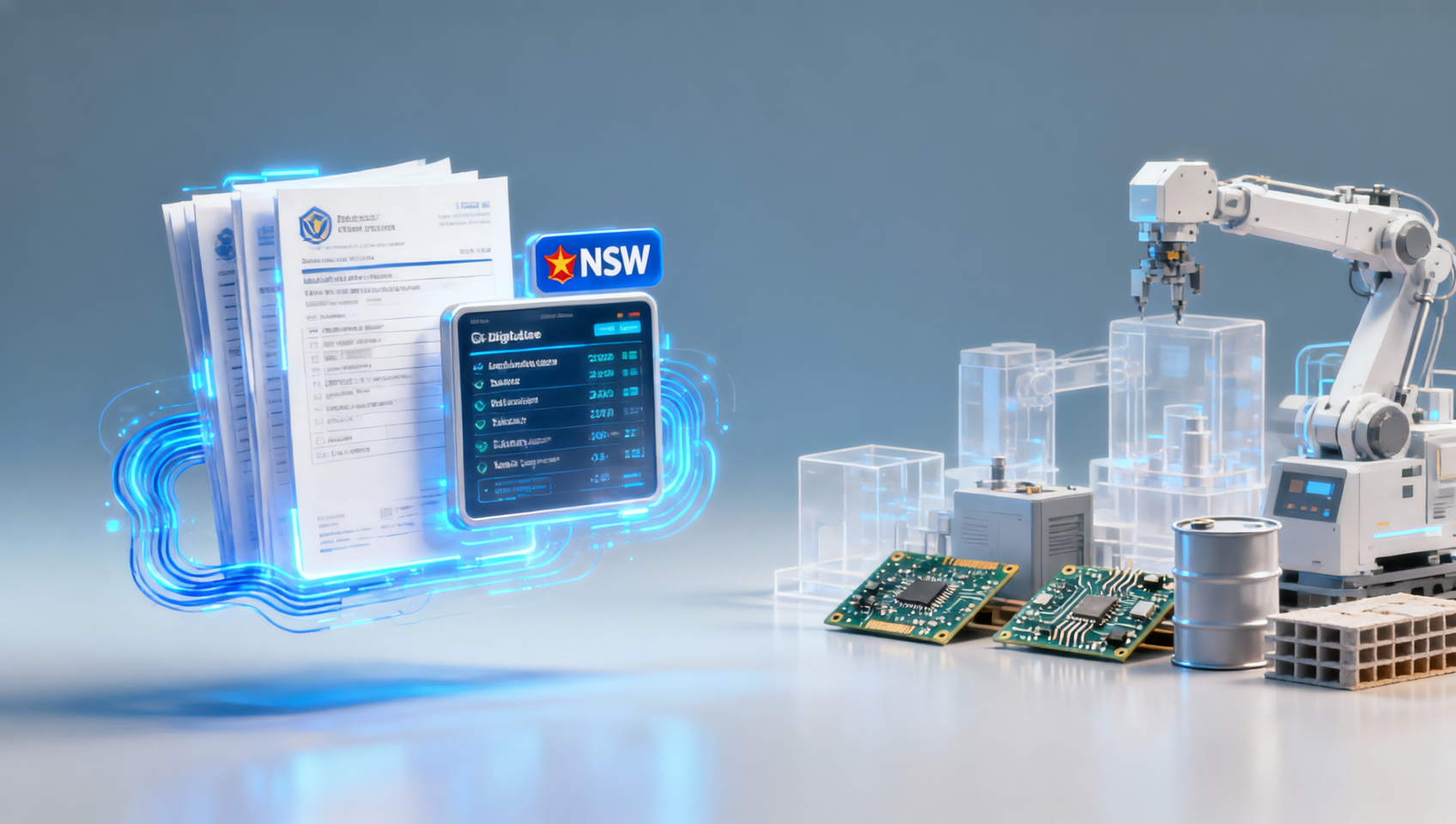
Vietnam’s upcoming e-documentation mandate—effective June 1—marks a pivotal shift in cross-border trade news, with major implications for the industrial goods market updates, export policy updates, and supply chain news. This regulatory change accelerates digital customs processes, directly impacting foreign trade policy analysis, sourcing market analysis, and buyer insights across electronics, automation equipment news, and smart manufacturing updates. As customs policy news intensifies, stakeholders—from procurement professionals to enterprise decision-makers—must align with new compliance workflows. Stay ahead with real-time export trade updates, in-depth industry reports, and actionable intelligence on raw material market trends and industry chain updates.
What the New E-Documentation Mandate Requires
Starting June 1, 2024, Vietnam’s General Department of Vietnam Customs (GDVC) enforces mandatory electronic submission of all import/export documentation via the National Single Window (NSW) system. The scope covers 100% of customs declarations, commercial invoices, packing lists, certificates of origin (Form A, Form D, or C/O), phytosanitary/sanitary certificates, and import licenses for regulated goods—including machinery, electronics components, chemicals, and building materials.
Unlike previous voluntary adoption phases, non-compliance now triggers automatic rejection at customs clearance points. Manual submissions—even if accompanied by scanned PDFs—will be declined without exception. The regulation applies uniformly to all exporters and importers, regardless of company size, annual trade volume, or country of origin. Firms must complete NSW registration and obtain a certified digital signature (e-signature) from an authorized Vietnamese CA provider before June 1.
Implementation is phased across three tiers: Tier 1 (June 1) includes all HS codes under Chapters 84–85 (machinery & electronics), 39 (plastics), and 28–30 (chemicals); Tier 2 (September 1) adds Chapters 68–69 (building materials), 73–76 (metals), and 94 (furniture); Tier 3 (December 1) covers remaining categories including agricultural packaging and home improvement accessories.
Impact on Industrial Supply Chains
The mandate significantly compresses customs processing time—from an average of 3–5 working days to under 24 hours for fully compliant filings. However, initial transition risks remain high: over 62% of surveyed SME exporters reported insufficient internal capacity to manage e-documentation workflows, citing gaps in staff training, ERP integration, and bilingual (Vietnamese/English) data formatting.
For procurement teams sourcing automation equipment or electronic components, delays now originate not from port congestion but from documentation mismatches—such as inconsistent HS code classification (e.g., misclassifying PLC controllers under Chapter 8517 instead of 8537), missing C/O issuance dates, or unsigned digital certificates. These errors trigger manual verification queues, adding 2–7 business days to lead times.
Supply chain visibility also shifts: real-time NSW status tracking replaces paper-based follow-ups. Buyers can now monitor declaration acceptance, tax assessment, inspection scheduling, and release confirmation—all accessible via API integration or NSW dashboard. This enables tighter coordination with logistics partners and more accurate delivery forecasting for just-in-time manufacturing environments.
Compliance Readiness Checklist for Exporters
To avoid clearance disruptions, enterprises must complete six critical actions before June 1:
- Register on the National Single Window (NSW) portal and assign at least two authorized signatories per legal entity;
- Obtain a Class 3 digital certificate issued by one of Vietnam’s five licensed Certificate Authorities (e.g., VNPT-CA, BKAV-CA);
- Validate ERP or customs software compatibility with NSW XML schema v3.2 (mandatory field mapping includes InvoiceNo, ExportDate, HSCodeLevel6, and CertOriginIssueDate);
- Conduct end-to-end test filing for ≥3 representative SKUs across target HS chapters (minimum 1 successful submission per chapter);
- Train at least 3 operational staff on NSW error codes (e.g., E107 = invalid C/O number format; E211 = mismatched invoice value vs. customs valuation);
- Maintain audit-ready logs for 5 years, including timestamped e-signature records and NSW acknowledgment receipts.
Key Documentation Requirements by Product Category
Industrial goods face category-specific validation rules. Below is a comparative overview of mandatory fields and common rejection causes across priority sectors:
These patterns underscore that technical accuracy—not just digital submission—is central to compliance. Procurement managers should verify documentation readiness during supplier onboarding and include e-documentation audit clauses in contracts.
Strategic Recommendations for Stakeholders
For distributors and agents handling multi-country shipments into Vietnam, integrating NSW-compatible TMS platforms reduces manual re-keying by up to 70%. Leading solutions now support automated HS code lookups, C/O template generation, and real-time error flagging—cutting pre-clearance processing from 4–6 hours to under 45 minutes per shipment.
Enterprise decision-makers should prioritize three initiatives: (1) appoint a dedicated NSW Compliance Officer with authority to halt shipments until documentation passes pre-submission validation; (2) implement quarterly cross-functional drills involving procurement, logistics, finance, and IT to simulate error resolution scenarios; and (3) require Tier-1 suppliers to provide NSW readiness certifications—verified via third-party audits every 6 months.
Finally, buyers evaluating new Vietnamese suppliers should request NSW filing history reports covering the past 90 days. A robust track record shows ≤0.8% rejection rate, ≥95% first-time acceptance, and median processing time ≤18 hours—key indicators of operational maturity in the new digital trade environment.
FAQ: Critical Questions for Procurement & Operations Teams
How long does NSW registration take for foreign-owned entities?
Standard processing is 5–7 business days after document submission. Required documents include notarized Articles of Incorporation, Vietnamese business license (or investment registration certificate), and appointment letter for local authorized signatory. Expedited service (3-day turnaround) is available for USD 120 fee.
Can we use existing digital signatures from Singapore or Malaysia?
No. Vietnam mandates locally issued Class 3 digital certificates only. Foreign e-signatures are not recognized under Decree No. 52/2023/ND-CP. Integration with international PKI systems remains unsupported until Q4 2024.
What’s the penalty for repeated NSW filing errors?
Three consecutive rejections within 30 days trigger mandatory retraining and a 14-day suspension of NSW access. Fines range from VND 20–50 million (~USD 800–2,000) per violation, plus customs storage fees at VND 1.2 million/day per container.
Vietnam’s e-documentation mandate isn’t merely procedural—it reshapes how industrial goods move across borders. For procurement professionals, it elevates documentation quality to the same strategic level as cost and lead time. For decision-makers, it demands integrated compliance governance across supply chain, IT, and legal functions. With real-time trade intelligence, validated supplier assessments, and adaptive workflow tools, businesses can turn regulatory complexity into competitive advantage. Get customized NSW readiness guidance, sector-specific documentation templates, and live NSW API integration support—contact our trade compliance team today.
Related News
- 00
0000-00
LATAM Electronics Surge vs. Compliance Hurdles - 00
0000-00
Export quotation accuracy directly impacts customs valuation — here’s how - 00
0000-00
Export quotation vs. pro forma invoice: which one triggers tariff costs? - 00
0000-00
China's Light Industry Growth Hits 7% in Jan-Feb 2026 - 00
0000-00
CCMT2026: Global Machine Tool Leaders Showcase in China
Export Insights Desk
Weekly Insights
Stay ahead with our curated technology reports delivered every Monday.