





As the electronic components industry forecast evolves, demand is increasingly split across manufacturing, e-commerce, energy, and home improvement sectors. For buyers, operators, and decision-makers, tracking electronic components price trends, semiconductor supply chain updates, and foreign trade policy impact on manufacturing is essential to understand risk, cost, and opportunity. This report connects market shifts with practical business intelligence for market analysis, helping readers identify where demand is growing and how supply chain pressure is reshaping strategy.
Electronic components are no longer driven by a single industrial cycle. In the current market, passive components, power devices, sensors, connectors, and control chips are being pulled by very different demand patterns, lead-time expectations, and compliance requirements. That split matters because it changes how procurement teams forecast inventory, how operators plan substitutions, and how business leaders evaluate margin pressure across multiple sectors.
For a cross-industry news and intelligence platform, the value lies in connecting signals that are usually viewed in isolation: factory automation orders, export policy changes, logistics disruption, energy project expansion, online retail device upgrades, and renovation-related electronics demand. When these signals are read together, the electronic components industry forecast becomes more practical and more useful for sourcing, pricing, and strategic planning.
How Demand Is Splitting Across Major End-Use Sectors
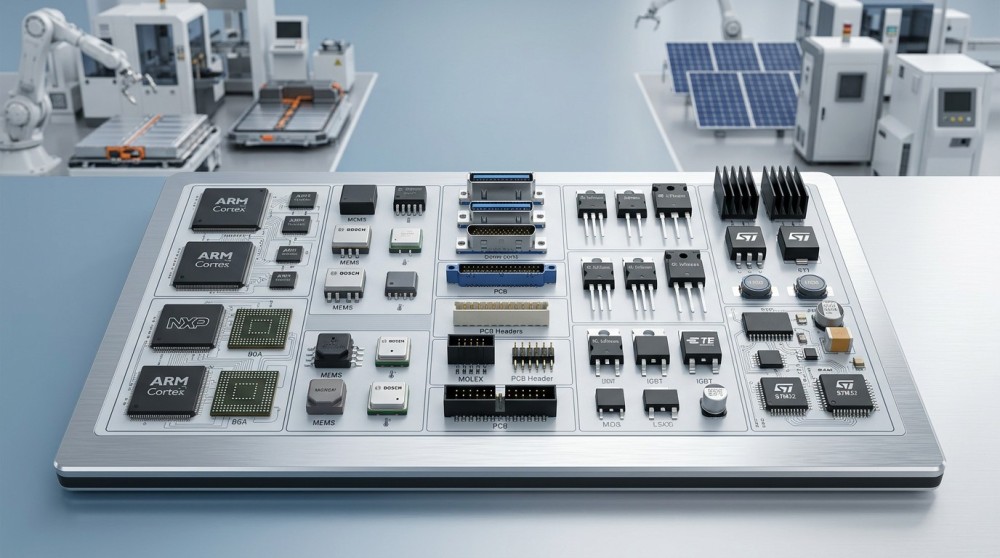
The most important shift in the electronic components industry forecast is not simply whether demand is rising or falling. It is where demand is moving. Manufacturing buyers often focus on industrial control boards, PLC-related modules, relays, connectors, and sensors. E-commerce players track mobile device accessories, warehouse automation electronics, and smart logistics equipment. Energy projects concentrate on power semiconductors, inverters, thermal management components, and protection devices. Home improvement channels increasingly consume smart switches, low-voltage control units, LED drivers, and connectivity modules.
These sectors do not buy on the same rhythm. A factory automation project may have a planning cycle of 8–16 weeks, while an e-commerce seller may reorder every 2–4 weeks based on promotional traffic. Energy infrastructure projects often involve approval, specification, and staged delivery over 3–9 months. Home improvement demand can be seasonal, with stronger purchasing activity before major renovation periods and holiday sales cycles.
This split creates uneven pressure on supply. Components that appear broadly available can still face localized shortages if one downstream sector suddenly accelerates. For example, a stable supply of standard capacitors does not guarantee stable supply of high-temperature power modules, automotive-grade connectors, or industrial sensors with narrow specification tolerances. Buyers should avoid treating the electronic components market as one uniform pool.
Four sectors, four purchasing behaviors
A practical way to read the demand split is to compare buying patterns by project length, substitution flexibility, and sensitivity to price changes. Operators and sourcing teams need this view because the same 5% cost increase can be manageable in one sector and damaging in another.
The table shows why demand split matters. Energy and manufacturing can tolerate fewer substitutions, but they often accept longer delivery windows. E-commerce and home improvement move faster, yet they are more price-sensitive and more exposed to rapid design changes. Market analysis that ignores these differences often produces poor purchasing decisions.
What this means for business planning
- Use separate demand models for project-based sectors and replenishment-based sectors.
- Track at least 3 variables every month: lead time, unit price movement, and policy or trade changes.
- Set different safety stock thresholds, such as 2–3 weeks for fast-moving items and 6–12 weeks for long-cycle industrial or energy components.
Price Trends, Supply Chain Pressure, and Trade Policy Signals
Electronic components price trends remain highly uneven. Commodity-like passive components may show relatively stable pricing over a quarter, while specialty semiconductors, power devices, and specific connector families can move sharply within 30–60 days. This is especially true when upstream wafer capacity, packaging constraints, freight cost changes, or trade policy adjustments hit one product group but not another.
Supply chain pressure is no longer just about shortages. In many categories, the market now faces a mix of oversupply in standard parts and persistent tightness in higher-specification items. A buyer may see normal availability for general-purpose microcontrollers but still face 10–20 week delays for industrial temperature-grade devices, higher current power modules, or products requiring strict traceability.
Foreign trade policy impact on manufacturing is also becoming more direct. Tariff changes, customs inspections, export controls, and local content requirements can reshape landed cost even when ex-factory prices remain unchanged. For cross-border buyers, a 3%–8% increase in total sourcing cost may come not from the component itself, but from compliance, logistics rerouting, or additional documentation steps.
Where cost pressure usually appears first
Procurement teams often react only after a price quote changes, but earlier warning signs usually appear in delivery commitments, order allocation limits, and reduced flexibility on small-volume orders. Monitoring these signals gives businesses 2–6 weeks of extra response time.
The key lesson is that pricing should be read together with lead time and policy exposure. A lower unit price may still produce a worse commercial outcome if delivery risk forces line stoppages, delayed launches, or emergency purchases. In many B2B scenarios, avoiding one week of disruption is more valuable than saving 2% on unit cost.
Three monitoring priorities for industry teams
- Track quarterly changes in semiconductor supply chain updates, especially packaging, testing, and regional logistics capacity.
- Separate spot-buy signals from contract-buy signals, because they can move in opposite directions for 1–2 months.
- Review policy-sensitive components every 30 days if imports, exports, or bonded logistics are involved.
What Buyers and Decision-Makers Should Evaluate Before Committing Orders
In a fragmented market, sourcing decisions should move beyond simple price comparison. Buyers need a decision framework that covers technical fit, supply continuity, total landed cost, and substitution risk. Operators need confidence that replacement parts will not disrupt installation, testing, or field maintenance. Business evaluators need a clear view of whether a component supports short-term cost control and long-term availability.
A useful approach is to score components across 4 dimensions: specification stability, lead-time predictability, compliance exposure, and commercial flexibility. For example, an item with a low quoted price but unstable supply and no approved alternate may be a weak choice for continuous manufacturing. By contrast, a slightly higher-cost part with 90-day forecast support and documented alternatives may lower operational risk significantly.
This is particularly important when demand is split between sectors. Components that work well in consumer-oriented channels may not meet industrial temperature, voltage, or durability expectations. Likewise, parts chosen for low-volume engineering samples may not scale efficiently when procurement shifts to 5,000- or 20,000-unit batches.
Procurement decision factors by priority
The following comparison can help buyers, sourcing teams, and management align on what matters most before placing an order.
A structured review like this helps procurement teams avoid false savings. It also improves communication with operations and management because the trade-off between cost, risk, and continuity becomes visible. For companies using an industry news platform, this framework works best when paired with weekly market updates and supplier-side changes.
Common buying mistakes to avoid
- Comparing prices without comparing delivery commitments, which can create hidden downtime costs.
- Approving a substitute without checking temperature range, certification needs, or connector footprint.
- Buying too much of a volatile item when demand visibility is under 60 days.
- Ignoring foreign trade policy impact on manufacturing when sourcing from multiple regions.
Implementation Strategy: Turning Market Signals Into Actionable Sourcing Plans
The best electronic components industry forecast is not just descriptive; it must support execution. For most companies, that means building a response plan that can operate on 3 levels: immediate supply protection, medium-term sourcing flexibility, and long-term category strategy. This is especially useful for organizations active across manufacturing, trade, electronics, packaging, machinery, energy, and home improvement, where demand cycles overlap but do not align.
A practical implementation process can be completed in 5 steps over 2–6 weeks, depending on the number of active SKUs. First, identify critical components that affect production continuity or customer delivery. Second, classify them by lead time, price volatility, and substitution difficulty. Third, link each category to a response rule, such as early buy, alternate qualification, or rolling forecast. Fourth, review trade and logistics exposure. Fifth, update sourcing cadence based on sector demand changes.
This process becomes more accurate when supported by a reliable flow of industry information. Corporate updates, policy notices, price changes, new product launches, and international trade trends should not be treated as background reading. They should feed directly into purchasing thresholds, inventory policy, and customer communication plans.
A workable 5-step execution model
- Create a top-20 critical parts list based on production impact, not just spend value.
- Assign each item a risk score from 1 to 5 for lead time, price movement, and substitution difficulty.
- Define reorder rules, such as 30-day buffer for standard parts and 60–90 day cover for long-lead items.
- Review policy and customs exposure at least once per month for imported or exported categories.
- Hold a cross-functional review every 4 weeks with procurement, operations, sales, and finance.
FAQ: practical questions from buyers and operators
How should companies handle volatile components without overstocking?
Use segmented inventory rules instead of one blanket target. For fast-moving but easily replaceable items, 2–4 weeks of stock may be enough. For long-lead or non-substitutable components, 6–12 weeks is often safer. The right level depends on forecast accuracy, customer penalty risk, and how quickly alternates can be validated.
Which sectors are most sensitive to semiconductor supply chain updates?
Energy and manufacturing are usually the most sensitive because they depend on reliable power devices, control chips, and industrial-grade parts with tighter qualification standards. E-commerce is highly reactive too, but it often has more flexibility to switch models or shift sourcing when demand changes quickly.
How often should procurement teams review electronic components price trends?
For high-value or policy-sensitive categories, every 2 weeks is reasonable. For stable categories, monthly review may be sufficient. If quote validity drops below 15 days or lead times extend by more than 25%, the review frequency should increase immediately.
A strong execution model turns broad industry news into direct commercial value. It gives buyers a clearer basis for negotiation, helps operators avoid surprises, and allows decision-makers to balance cost discipline with supply security. That is the practical benefit of treating market analysis as an operating tool rather than a reporting exercise.
The electronic components industry forecast points to a market where demand is increasingly segmented by sector, timing, and technical requirement. Manufacturing, e-commerce, energy, and home improvement are not competing for the same component basket in the same way, which means procurement strategy must become more selective, more data-aware, and more responsive to trade and supply chain signals.
For industry researchers, sourcing teams, business evaluators, and enterprise leaders, the priority is clear: track price trends, monitor semiconductor supply chain updates, assess foreign trade policy impact on manufacturing, and convert those signals into practical buying rules. A cross-industry information platform can shorten response time, improve planning accuracy, and support better communication across procurement, operations, and management.
If you need deeper market tracking, tailored sourcing insight, or a more structured way to connect industry updates with purchasing decisions, now is the right time to get a customized solution, consult product and market details, and explore more industry intelligence options.
- market analysis
- supply chain
- industry news
- business intelligence
- corporate updates
- supply chain updates
- foreign trade policy
- price trends
- manufacturing
- factory automation
- sensors
- electronic components
- connectors
- cement
- sourcing cost
- foreign trade
- international trade
- machinery
- home improvement
- packaging
- electronics
- semiconductor
- e-commerce
- energy
- business intelligence for market analysis
- electronic components industry forecast
- electronic components price trends
- semiconductor supply chain updates
- foreign trade policy impact on manufacturing
Related News
- China’s 'AI+Education' Action Plan Opens Standardization Window for AI Ed-Tech ExportsApr 22, 2026AI+Education Action Plan unlocks AI ed-tech export opportunities—discover how CE-EDU, FCC-ID & ISO/IEC 23053 alignment drives global market access.
- RoHS Compliance Testing Failures Often Start With MaterialsApr 20, 2026RoHS compliance testing starts with materials. Learn how product certification standards, the CE certification process, UL certification requirements, and REACH guide smarter sourcing.
- Consumer electronics market analysis: where demand is movingApr 21, 2026Consumer electronics market analysis reveals where demand is shifting, with insights on foreign trade policy changes, packaging solutions for e-commerce, and economic indicators for global trade.
- Electronics industry trends 2023 that still affect sourcingApr 22, 2026Electronics industry trends 2023 still shape sourcing, from electronics manufacturing trends and semiconductor intelligence to foreign trade policy for electronics—discover actionable insights now.
Related News
- 00
0000-00
Two Supreme Organs Issue Anti-Bribery Judicial Interpretation (II) - 00
0000-00
Yangtze River Delta: 163 Projects Boost Manufacturing Sourcing Hub - 00
0000-00
China’s 'AI+Education' Action Plan Opens Standardization Window for AI Ed-Tech Exports - 00
0000-00
HKMA Sets Q3 2026 Timeline for First Stablecoin Licenses - 00
0000-00
China-Sri Lanka Joint Operation Repatriates 125 Telecom Fraud Suspects
Electronics & Tech Desk
Weekly Insights
Stay ahead with our curated technology reports delivered every Monday.