





As demand grows for industrial gases for medical applications, purity risks are becoming a critical concern for buyers, regulators, and healthcare-linked supply chains. From trace contaminants and storage issues to compliance pressure and sourcing transparency, understanding these risks helps decision-makers evaluate suppliers more accurately and respond to changing policy updates for chemical industry and broader market expectations.
For information researchers, commercial evaluators, and business decision-makers, the issue is no longer limited to whether oxygen, nitrogen, carbon dioxide, or medical air can be sourced at a competitive price. The deeper question is whether industrial gas supply systems can consistently meet medical-use purity thresholds across filling, transport, storage, and end-use conversion. In many sectors, a single weak link in gas handling can create downstream quality, liability, and continuity risks.
This matters across the broader industrial landscape because medical-linked gas demand sits at the intersection of chemicals, manufacturing, packaging, logistics, compliance, and healthcare procurement. Buyers tracking policy updates, market shifts, and supplier reliability need a practical framework to identify purity risks early, compare supply options more rigorously, and align procurement decisions with both regulatory expectations and operational resilience.
Why purity risks in medical-linked gas supply are rising
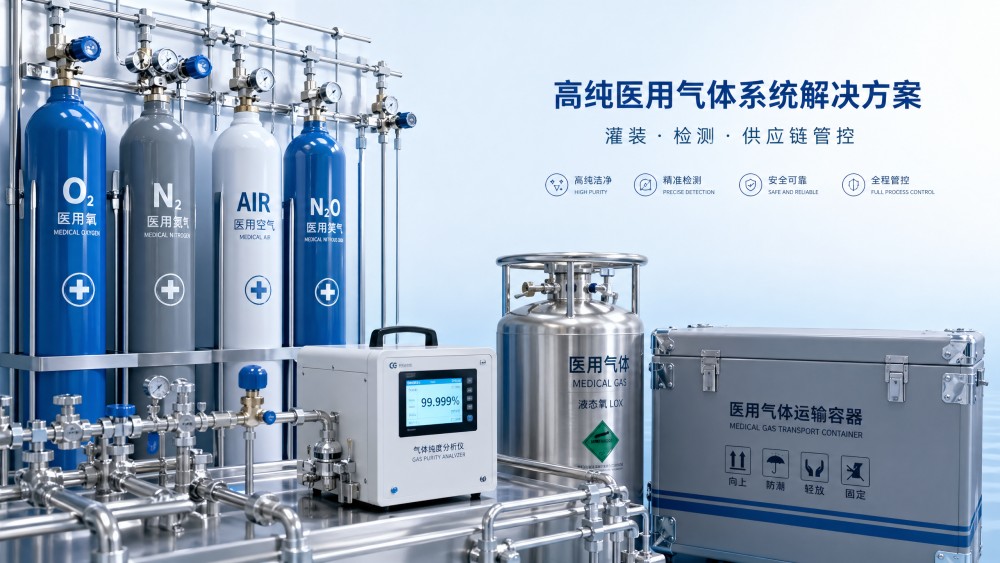
Industrial gases for medical applications occupy a sensitive category because the same base gases may exist in multiple grades, yet the application environment changes the risk profile dramatically. Oxygen used in steelmaking and oxygen intended for patient-facing systems may come from similar production routes, but impurity limits, documentation depth, and handling controls differ substantially. Even trace contamination at ppm-level ranges can become material in respiratory, anesthesia, sterilization, or laboratory settings.
Over the last 3 to 5 years, supply chains have also become more complex. More buyers now rely on cross-border sourcing, third-party filling stations, and multi-node transport models. That creates more transfer points, and each transfer point adds contamination opportunities. Typical risk points include compressor oil carryover, valve residue, moisture ingress, hydrocarbon traces, and cylinder mix-up. In practical terms, 4 to 6 handoff stages may exist between production and final use, especially in fragmented regional markets.
Another factor is the tightening overlap between healthcare standards and industrial procurement scrutiny. Corporate buyers are now expected to verify not just product availability, but also batch traceability, cylinder lifecycle control, and quality documentation. This is particularly relevant for companies operating in chemicals, packaging, electronics, and foreign trade, where procurement teams may be sourcing gas for medical-device production, cleanroom support, test environments, or medical packaging processes rather than direct hospital use.
Price volatility adds further pressure. When gas prices move sharply within a 30-day to 90-day cycle, some buyers may shift to lower-cost channels without fully examining grade separation and documentation consistency. That is where purity risk often enters commercial decisions: not because the gas is unavailable, but because supplier controls are uneven.
Key drivers behind higher scrutiny
- Stricter buyer qualification processes, often involving 5 to 8 review items before contract approval.
- Greater focus on chain-of-custody records for cylinders, tanks, and refill operations.
- More frequent audits tied to policy updates for chemical industry compliance and safety management.
- Expansion of medical-adjacent manufacturing, where gas purity affects product quality even outside hospitals.
The main purity risks buyers should evaluate before sourcing
When evaluating industrial gases for medical applications, buyers should not treat purity as a single number printed on a specification sheet. Purity risk is multi-dimensional. A gas described as 99.5%, 99.9%, or 99.99% pure may still present issues if moisture, particulates, oils, or cross-residuals are not controlled in line with the intended medical or medical-adjacent use. In sensitive applications, the type of impurity can matter more than the headline purity percentage.
Moisture is one of the most underestimated variables. Excess water vapor may contribute to corrosion inside cylinders or pipelines, support microbial concerns in poorly controlled systems, or interfere with instrument calibration. For many users, dew point control and documented drying procedures are as important as base gas composition. Likewise, hydrocarbons and compressor-related residues are critical red flags in oxygen-rich systems, where safety and compatibility concerns increase.
Storage and packaging conditions also change the purity equation. A compliant gas can become non-compliant after filling if cylinders are not adequately evacuated, valves are damaged, seals are compromised, or dedicated lines are not maintained. In regional trade networks, reused cylinders may circulate through several filling points over 6 to 12 months. Without strong cylinder history management, residual contamination risk rises significantly.
Documentation gaps create a separate risk layer. A supplier may provide a certificate of analysis, but buyers should still confirm sampling frequency, batch association, and whether the certificate reflects actual delivered product or only a source tank benchmark. In B2B procurement, document quality often determines whether purity claims are actionable or only marketing language.
High-priority risk categories
The table below helps procurement and assessment teams map the most common purity risk categories to their operational consequences and control priorities.
The key takeaway is that purity must be assessed through both chemistry and handling. A supplier with stable production but weak cylinder control may still create unacceptable risk. For buyers comparing two offers with only a 3% to 8% price gap, the better choice is often the supplier that can prove process separation, testing discipline, and logistics integrity.
Common buying mistakes
- Using headline purity only, without asking for impurity profile details.
- Assuming industrial grade can be upgraded by paperwork alone.
- Overlooking cylinder history and refill segregation rules.
- Accepting generic certificates that are not batch-linked to delivered lots.
How to assess suppliers, documentation, and supply-chain controls
For decision-makers, supplier assessment should move beyond product brochures and into process verification. A reliable supplier of industrial gases for medical applications should be able to explain how production grade is separated, how cylinders or bulk vessels are assigned, how testing is performed, and how records are retained. In many procurement programs, a 4-part review model works well: product quality, equipment control, documentation quality, and delivery continuity.
Testing frequency is especially important. Some suppliers test every batch, while others rely on periodic composite checks. That difference can materially affect risk exposure, particularly when monthly delivery volumes exceed 20 to 50 cylinders or when the gas supports regulated manufacturing or medical-device environments. Buyers should ask whether test points include source tank, post-fill, and pre-dispatch stages, because one-point testing may miss downstream contamination events.
Traceability should also be practical, not theoretical. A usable traceability system allows procurement and quality teams to connect a delivered cylinder or bulk lot to fill date, equipment line, operator record, inspection status, and supporting certificate within a reasonable retrieval time, often within 24 hours. If retrieval takes several days or depends on manual cross-checking across departments, the control system may not be robust enough for higher-risk medical-linked applications.
Commercial terms matter as well. Buyers should define non-conformance handling, replacement timelines, and data-sharing responsibilities before onboarding. A strong contract normally specifies the review cycle for quality documents, the notification period for process changes, and the expected response time for complaints, such as 24-hour acknowledgement and 72-hour preliminary investigation feedback.
Supplier evaluation checklist
The following framework can help business evaluators compare multiple suppliers using clear operational criteria rather than price alone.
This type of evaluation helps procurement teams convert a technical issue into a contract-ready decision matrix. It also supports cross-functional review between sourcing, quality, operations, and compliance teams, which is often necessary when the gas will support packaging, clean manufacturing, or medical-related production processes.
Practical review sequence
- Step 1: Confirm intended application and required grade level.
- Step 2: Review impurity controls, not only stated purity percentage.
- Step 3: Audit cylinder, bulk, or onsite storage handling practices.
- Step 4: Check response procedures for quality deviation and supply disruption.
- Step 5: Align pricing comparison with risk-adjusted supplier capability.
Procurement strategies for different business scenarios
Not every buyer needs the same procurement model. A company sourcing industrial gases for medical applications for direct patient environments will apply stricter thresholds than a manufacturer using high-purity gases in medical packaging, calibration, or clean process support. The right sourcing strategy depends on volume, criticality, storage infrastructure, audit frequency, and tolerance for disruption. For some firms, a dual-supplier structure is more valuable than marginal unit-price savings.
Small and mid-sized buyers often rely on cylinder supply because it reduces capital investment and enables flexible ordering in cycles of 7 to 30 days. However, cylinder-based procurement requires stronger attention to refill quality, valve condition, and inbound inspection. Larger facilities may prefer bulk supply or manifold systems where monthly usage is stable, but these models shift risk toward tank maintenance, transfer procedures, and site-level gas monitoring.
Foreign trade and regional distribution businesses should pay special attention to transit duration and climate conditions. A shipment moving through high humidity environments, repeated loading points, or extended customs holding for 10 to 20 days may face greater packaging and seal integrity challenges. This makes logistics visibility and packaging validation part of the purity discussion, not just a transport issue.
For decision-makers comparing offers, the most resilient strategy usually combines 3 elements: a qualified primary supplier, a pre-assessed backup source, and an internal acceptance procedure. That procedure may include document review, visual inspection, label verification, and periodic sample validation depending on risk class.
Sourcing model comparison
Different business models require different control priorities. The table below summarizes common procurement options and where purity risks tend to concentrate.
The comparison shows that no model is risk-free. The better question is which control system best matches the business scenario. In many cases, a slightly higher unit cost can be justified if it reduces requalification work, complaint handling, and production interruption risk.
Internal acceptance controls worth adopting
- Check labels, lot references, and documentation before unloading.
- Inspect seals, valves, and visible cylinder condition on receipt.
- Record storage location, receiving date, and intended use area.
- Apply periodic verification sampling for higher-risk applications.
Implementation, monitoring, and market outlook for decision-makers
Once supplier selection is complete, execution determines whether the procurement strategy actually protects purity. Implementation should include a documented onboarding phase, usually over 2 to 6 weeks, covering specification review, document approval, delivery mapping, site storage checks, and non-conformance escalation rules. Without an onboarding structure, even a qualified supplier relationship can fail at the operational level.
Monitoring should combine routine review and trigger-based review. Routine review may be monthly for document completeness and quarterly for broader supplier performance. Trigger-based review should occur after delivery delay, packaging anomaly, certificate discrepancy, or any process change communicated by the supplier. A useful approach is to track at least 6 indicators: on-time delivery, document accuracy, complaint frequency, replacement speed, inspection pass rate, and change notification discipline.
From a market perspective, industrial gases for medical applications will likely remain under stronger cross-sector scrutiny as policy, healthcare supply resilience, and chemical industry compliance continue to intersect. Buyers should expect more emphasis on transparency, more pressure for digital traceability, and greater differentiation between suppliers that can support audited medical-linked use cases and those that mainly serve general industrial demand. This creates opportunity for informed buyers to build more stable sourcing positions early.
For industry news users and commercial decision-makers, the most practical next step is to turn market monitoring into procurement readiness. That means tracking policy updates, supplier changes, regional price movements, and documentation expectations in one place, then using those signals to adjust sourcing strategy before disruptions or compliance issues emerge.
FAQ for business evaluators
How should buyers compare purity claims from different suppliers?
Start with the stated purity grade, but do not stop there. Ask for impurity profile details, test frequency, and whether the certificate is tied to the delivered batch. A 99.9% claim with weak traceability may be riskier than a slightly different spec backed by consistent post-fill verification and strong cylinder management.
Which applications need the strictest review?
The highest review intensity is typically needed where gas supports respiratory use, anesthesia systems, sterile manufacturing, medical-device production, laboratory validation, or clean packaging environments. In these cases, even low-level contamination or documentation gaps can affect compliance, safety, or product release decisions.
How often should supplier performance be reassessed?
A practical baseline is monthly operational review and a deeper quarterly assessment. Higher-risk or higher-volume buyers may add semiannual onsite audits or remote quality reviews. Any major process change, delayed delivery trend, or documentation issue should trigger an immediate reassessment outside the normal cycle.
What is the most overlooked risk in cross-border supply?
Many firms focus on customs timing and freight cost, but overlook cylinder history, refilling control, and environmental exposure during transit. Extended storage at ports or multiple transfer points can increase seal integrity and moisture-related concerns, especially when documentation quality is already uneven.
Purity risks in industrial gases for medical applications are no longer a narrow technical issue. They affect procurement quality, compliance readiness, supply continuity, and commercial confidence across chemicals, manufacturing, trade, packaging, and healthcare-linked operations. The most effective buyers assess impurity risk, storage control, traceability, and supplier discipline together rather than relying on price or headline purity alone.
If your team needs clearer market intelligence, supplier screening support, or deeper visibility into policy updates for chemical industry and related sectors, now is the right time to strengthen your sourcing framework. Contact us to learn more solutions, request a tailored analysis, or explore practical procurement insights for your next evaluation cycle.
Related News
- Metro China Leadership Reshuffle: Supply Chain ImpactApr 27, 2026Explore how Metro China's 2026 leadership changes with Andrew Miles and Xu Shaochuan may impact trade, manufacturing, and global supply chains. Key insights for suppliers and exporters.
- Industrial gases for medical applications: purity risks to watchApr 27, 2026Industrial gases for medical applications: learn key purity risks, supplier checks, and policy updates for chemical industry to source safer, compliant gas with confidence.
- Wind Farm Expansion in Company News for Renewable EnergyApr 27, 2026Stay updated with company news in renewable energy! Explore wind farm expansions, energy sector investment opportunities, and market trend analysis for investors seeking long-term industrial growth.
- Hydrogen Infrastructure Energy Investment OpportunitiesApr 27, 2026Explore energy sector investment opportunities in hydrogen. Get expert market trend analysis for investors, industry trends in digital transformation, and research reports to drive strategic growth.
Related News
- 00
0000-00
Yangtze River Delta Ports Q1 Throughput Up 7.2% Amid RCEP Stability - 00
0000-00
2026 Beijing Auto Show: AI-Driven Smart Car Export Enters Technical Compliance Phase - 00
0000-00
Tourism Vouchers Fuel Domestic Demand, Signal Export Opportunities - 00
0000-00
Metro China Leadership Reshuffle: Supply Chain Impact - 00
0000-00
Which biodegradable packaging solutions keep food fresh longer?
Energy Insights Desk
Weekly Insights
Stay ahead with our curated technology reports delivered every Monday.