





Building materials price fluctuations remain difficult to forecast because they are shaped by shifting supply chains, policy changes, energy costs, and demand cycles across industries. For readers seeking manufacturing industry market analysis, foreign trade policy impact on manufacturing, and home decoration market insights, understanding these moving parts is essential. This article explores why price signals stay unstable and how better business intelligence for market analysis can support smarter sourcing and planning.
For procurement teams, operators, market researchers, commercial evaluators, and business leaders, the challenge is not simply that prices go up or down. The real issue is that cost movements often happen at different speeds across cement, steel, glass, aluminum, insulation, coatings, and packaging inputs. A 2-week change in freight or energy costs can ripple into a 30- to 90-day pricing adjustment at the distributor level, creating uncertainty in budgeting, tendering, and inventory planning.
On a cross-industry news platform, building materials pricing cannot be analyzed in isolation. Manufacturing output, export orders, environmental regulation, machinery utilization, real estate sentiment, and home improvement demand all interact. That is why price forecasting remains hard: the market responds to multiple signals at once, and those signals are not always aligned.
Why building materials prices rarely move for just one reason
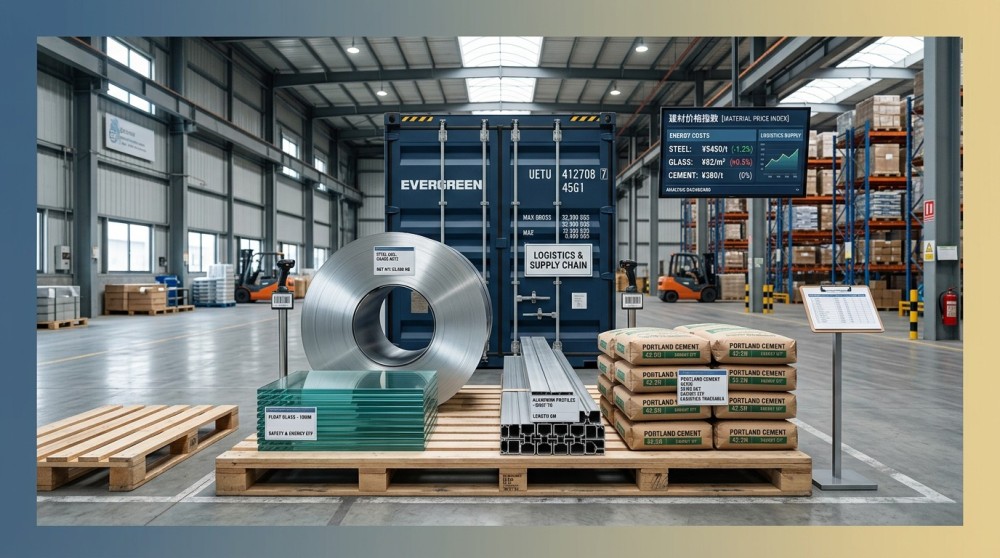
In practice, building materials price fluctuations are driven by a layered cost structure. Raw materials may account for 35% to 70% of total cost depending on the category, while energy, transport, labor, compliance, and channel margins fill the rest. When several inputs shift at the same time, a straightforward forecast becomes unreliable. Even if ore or petrochemical feedstock prices remain stable for 1 month, logistics or policy changes can still move finished material prices.
Another complication is timing. Spot prices, contract prices, and end-user transaction prices do not always move together. A steel coil quote may change in 3 days, but finished profiles, structural components, or fabricated systems may only adjust after existing orders are fulfilled. This lag can range from 2 weeks to 8 weeks, depending on stock levels and supplier contracts. Buyers who track only one price layer often misread the broader market.
Demand is equally uneven. Infrastructure projects, commercial construction, export-oriented manufacturing, and home decoration rarely peak at the same time. If housing renovation demand softens but industrial facility expansion rises, the effect on gypsum board, metal sections, cables, adhesives, and coatings will differ. This creates category-specific volatility instead of one unified market trend.
Cross-border trade adds another variable. Exchange rates, anti-dumping measures, customs checks, and regional supply shifts can change landed cost by 5% to 15% within a single quarter. For import-reliant buyers, a stable factory quote does not guarantee a stable delivered price. For exporters, foreign trade policy impact on manufacturing can quickly reshape domestic supply availability and push local pricing in unexpected directions.
Key sources of pricing uncertainty
- Raw material cost swings, especially in steel, nonferrous metals, resins, and chemicals used in panels, pipes, coatings, and insulation.
- Energy cost changes, which are highly relevant for cement kilns, glass furnaces, ceramics, aluminum processing, and chemical production.
- Freight and warehousing pressure, including port congestion, inland trucking shortages, and container imbalance across trade lanes.
- Regulatory shifts such as emissions rules, safety standards, or production curbs that can affect output volume within 7 to 30 days.
- Demand cycles linked to construction seasons, renovation peaks, public spending, and export order recovery.
How one event can trigger multi-step price movements
A single policy or supply event often moves through the market in 4 steps. First, traders react immediately in spot quotations. Second, manufacturers revise production plans or surcharges. Third, distributors update inventory valuation and restocking terms. Fourth, contractors and end users face new project costs. These stages do not happen on the same day, so what looks like random volatility is often delayed transmission across the chain.
Supply chains, energy, and policy create different kinds of price signals
To read building materials price fluctuations correctly, businesses need to separate short-cycle signals from structural signals. Short-cycle factors include freight spikes, weather disruption, or temporary production outages. Structural factors include long-term energy reforms, environmental compliance costs, or capacity migration to other regions. Mixing the two leads to poor purchasing decisions, such as overbuying after a temporary spike or delaying orders during a sustained uptrend.
Energy is one of the clearest examples. In energy-intensive segments, a 10% rise in fuel or power cost can materially affect factory-level pricing. Cement, flat glass, bricks, ceramics, and many chemical-based building products are especially sensitive. However, the pass-through rate is not equal. Some suppliers can absorb part of the increase for 2 to 6 weeks, while others adjust immediately due to thinner margins or stricter cash-flow discipline.
Policy shifts can also be indirect. An environmental inspection campaign may not mention a specific product, but if it limits output in upstream mining, smelting, or transport, downstream building materials prices may rise later. Likewise, foreign trade controls on machinery parts, packaging materials, or industrial chemicals can alter production efficiency and packaging cost, which eventually shows up in building material offers.
For business users following manufacturing industry market analysis, the lesson is clear: price direction is only one piece of the puzzle. What matters more is whether the driver is local or global, temporary or structural, input-side or demand-side. That distinction helps determine whether to hedge, wait, split orders, or renegotiate delivery terms.
Typical drivers and how fast they affect quotes
The table below summarizes common drivers behind unstable price signals and shows why buyers cannot rely on a single benchmark when evaluating construction input costs.
The main takeaway is that not all price signals deserve the same response. A 7-day freight spike may call for tactical scheduling, while a 90-day regulatory tightening may justify contract restructuring or alternative sourcing. Businesses that separate signal type from signal intensity usually make better timing decisions.
A practical monitoring rhythm
- Track upstream commodities weekly rather than daily unless the category is highly traded.
- Review freight, energy, and FX indicators every 7 days for import-heavy or export-linked materials.
- Check policy and compliance updates at least twice per month, especially before tender cycles.
- Reassess supplier lead times every 2 to 4 weeks when demand conditions are changing quickly.
Demand cycles differ across construction, manufacturing, and home improvement
Many forecast errors happen because businesses treat the building materials market as one demand pool. In reality, there are at least 3 major demand channels: project construction, industrial facility and manufacturing demand, and retail or home decoration market demand. Each channel follows a different budget cycle, approval process, and product mix. A weak residential market does not always mean weak demand for industrial flooring, insulated panels, process piping, or packaging-related materials.
Home improvement is especially sensitive to consumer confidence, renovation timing, and promotional seasons. Paint, laminates, decorative panels, lighting accessories, and sanitary hardware may move in shorter cycles of 4 to 10 weeks. Large project materials such as rebar, bulk cement, structural steel, and curtain wall systems often depend on financing schedules and public or private capital release, which can create different peaks over a 1- to 2-quarter period.
Manufacturing demand adds another layer. Factory upgrades, warehouse expansion, clean-room retrofits, machine foundation work, and export packaging lines all consume building-related materials, but the purchase behavior is less seasonal than household renovation. This is why manufacturing industry market analysis can reveal price support in categories that appear weak if viewed only through the construction lens.
For commercial evaluators and business leaders, the key is to map each material category to its real demand engine. Without that mapping, a company may assume a nationwide downturn will lower all procurement costs, when in fact specific industrial or export-linked categories remain tight due to steady orders and limited supply elasticity.
Different demand channels, different market behavior
The table below shows why the same macro headline can produce very different pricing outcomes across categories relevant to building materials, manufacturing, and home decoration market insights.
This comparison matters because procurement timing should match the demand profile. If a category is tied to promotional retail demand, waiting for quarterly macro data may be too slow. If it is tied to large projects, daily retail quotes may be too noisy to guide contract strategy.
Common misreads in demand analysis
- Using residential sales alone to predict all building material prices.
- Ignoring export demand when evaluating aluminum, hardware, glass, or packaging-linked materials.
- Assuming short-term distributor discounts reflect a long-term downtrend rather than inventory clearance.
- Overlooking regional seasonality, where one market enters peak installation 30 to 45 days earlier than another.
How procurement teams can respond when prices stay unstable
When building materials price fluctuations remain hard to predict, the goal is not perfect forecasting. The goal is controlled exposure. Procurement teams can reduce risk by dividing purchases into critical, flexible, and speculative categories. Critical items with long lead times or installation dependencies may require earlier locking. Flexible items with multiple substitutes can be staggered. Speculative purchases should be limited unless there is a clear cost advantage supported by inventory and cash-flow analysis.
A common practical approach is to split order volume into 3 tranches. For example, 40% can be locked for schedule protection, 30% can be tied to a rolling index review every 2 weeks, and the final 30% can stay open for opportunistic buying if the market softens. This method does not eliminate volatility, but it avoids the all-in timing error that often causes budget overruns or supply gaps.
Supplier diversification also matters, but not only in terms of supplier count. Buyers should compare sourcing channels by geography, inventory depth, lead time stability, and contract flexibility. Two suppliers in the same cluster may not provide true diversification if they share the same upstream source or logistics route. For many categories, 2 to 3 qualified supply paths are more valuable than 5 similar quotations.
Business intelligence for market analysis plays an increasingly important role here. Instead of reacting to isolated quotes, teams should combine policy news, factory operating conditions, energy trends, import-export developments, and downstream demand indicators. On a multi-sector information platform, that integrated view helps turn scattered updates into actionable sourcing decisions.
A workable procurement response model
- Define the procurement window: separate items needed in 7 days, 30 days, and 90 days.
- Rank materials by cost sensitivity: identify which categories move more than 5% within one quarter.
- Check substitution options: confirm whether grade, thickness, finish, or packaging alternatives are acceptable.
- Set trigger rules: for example, review strategy if freight rises above a preset threshold or lead time extends beyond 21 days.
- Update supplier risk maps twice per month during volatile periods.
What decision-makers should ask before locking a contract
Senior teams should ask 4 basic questions. First, is the current increase coming from raw materials, logistics, policy, or demand? Second, is the supplier quoting from current stock or future production? Third, what part of the price is adjustable under contract terms? Fourth, what is the operational cost of waiting 2 to 4 more weeks? These questions often reveal whether the company is facing a real supply risk or simply reacting to noise.
What better market intelligence looks like in a volatile materials environment
A useful market intelligence system for building materials should connect more than price lists. It should organize information from at least 5 layers: policy and regulation, upstream raw materials, energy and logistics, corporate capacity and production updates, and downstream demand indicators across construction, manufacturing, and home improvement. Without this structure, teams may have more information but less clarity.
For information researchers and content teams, this means tracking not just what changed, but why it changed and how long the effect may last. A credible update should distinguish between immediate market movement, medium-term planning risk, and long-term structural shifts. For example, a temporary freight bottleneck should not be interpreted the same way as a multi-quarter environmental compliance trend.
For operators and users, market intelligence becomes valuable when it links directly to workflow. That could include inventory alerts, substitute material screening, lead-time watchlists, or tender timing recommendations. For purchasing managers and executives, value comes from better timing, fewer emergency buys, and stronger communication with finance, sales, and project teams.
In sectors connected to foreign trade, electronics, chemicals, packaging, and energy, cross-sector reading is especially important. A policy affecting chemicals may influence coatings or insulation. A power price revision may affect glass and cement. An export rebound in machinery may tighten industrial panel demand. The more connected the analysis, the less likely a company is to miss early warning signals.
What to monitor on an industry news platform
- Weekly changes in upstream inputs such as steel, aluminum, resins, and fuel-related costs.
- Policy and regulation updates affecting emissions, safety, trade, customs, and industrial production.
- Corporate news on capacity expansion, shutdowns, maintenance cycles, and new product launches.
- Regional demand signals from manufacturing, foreign trade, real estate, and home improvement channels.
- Lead-time and delivery trend changes, especially when normal cycles shift from 7–15 days to 20–45 days.
FAQ for buyers, analysts, and decision-makers
How often should building materials prices be reviewed?
For stable categories, a weekly review is usually enough. For imported, energy-intensive, or highly traded materials, 2 reviews per week may be necessary during volatile periods. Daily tracking is useful only when a purchase decision is imminent or when market conditions are changing sharply.
Which teams are most affected by unpredictable pricing?
Procurement is the most visible function, but the impact extends to operations, finance, sales, engineering, and executive planning. A 5% to 8% input change can alter project margins, tender competitiveness, installation timing, and working capital requirements.
Can better forecasting eliminate price risk?
No. Even strong analysis cannot remove uncertainty caused by sudden policy shifts, logistics disruption, or demand surprises. What better forecasting does is reduce blind spots, improve response speed, and support more disciplined decisions on order timing, supplier mix, and contract terms.
What is a realistic lead-time warning threshold?
A practical rule is to investigate when confirmed lead times extend 25% or more above the recent norm. If a product that usually ships in 12 days starts moving toward 16 to 20 days, that often signals tightening supply, logistics friction, or order congestion that may soon affect pricing.
Building materials price fluctuations remain hard to predict because costs, policy, energy, logistics, and demand cycles move at different speeds across industries. The most effective response is not to chase every quote, but to build a clearer market view that connects manufacturing trends, foreign trade developments, and home improvement demand with real procurement timing. If you need timely cross-sector updates, smarter sourcing support, or deeper business intelligence for market analysis, contact us to explore tailored insights, product tracking, and decision-ready industry information.
- manufacturing trends
- market analysis
- supply chain
- building materials
- machinery parts
- industry news
- business intelligence
- policy and regulation updates
- foreign trade policy
- manufacturing
- cement
- packaging materials
- adhesives
- distributors
- foreign trade
- machinery
- building materials market
- home improvement
- home decoration
- chemicals
- packaging
- electronics
- energy
- business intelligence for market analysis
- manufacturing industry market analysis
- foreign trade policy impact on manufacturing
- building materials price fluctuations
- home decoration market insights
Related News
- Brent Crude Hits $98/bbl; BAF Up 5–8% in MayApr 22, 2026BAF up 5–8% in May as Brent crude hits $98/bbl—key alert for Chinese machinery, furniture & building materials exporters. Act now to protect margins.
- Wholesale Price Comparison vs Total Landed CostApr 20, 2026Wholesale price comparison only shows part of the sourcing picture. Learn how total landed cost, supplier sourcing strategies, quality inspection checklist, and compliance factors reduce risk and improve buying decisions.
- Wholesale Price Comparison Gets Misleading Without These ChecksApr 20, 2026Wholesale price comparison can mislead without checks on ex factory price negotiation, quality inspection checklist, and product certification standards. Learn smarter supplier sourcing strategies.
- What’s driving construction materials price trends in 2026Apr 21, 2026Construction materials price trends in 2026: track foreign trade policy changes, economic indicators for global trade, and product innovation in building materials to manage risk and source smarter.
Related News
- 00
0000-00
Two Supreme Organs Issue Anti-Bribery Judicial Interpretation (II) - 00
0000-00
Yangtze River Delta: 163 Projects Boost Manufacturing Sourcing Hub - 00
0000-00
China’s 'AI+Education' Action Plan Opens Standardization Window for AI Ed-Tech Exports - 00
0000-00
HKMA Sets Q3 2026 Timeline for First Stablecoin Licenses - 00
0000-00
China-Sri Lanka Joint Operation Repatriates 125 Telecom Fraud Suspects
Price Monitoring Desk
Weekly Insights
Stay ahead with our curated technology reports delivered every Monday.