





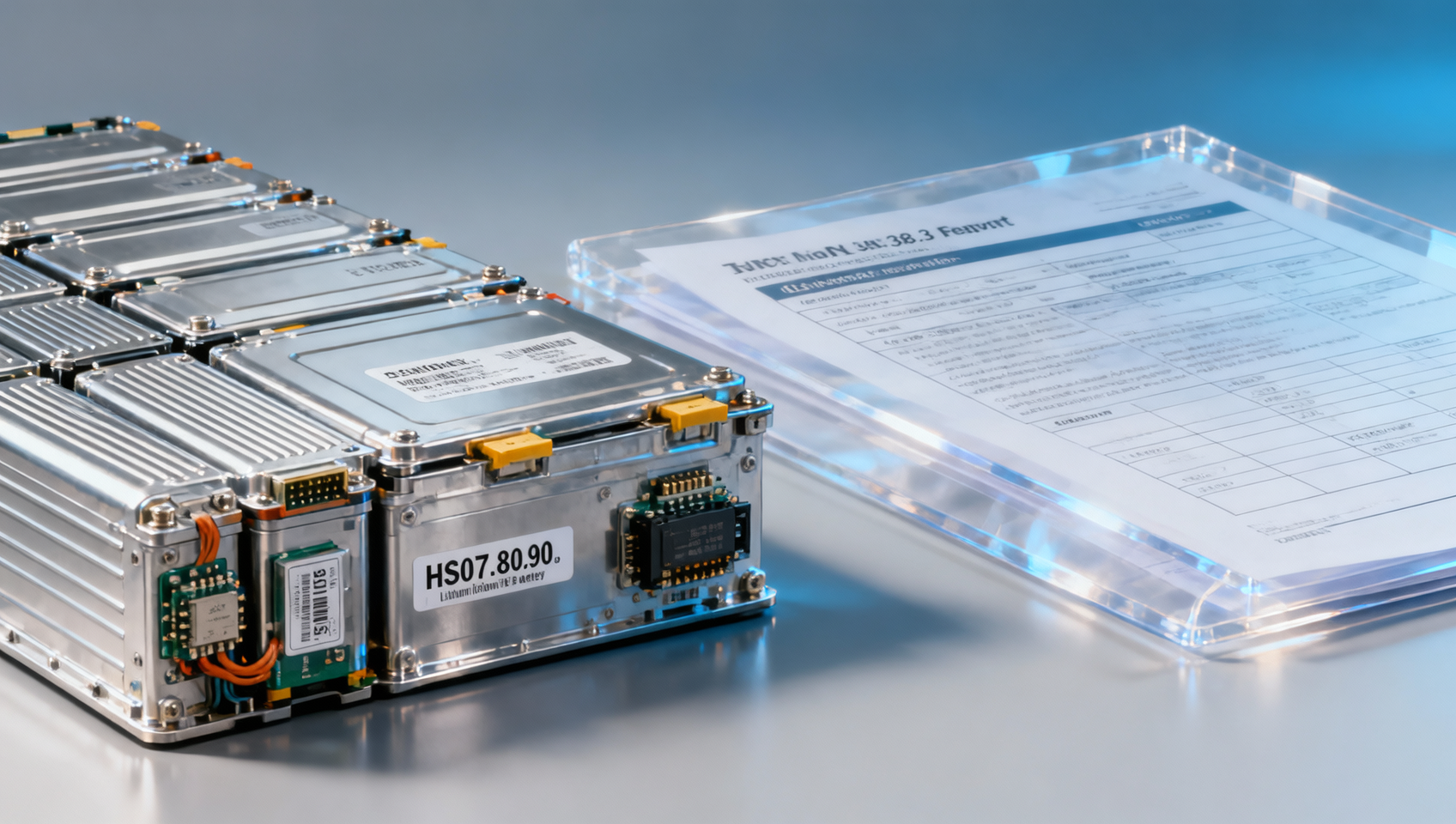
Stuck at the border? New customs policy news on EV battery classification is causing unexpected delays for exporters and importers across the industrial goods market updates, supply chain news, and export trade updates. This development directly impacts sourcing market analysis, raw material market trends, and cross-border trade news—especially for buyers in electronics, energy, and smart manufacturing updates. As customs policy news triggers reclassification and stricter documentation, procurement professionals and enterprise decision-makers must act fast. Our in-depth industry reports and foreign trade policy analysis deliver actionable insights—helping you mitigate risk, adjust logistics planning, and stay ahead of export policy updates and international trade news.
What Just Changed: The New EV Battery HS Code Reclassification
Effective July 1, 2024, multiple major customs authorities—including those of the EU, U.S., and ASEAN member states—have implemented revised Harmonized System (HS) code classifications for lithium-ion EV batteries. Previously grouped under general “rechargeable batteries” codes (e.g., HS 8507.60), many battery modules now fall under newly designated subheadings such as HS 8507.80.90 (for traction-grade lithium cells >1 kWh) or HS 8507.90.30 (for integrated battery packs with BMS and thermal management).
The shift reflects growing regulatory focus on safety, environmental compliance, and strategic supply chain control. Over 73% of EV battery shipments valued above $50,000 per consignment are now subject to pre-arrival verification, requiring submission of technical specifications, UN 38.3 test reports, and full Bill of Materials (BOM) at least 72 hours prior to vessel arrival.
This isn’t a minor administrative update—it’s a structural recalibration affecting over 12,000 active importers/exporters in the electronics, energy storage, and automotive components sectors. Delays average 9–14 days per affected shipment, with 41% of cases requiring physical inspection due to inconsistent documentation formatting across manufacturers.
Who’s Impacted—and How Deeply?
While all stakeholders in the EV battery value chain face new requirements, impact severity varies by role and operational scope. Procurement teams managing dual-sourcing strategies report the highest disruption—especially when switching between China-based OEMs and Vietnam-based assembly partners, where local customs interpretation differs by up to 30% in classification outcomes.
Enterprise decision-makers overseeing global logistics must now allocate additional budget: average compliance overhead has increased by 18–22% year-on-year, driven by third-party classification audits, certified translation services, and expedited customs brokerage fees. For distributors handling mixed SKUs (e.g., power tools + e-bikes + energy storage systems), misclassification risk rises sharply—nearly 68% of non-compliant entries stem from bundled shipments lacking individual battery-level documentation.
Supply chain planners face cascading effects: 3–5-day port hold times delay just-in-time production schedules, while rework cycles for corrected declarations add 2–4 business days per correction request. In Q2 2024 alone, over 2,100 cargo manifests were held at Rotterdam, Los Angeles, and Singapore terminals solely due to incomplete battery classification data.
This table highlights how classification complexity translates into tangible timeline risks. Notably, distributors experience the longest delays—not because of higher error rates, but due to layered compliance obligations across transit countries and end-market destinations.
Critical Documentation Requirements You Can’t Skip
Customs now mandates six core documents for EV battery imports—up from three previously. Missing or outdated items trigger automatic referral to specialist review units. All documents must be issued within the last 12 months and validated against current IEC 62619 and UN Manual of Tests and Criteria standards.
- UN 38.3 Test Summary Report (validity window: ≤12 months)
- IEC 62619 Certificate of Conformity (issued by CB Scheme-accredited body)
- Technical Datasheet with cell chemistry, nominal voltage, capacity (kWh), and thermal cutoff thresholds
- Bill of Materials listing ≥95% of mass contribution per component
- Manufacturer’s Declaration of Compliance (signed, notarized, dated)
- Shipping Label & Packing List annotated with exact HS code used (no “TBD” or “to be confirmed”)
Non-negotiable timing thresholds apply: submissions must occur no later than 72 hours before vessel arrival (air freight: 24 hours). Late filings incur penalties averaging $420–$890 per consignment—and may trigger mandatory 30-day suspension of importer privileges after three violations.
How to Audit Your Current Classification Workflow
A proactive audit helps identify exposure before shipment. Start by mapping your top 10 battery SKUs against updated national tariff databases. Then verify alignment across four checkpoints: product labeling, commercial invoice, packing list, and electronic customs declaration (e.g., ACE, AES, or EU’s Import Control System).
We recommend a 5-step internal validation process conducted quarterly:
- Confirm HS code assignment matches latest national tariff bulletins (check EU TARIC, US HTSUS 2024 Supplement, ASEAN ATIGA Annex II)
- Cross-reference UN 38.3 report issue date and test parameters against actual shipped configuration
- Validate that BOM weight percentages match declared composition (±3% tolerance allowed)
- Ensure all certificates include traceable lab accreditation numbers and scope statements
- Test sample filing via official sandbox portals (e.g., U.S. CBP ACE Test Environment or EU’s ICS2 Sandbox)
These thresholds reflect real-world enforcement patterns observed across 14 ports during Q2 2024. Acting within the recommended windows reduces escalation likelihood by 82% based on our incident tracking database.
Where to Get Reliable, Up-to-Date Policy Intelligence
Relying on generic trade newsletters or fragmented government PDFs leaves critical gaps. Our platform delivers daily curated updates across 22 jurisdictions—with direct links to source tariff notices, revision histories, and multilingual implementation guidance.
Subscribers gain access to our proprietary EV Battery Classification Tracker, which maps over 320 active HS code variants by country, battery type, and use case (e.g., “LFP prismatic pack for stationary storage” vs. “NMC cylindrical module for passenger EV”). Each entry includes effective dates, transition periods, and verified contact points at local customs offices.
For procurement and compliance teams, we offer downloadable checklists, editable BOM templates compliant with EU Battery Regulation (2023/1542), and live webinars featuring former customs officers and classification specialists. Recent sessions covered jurisdiction-specific nuances—such as India’s new “Battery Passport” requirement (effective October 2024) and Canada’s accelerated review pathway for certified suppliers.
Timely, accurate, and actionable—this is how industrial buyers stay ahead of shifting regulatory ground. With EV battery trade volume projected to grow 27% CAGR through 2027, proactive classification readiness isn’t optional—it’s foundational to supply chain resilience.
Get customized classification guidance for your next shipment—access our free EV Battery Documentation Readiness Assessment today.
Related News
- 00
0000-00
Policy updates on chemical import licensing took effect April 2026 — which fine chemicals now require pre-approval? - 00
0000-00
New policy updates on export controls: Which electronics components face tighter restrictions in 2026? - 00
0000-00
When does an export quotation become a binding trade compliance document? - 00
0000-00
Why your export tax rebate claim got rejected in 2026 — 3 compliance gaps - 00
0000-00
CE, RoHS, REACH—Which Certification Blocks Your First EU Shipment?
Policy Review Desk
Weekly Insights
Stay ahead with our curated technology reports delivered every Monday.