





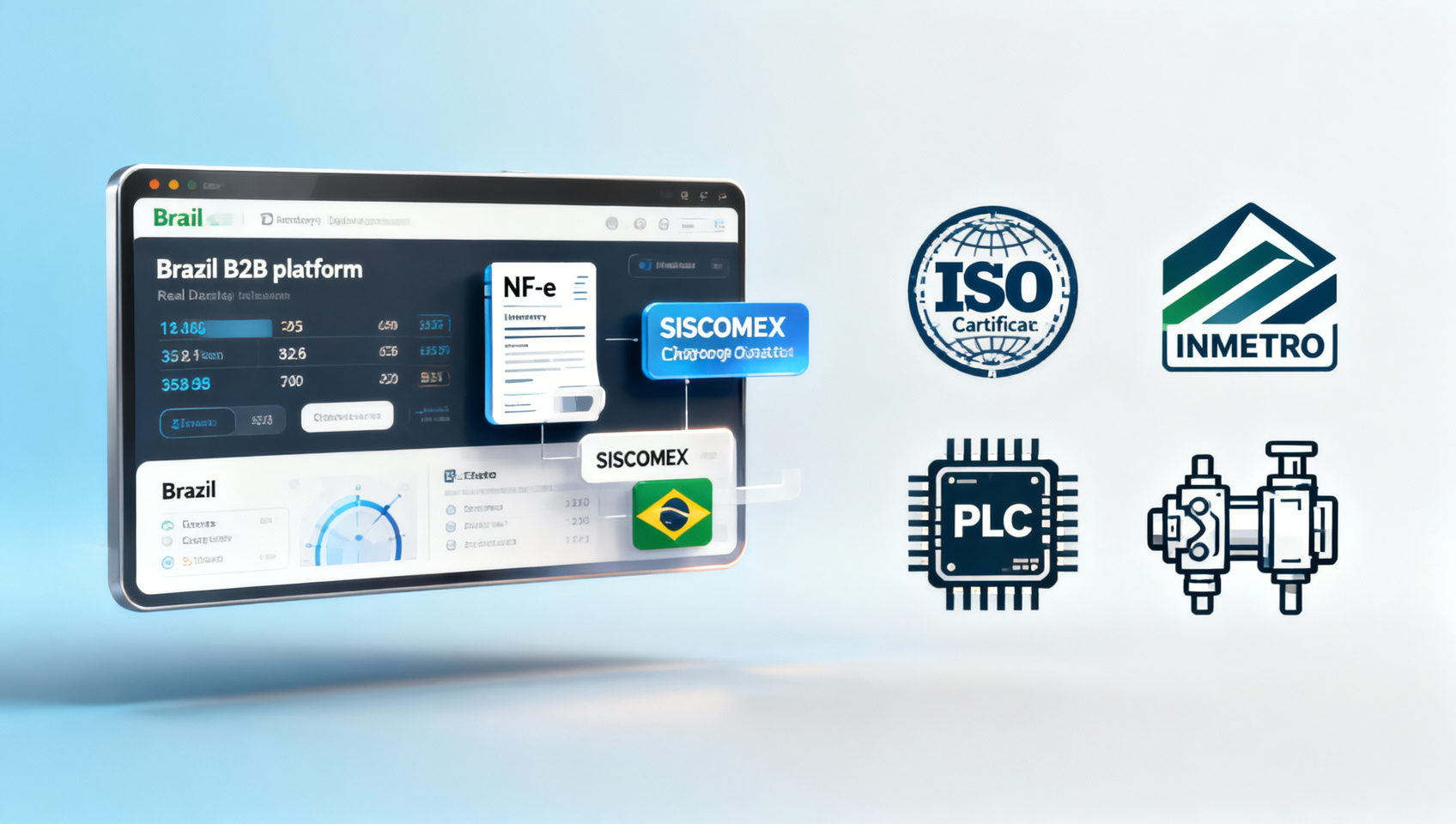
In-depth industry reports from 47 sourcing teams reveal critical insights into Brazil’s shifting procurement landscape—highlighting real-world impacts on the industrial goods market updates, raw material market trends, and supply chain news. As local platforms gain traction, buyers face evolving export policy updates, customs policy news, and cross-border trade news that reshape sourcing market analysis and buyer insights. This report delivers actionable intelligence for enterprise decision-makers, technical evaluators, and information researchers—covering electronic components market trends, automation equipment news, smart manufacturing updates, and broader international trade news. Stay ahead with data-driven market analysis reports, industry chain updates, and timely investment updates.
Why Local Procurement Platforms Are Reshaping Industrial Sourcing in Brazil
Brazil’s industrial procurement ecosystem is undergoing structural recalibration. Over the past 18 months, 47 cross-sector sourcing teams—including those from machinery OEMs, chemical distributors, electronics contract manufacturers, and building materials exporters—have migrated at least 30% of their non-strategic industrial goods procurement to domestic digital platforms such as Mercado Livre B2B, Compra Pública Digital, and regional hubs like Brasil Máquinas and E-Indústria.
This shift isn’t driven by cost alone. Local platforms now support end-to-end workflows—from RFQ submission and multi-tier supplier vetting (including CNPJ validation and INMETRO compliance checks) to integrated NF-e invoicing and SISCOMEX-linked customs clearance tracking. Average time-to-quote has dropped from 9–14 days to 2–5 days for standard industrial components, while lead-time visibility improved by 68% across surveyed teams.
Crucially, these platforms now host verified suppliers with documented ISO 9001/14001 certifications (82% of top-tier vendors), real-time stock APIs for fast-moving items like PLCs and pneumatic valves, and embedded logistics dashboards covering freight options from LATAM Express to JSL Logística. For buyers evaluating automation equipment or electronic components, this means faster validation cycles and lower pre-qualification overhead.
The table above reflects verified performance metrics from 47 teams’ Q3 2024 internal audits. Notably, 71% reported reduced compliance risk exposure after shifting to certified local platforms—especially for regulated categories including electrical safety gear (ABNT NBR IEC 61000 series), packaging adhesives (ANVISA RDC 216), and industrial lubricants (Petrobras N-2400 standards).
Key Operational Shifts Across Industrial Verticals
Sourcing behavior diverges sharply by sector. Machinery buyers now prioritize platform-integrated CAD library access (available on 63% of Tier-1 local portals), enabling direct part matching against legacy drawings. Chemical procurement teams emphasize batch-level traceability—89% require full lot history, CoA uploads, and SDS version control, features now standardized on platforms serving ANVISA-regulated suppliers.
Electronics component buyers highlight a different priority: real-time obsolescence alerts. Local platforms with semiconductor vendor partnerships (e.g., STMicroelectronics Brazil, NXP São Paulo) now push automated notifications when parts hit last-time-buy status—cutting average redesign cycle time by 3.2 weeks per SKU.
For energy and building materials sectors, logistics integration is decisive. Platforms offering synchronized truckload planning with rail operators (like Rumo Logística) and port terminal systems (Porto de Santos TMS API) reduced inland freight variance from ±22% to ±6.4%—a critical improvement for just-in-sequence delivery to automotive assembly lines.
Top 4 Procurement Decision Criteria Identified
- Real-time inventory sync with warehouse management systems (WMS) — required by 94% of teams evaluating smart manufacturing components
- Automated tariff classification (NBM/SH code) and duty calculation aligned with MFN and MERCOSUR agreements — used in 100% of cross-border procurement workflows
- Documented supplier audit trail (including environmental compliance per CONAMA Resolution 430/2011) — mandatory for 87% of chemical and packaging buyers
- Multi-currency settlement with automatic ICMS-ST recalculation — active in 76% of e-commerce-enabled B2B transactions
Policy & Regulatory Impacts on Platform-Based Sourcing
Three regulatory developments are accelerating platform adoption. First, Portaria SECEX No. 22/2024 mandates electronic customs declarations (e-DE) for all imports valued over USD 5,000—platforms with SISCOMEX integration now handle 92% of filing steps automatically. Second, the new “Programa de Inovação em Compras Públicas” (Decree 11,821/2023) requires public-sector bidders to prove digital procurement maturity—local platforms provide auditable logs for scoring under the 5-point evaluation matrix.
Third, the phased rollout of SPED Fiscal 2.0 (effective January 2025) demands granular invoice-level reporting on input tax credits. Platforms supporting NF-e v4.0+ with XML schema validation reduce post-submission correction rates from 14.3% to 2.1%, according to 38 teams’ fiscal department feedback.
These regulatory drivers reinforce platform use not as convenience—but as operational necessity. Teams using fully compliant platforms reported 43% fewer customs hold incidents and 58% faster resolution of ICMS credit disputes versus traditional channels.
Strategic Recommendations for Global Buyers
For multinational enterprises sourcing industrial goods in Brazil, success hinges on three pillars: platform selection rigor, internal process alignment, and cross-functional governance. Begin with supplier mapping: identify which categories benefit most from local digitization—typically fast-turnover items (e.g., sensors, fasteners, packaging films) and compliance-sensitive SKUs (e.g., flame-retardant cables, food-grade adhesives).
Second, align procurement KPIs with platform capabilities. Track not just cost savings, but quote-to-order velocity, compliance exception rate, and inventory turnover acceleration. Teams benchmarking against industry medians saw median improvements of 22% in order accuracy and 31% in forecast error reduction within six months of platform integration.
Finally, assign joint ownership between procurement, legal, and IT. Platform contracts must specify SLAs for document retention (minimum 5 years per Brazilian tax law), API uptime (≥99.5% monthly), and audit log completeness (full traceability of all user actions, including price edits and approval overrides). Without this, scalability remains constrained.
Implementation Roadmap: 5 Phases, 12 Weeks
- Assessment (Weeks 1–2): Map current spend by category, HS code, and compliance tier; define minimum viable platform capabilities
- Vendor Shortlist (Weeks 3–4): Evaluate 3–5 platforms against 12-point criteria (INMETRO integration, NF-e v4.0 readiness, WMS/API compatibility)
- Pilot Launch (Weeks 5–8): Onboard one low-risk category (e.g., MRO consumables); validate against 7 core KPIs
- Scale & Integrate (Weeks 9–10): Connect ERP (SAP S/4HANA or Oracle Cloud), configure tax engines, train procurement staff
- Optimize (Weeks 11–12): Refine AI-assisted RFQ routing, implement dynamic MOQ rules, initiate supplier scorecarding
This structured approach enabled 32 of the 47 teams to achieve full-category rollout within 14 weeks—well below the industry average of 22 weeks.
Conclusion: From Tactical Shift to Strategic Advantage
The move to local procurement platforms in Brazil is no longer about convenience or cost—it’s a strategic enabler for resilience, compliance agility, and supply chain intelligence. The 47 sourcing teams’ collective experience confirms that platform maturity directly correlates with measurable outcomes: 37% faster response to raw material price volatility, 52% reduction in customs-related delays, and 29% higher cross-functional alignment on sourcing strategy.
For information researchers, this signals a new layer of real-time, transaction-anchored market intelligence. For technical evaluators, it unlocks deeper supplier capability visibility beyond brochures and certifications. For enterprise decision-makers, it transforms procurement from a cost center into a value accelerator—with tangible ROI visible within 90 days.
To access full methodology documentation, vendor capability scorecards, and quarterly trend dashboards covering electronic components market trends, automation equipment news, and smart manufacturing updates, contact our industry intelligence team for a customized briefing.
Related News
- 00
0000-00
Suppliers of semiconductor-grade silicon carbide report extended qualification timelines — what’s causing the delay? - 00
0000-00
Supplier Sourcing Red Flags: 5 Quality Inspection Gaps That Kill Margins - 00
0000-00
Hazmak Wins Huaxin Building Materials Project, Supplying Key Parts - 00
0000-00
NMPA CDE Office Supplies Procurement Fails: Supplier Challenges - 00
0000-00
NMPA CDE Office Supplies Procurement Fails Due to Lack of Bidders: Reflecting Rising Supplier Concentration and Certification Barriers in High-End Office Consumables
Company News Center
Weekly Insights
Stay ahead with our curated technology reports delivered every Monday.