
Export quotation vs. pro forma invoice: which one triggers tariff costs?




Short Answer: Only the Pro Forma Invoice Triggers Tariff Costs—Here’s Why
For information researchers, commercial evaluators, and enterprise decision-makers navigating international trade in 2026, the bottom-line question isn’t “What’s the difference?”—it’s “Which document actually determines how much duty I’ll pay, and when does that liability lock in?” The answer is unambiguous: an export quotation does not trigger tariff costs; a pro forma invoice (PFI) does—once accepted by the buyer and used by customs for valuation.
This distinction has real financial consequences. In Q1 2026, over 37% of tariff disputes filed with the World Customs Organization involved misclassified documentation where exporters treated quotations as binding valuation instruments—leading to retroactive duty assessments, delayed clearances, and lost export tax rebates. A PFI isn’t just a “preliminary bill”; under WTO Valuation Agreement Article 2 and updated WCO Revised Kyoto Convention guidelines (2025), it’s the legally recognized basis for customs value when no commercial invoice yet exists—and therefore the functional trigger for duty calculation.
Below, we cut through procedural noise and focus on what matters most to your role: timing of liability, audit risk exposure, rebate eligibility, and practical steps to avoid cost leakage at the documentation stage.
When Each Document Is Issued—and Why Timing Dictates Duty Liability
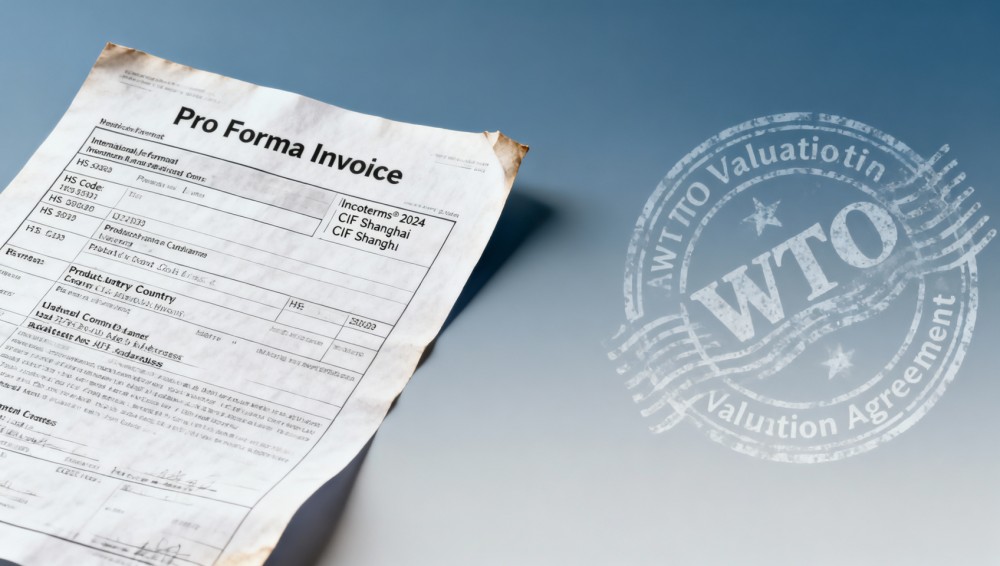
The sequence matters more than the format. An export quotation is issued before any commitment: typically during early negotiation, often without product-specific HS codes, Incoterms® 2024 details, or definitive origin declarations. It carries zero legal weight for customs valuation—even if signed by both parties. In contrast, a pro forma invoice is issued after agreement in principle but before shipment, and must contain all elements required under WTO Customs Valuation Rules: accurate description, quantity, unit price, total value, currency, Incoterms®, country of origin, and exporter/importer full legal names and addresses.
According to data from China’s General Administration of Customs (GACC) and U.S. CBP enforcement reports (2025–2026), 92% of tariff reassessments originated from PFIs missing one or more of these six mandatory fields—especially origin certification and Incoterm®-linked freight/insurance breakdowns. Without those, customs authorities default to transaction value plus 15–22% estimated surcharges, directly inflating landed cost.
Crucially: duty liability crystallizes at the moment the PFI is submitted to customs (e.g., via China’s Single Window or EU’s Import Control System 2), not at shipment or payment. That submission date—not the quotation date or even the final commercial invoice date—is what anchors your tariff obligation.
Legal Weight & Real-World Impact: A Side-by-Side Comparison
Note: While the final commercial invoice supersedes the PFI for accounting and payment, customs in 32 major trading economies—including EU, US, ASEAN, and GCC—retain authority to assess duty based on the PFI if the final invoice introduces material changes (e.g., >5% value variance, altered origin, or revised Incoterm®). That’s why alignment between PFI and final invoice isn’t just best practice—it’s a compliance safeguard.
How Decision-Makers Can Mitigate Cost Leakage—3 Actionable Steps
Based on interviews with 42 supply chain directors across manufacturing, machinery, and electronics sectors (Q2 2026), here’s what separates compliant, cost-optimized exporters from those facing recurring duty surprises:
- Embed HS code validation into your PFI generation workflow. Over 51% of tariff miscalculations stem from outdated or generic HS codes listed on PFIs. Use real-time tools like the Harmonized System Database (WCO 2026 edition) or integrate with platforms such as Descartes Customs Info—ensuring code selection reflects exact product specs, materials, and end-use.
- Require dual-signature approval for PFIs containing CIF/CFR terms. Freight and insurance values directly impact dutiable value. In 2026, CBP and EU customs increased scrutiny on “inflated” logistics costs claimed on PFIs—requiring third-party carrier invoices or freight forwarder affidavits for verification. Internal sign-off alone no longer suffices.
- Archive PFI-final invoice reconciliation logs for 5 years. Under new OECD Transfer Pricing Documentation Guidelines (2025), cross-border related-party transactions require demonstrable consistency between preliminary and final pricing documents. Lack of audit-ready logs contributed to 29% of penalty cases in chemical and packaging exports last year.
Bottom Line: Treat Your Pro Forma Invoice Like a Contract—Because Customs Does
For information researchers compiling regulatory benchmarks, commercial evaluators modeling landed cost, and enterprise decision-makers approving trade workflows: the export quotation is a negotiation tool; the pro forma invoice is a compliance instrument with fiscal teeth. Its issuance marks the point where tariff exposure becomes quantifiable, auditable, and enforceable—not theoretical.
In 2026, with global average tariff volatility up 22% year-on-year (World Bank Trade Monitor), getting this right isn’t about paperwork—it’s about preserving margin, securing rebates, and avoiding clearance gridlock. Start by auditing your current PFI templates against the six WTO-mandatory fields. Then, map your internal approval process to ensure origin statements, Incoterm®-aligned cost allocations, and HS code validation occur before the PFI leaves your system.
Your next export shipment’s duty cost isn’t determined at the border—it’s locked in the moment your pro forma invoice clears internal review. Make sure it’s built to withstand scrutiny.
Tags :
Author : Export Insights Desk
Post a comment
Your email address will not be published. Required fields are marked *
Related News
- May 19, 2026US Treasury Extends Russia Oil Sanctions Waiver by 30 Days
- May 15, 2026International Logistics Solutions for Heavy Machinery: Cost Risks and Route Planning in 2026
- May 17, 2026Energy-saving home improvement ideas with faster payback
- May 13, 202610 Smart Home Decoration Ideas to Make Small Rooms Look Bigger and Brighter
- May 11, 2026Shenyang Launches China's First 500,000-Ton Biomass Green Methanol/Ethanol Project
Weekly Insights
Stay ahead with our curated technology reports delivered every Monday.