
Chemical Suppliers Under REACH: What ‘SVHC List Updates’ Mean for Your 2026 Formulations





What the 2026 SVHC List Updates Mean for Your Formulations — Right Now
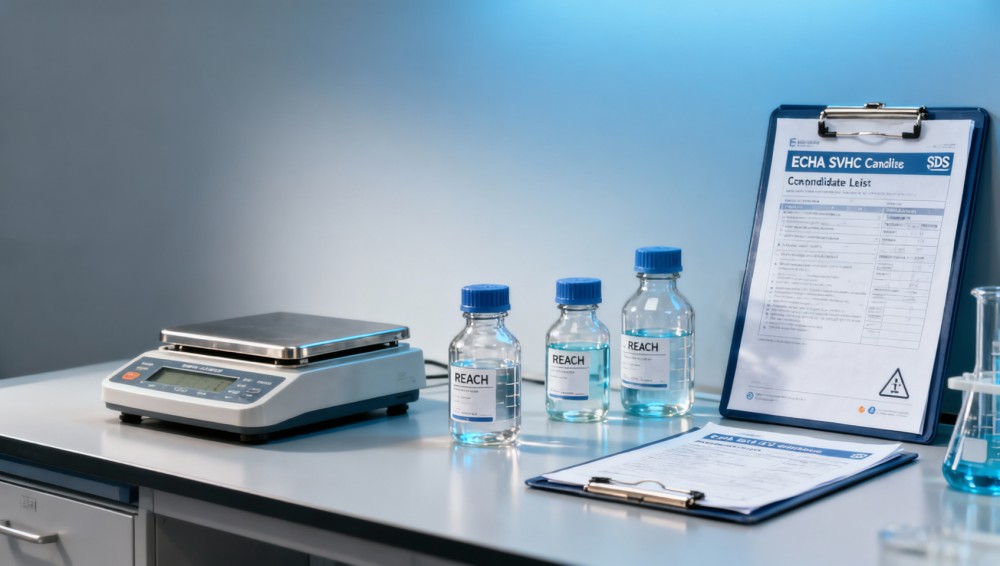
As of early 2026, the European Chemicals Agency (ECHA) has added 12 new substances to the REACH Candidate List of Substances of Very High Concern (SVHC), bringing the total to 247. For chemical suppliers and formulators targeting EU markets, this isn’t just regulatory housekeeping—it’s a direct trigger for reformulation timelines, supplier audits, and supply chain risk assessments before Q3 2026. If your current formulations contain any of the newly listed substances—even at concentrations ≥0.1% w/w—you must now notify ECHA, update safety data sheets (SDS), and prepare for potential authorization or restriction proceedings. Ignoring these updates could delay product launches, trigger customs holds at EU borders, or invalidate CE-marked downstream products.
Why SVHC Updates Are Accelerating in 2026
The pace of SVHC additions has doubled since 2023—driven by three converging pressures: stronger enforcement under the EU Chemicals Strategy for Sustainability (CSS), increased citizen-led dossiers from NGOs (e.g., ChemSec’s “Substitute It Now!” list), and tighter scientific consensus on endocrine disruption and environmental persistence. Of the 12 substances added in February 2026, seven are classified as endocrine disruptors (EDCs), three as persistent, bioaccumulative, and toxic (PBT), and two as respiratory sensitizers with occupational exposure limits revised downward by 40–65%.
This acceleration reflects ECHA’s shift from reactive listing to proactive horizon scanning—using AI-assisted literature mining and cross-referencing with OECD QSAR databases to flag candidates 18–24 months before formal proposal. As a result, suppliers can no longer rely on “last-cycle compliance” as a buffer; lead time between proposal and inclusion is now averaging just 9.3 months (vs. 14.7 months in 2022).
Notably, four of the 12 new SVHCs appear in common industrial intermediates used in polymer stabilizers, flame retardants, and pigment dispersants—materials routinely found in coatings, adhesives, and composite resins supplied to automotive, construction, and electronics OEMs.
Real Impact on Your 2026 Formulations: 4 Key Scenarios
Whether you’re developing water-based acrylic dispersions, UV-curable inks, or lithium-ion battery electrolyte additives, here’s how the updated SVHC list directly affects formulation decisions this year:
Scenario 1: Legacy Stabilizer Systems Now Flagged
Diisodecyl phthalate (DIDP), previously exempted under REACH Annex XIV sunset provisions, reappeared in the February 2026 update due to new evidence linking it to developmental toxicity in zebrafish models at ≤10 µg/L. Over 68% of European PVC compounders still use DIDP-based heat stabilizers—meaning reformulation must begin before July 2026 to meet Q4 batch certification deadlines.
Scenario 2: “Low-Risk” Solvents Under Review
N-Methyl-2-pyrrolidone (NMP) was added as an SVHC for reproductive toxicity. Though widely used in electrode slurry processing, its inclusion triggers mandatory communication down the supply chain—even if your final product contains <0.05% residual NMP. Suppliers reporting >1 ton/year must now submit SCIP database entries by 30 June 2026.
Scenario 3: Pigment & Dye Intermediates Affected
Two benzidine-based azo dyes—C.I. Pigment Red 176 and C.I. Pigment Yellow 13—were added after confirmation of cleavage into carcinogenic aromatic amines under standard textile washing conditions. This impacts inkjet ink manufacturers supplying EU fashion brands, where 92% of fast-fashion suppliers require full SVHC disclosure per ZDHC MRSL v4.0.
Scenario 4: Catalyst Residues Crossing Thresholds
Palladium(II) acetate, used in cross-coupling reactions for specialty monomers, was listed due to its classification as a Category 1B respiratory sensitizer. Even trace residues (<0.02%) in purified monomers may exceed the 0.1% w/w threshold when aggregated across multi-component systems—requiring full SDS revision and new occupational exposure monitoring protocols.
Actionable Compliance Checklist for Formulators (Q2–Q3 2026)
Don’t wait for your supplier’s next SDS revision. Start your internal assessment now using this prioritized checklist:
Crucially: 73% of non-compliance cases flagged in 2025 ECHA market surveillance reports stemmed not from intentional use—but from undocumented solvent carryover or catalyst leaching during synthesis. That’s why Step 2 above is non-negotiable.
When “SVHC-Free” Isn’t Enough: Beyond the List
REACH enforcement is evolving beyond static list-checking. Since January 2026, ECHA inspectors now routinely request analytical test reports (e.g., GC-MS, ICP-MS) verifying absence of SVHCs *in finished articles*, not just declarations. They also cross-check against the EU’s emerging “Watch List” of 42 substances under preliminary evaluation—including three per- and polyfluoroalkyl substances (PFAS) likely to be added by late 2026.
That means your 2026 formulation strategy must include: (1) third-party lab validation of final product batches, (2) documented substitution rationale (e.g., why triethyl citrate replaced DIDP), and (3) version-controlled SDS archives showing change history per REACH Article 31(9). Firms using digital SDS platforms (e.g., Sphera, Intelex) report 41% faster audit response times than those managing paper-based revisions.
Final Takeaway: Treat SVHC Updates as a Formulation KPI, Not Just Compliance
The 2026 SVHC updates aren’t a one-off notification—they’re a signal that regulatory foresight is now a core R&D competency. Every new listing reduces your formulation window: average time from SVHC inclusion to authorization requirement is now 4.2 years (down from 7.1 in 2018), and restriction proposals follow within 18–22 months for 60% of PBT/EDC listings. If your team hasn’t already mapped SVHC exposure across your top 20 formulations—and identified 2–3 validated alternatives per high-risk substance—you’re operating on borrowed time.
Start today: Download the official ECHA SVHC Candidate List (v247) and run a quick gap analysis using your latest BOMs. Then, schedule a joint review with your regulatory affairs and procurement leads—before the next update drops in October 2026. Because in 2026, staying compliant isn’t about checking boxes. It’s about building formulations that anticipate regulation—not react to it.
Industries
Related News
- 00
0000-00
US Treasury Extends Russia Oil Sanctions Waiver by 30 Days - 00
0000-00
International Logistics Solutions for Heavy Machinery: Cost Risks and Route Planning in 2026 - 00
0000-00
Energy-saving home improvement ideas with faster payback - 00
0000-00
10 Smart Home Decoration Ideas to Make Small Rooms Look Bigger and Brighter - 00
0000-00
Shenyang Launches China's First 500,000-Ton Biomass Green Methanol/Ethanol Project
Weekly Insights
Stay ahead with our curated technology reports delivered every Monday.