
How Do You Prevent Duplicate Production Orders from Online Sales?





One online sale should not trigger two production runs. Preventing that outcome requires more than filtering repeated notifications: every manufacturing request needs a stable business identifier, retries must return the existing result rather than create another order, and one system must control production release. These controls must remain effective when messages arrive twice, integrations time out, or staff intervene manually.
The strongest approach combines event deduplication with idempotent production-order creation and quantity-based release controls. Event filtering stops a repeated message; idempotency stops repeated attempts from creating the same manufacturing instruction; release controls prevent different messages or channels from authorizing the same demand twice. None of these safeguards fully replaces the others.
Identify what is actually being duplicated
Several different failures can look like a duplicate production order. An e-commerce platform may send the same webhook again because it did not receive an acknowledgment. An integration may retry an ERP request after a timeout, even though the ERP already created the order. Alternatively, separate workflows may process “payment confirmed” and “order updated” as independent instructions to manufacture.
These failures need different controls. A repeated webhook can be recognized by its event identifier. Two different events concerning the same sale need a shared business reference. Two workers processing that reference simultaneously require an atomic database constraint or an equivalent concurrency control.
There is also an important distinction between duplicate demand and legitimate production splitting. One sales line may require separate work orders for different factories, delivery dates, or manufacturing stages. Conversely, a make-to-stock operation may combine demand from several sales orders into one production batch. A blanket rule allowing only one production order per customer order would mishandle both situations.
The useful rule is narrower: each authorized manufacturing allocation should be created once, and released quantities must not exceed the demand approved for production. For made-to-order products, the allocation may correspond to a sales line. For pooled replenishment, it may correspond to an approved planning proposal linked to aggregated demand.
Why common safeguards offer different levels of protection
A spreadsheet check can be adequate where every release is reviewed and volumes remain manageable. It becomes fragile when automated imports, manual entries, and multiple sales channels operate in parallel. Reviewers may see different snapshots, and a duplicate may reach scheduling before anyone compares the records.
Automation is not inherently safer. A workflow that creates a work order whenever a payment notification arrives simply reproduces the same mistake faster. The decisive difference is whether the workflow recognizes existing manufacturing authorization before creating anything new.
Use business identifiers, not just message identifiers
An event ID identifies a notification. A sales-order ID identifies commercial demand. A production-release key identifies the specific authorization to manufacture. Keeping these identities separate prevents a common design error: treating every new notification as new demand.
A practical source-order reference includes the sales platform, store or account, and platform order ID. Order number “1042” alone is unsafe if two stores can issue that number. Each line also needs a stable reference; a SKU is insufficient because the same item can appear on multiple lines with different specifications or delivery requirements.
A manufacturing key can then reference the internal demand line and an authorized allocation ID. For example, a line split between two plants needs two allocations, each with its own key. Retrying either allocation must return its existing work order, not produce a third one.
Do not generate a fresh key for every retry, and do not use timestamps as the primary identity. Both approaches make repeated attempts appear unique. Likewise, an order update should not automatically produce a new release key merely because its version changed. A version helps determine which information is current; it does not by itself authorize additional production.
Cross-channel duplication needs a separate rule. The same sale might enter through a marketplace connector and a manual ERP import. Where available, a shared external purchase-order or source-transaction reference can connect those records. Matching only customer name, SKU, quantity, and date is unsafe: a customer can legitimately place identical orders. Ambiguous matches should be held for review rather than silently merged.
Make production creation safe under retries and concurrency
Idempotency means that repeating the same authorized request has the same business effect as processing it once. If a request creates work order WO-582, subsequent attempts using the same manufacturing key should return WO-582 and its status.
A simple “search, then create” workflow does not guarantee this. Two workers can both search before either has saved a record, find nothing, and each create an order. Protection requires an atomic decision, such as a unique database constraint on the release key combined with transactional processing.
When the idempotency record and production order share a database, they can be committed in one transaction. If a competing request arrives, the uniqueness rule rejects the second creation, and the application retrieves the existing result. The stored record should retain the key, relevant request details, production-order reference, and processing outcome.
If the same key arrives with different quantities or specifications, the system should flag a conflict rather than quietly accept the new payload. Otherwise, idempotency can hide an order amendment instead of managing it.
The harder situation occurs when production orders are created in a separate ERP. Consider this sequence:
- The integration sends a creation request with a stable release key.
- The ERP creates the work order.
- The response is lost or arrives after the integration times out.
- The integration cannot tell whether creation succeeded.
Retrying with a new key can create a duplicate. The safer option is to retry with the original key when the ERP supports idempotency, or query the ERP by a uniquely enforced external reference. If neither is available, the request has an uncertain outcome and should enter reconciliation rather than trigger another blind creation attempt.
A transactional outbox helps preserve intended work when a local application saves demand and queues an ERP request. It records the request alongside the local transaction so a delivery worker can send it later. However, outbox delivery can still occur more than once. It prevents lost handoffs; downstream idempotency remains necessary to prevent repeated execution.
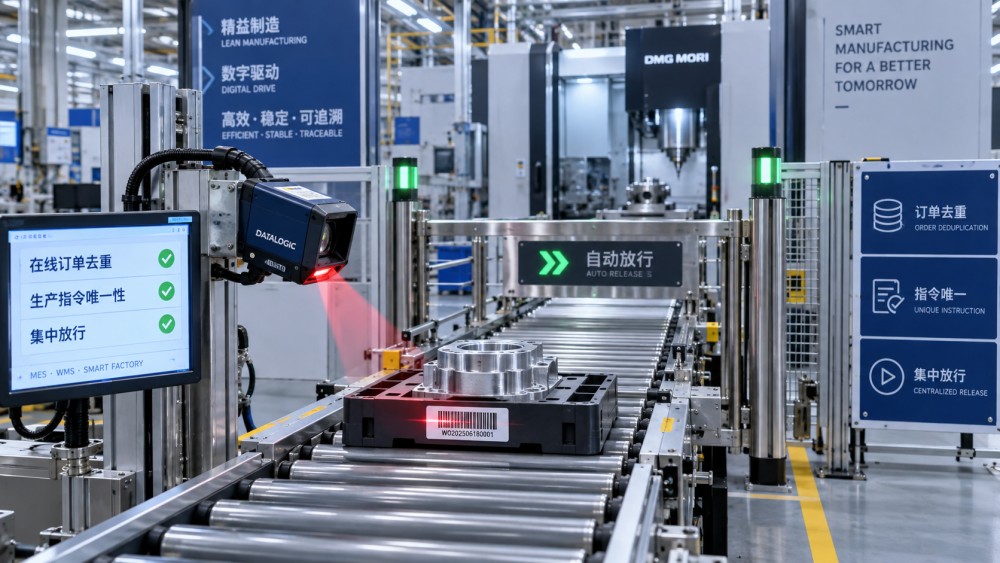
Choose one authority for production release
There are two workable ownership models. The appropriate choice depends on where demand becomes ready for manufacturing.
ERP-led release fits operations where the ERP already governs material planning, approved specifications, inventory allocation, and production scheduling. Online channels create or update sales demand in the ERP, but do not independently create work orders. The ERP or its planning process decides what requires manufacture.
This avoids a dangerous overlap: an e-commerce integration creates a work order immediately, while a later planning run generates another order for the same unfulfilled demand. The planning system must recognize existing supply allocations, and channel imports must not bypass that accounting.
Order-management-led release can suit operations that need to coordinate payment, customization approval, channel allocation, or routing before sending work to multiple production systems. A central order-management layer authorizes each allocation, assigns its release key, and maintains the relationship between customer demand and downstream work orders.
This model carries more integration responsibility. The central layer must track acknowledgments, uncertain outcomes, cancellations, and production status. It cannot assume that sending a request means the factory system accepted it.
The weakest arrangement is divided ownership without explicit boundaries: a storefront automation, an ERP planning job, and a manual team can all release the same demand. Manual intervention should use the same release mechanism or reserve an allocation through it. A separate spreadsheet or email instruction is not exempt from duplication control.
Treat amendments as changes, not new orders
An online order can generate payment, address, quantity, and cancellation events. Production should respond to an approved state transition, not simply to the arrival of another event.
The eligibility rule depends on the commercial process. A prepaid customized item may require payment and design approval. A credit-account order may instead require commercial approval and a confirmed specification. Requiring payment for every order would be inappropriate where agreed payment terms allow production before settlement.
Once production has been released, amendments need explicit handling:
- Quantity increase: authorize the additional quantity or amend the existing work order where its production state permits.
- Quantity decrease: reduce unreleased demand and assess whether released work can still be changed.
- Specification change: require an approved revision, with a clear decision about existing materials and work in progress.
- Cancellation: block further releases and request cancellation of existing work rather than merely deleting the sales record.
Quantity accounting should distinguish eligible demand, active production allocations, completed supply, and confirmed cancellations. A request to cancel a work order does not free its allocation until cancellation is confirmed. Otherwise, the system could authorize replacement production while the original job remains active.
Events may also arrive out of sequence. An older “approved” notification must not overwrite a newer cancellation. Use source versions or sequence information where available; if ordering cannot be established reliably, retrieve the current source record before making an irreversible release decision.
Test failures at the handoff, not only successful orders
A successful single-order test proves little about duplicate prevention. Acceptance testing should include simultaneous processing, repeated notifications, delayed responses, and recovery after interruption.
The critical scenarios are a repeated webhook, two different events for the same demand, two workers attempting the same release, and an ERP timeout after successful creation. Tests should also cover a manual release overlapping an automated one, a quantity amendment after partial release, and an old event arriving after cancellation.
The expected result is not necessarily one work order per sale. It is the correct set of authorized allocations, no excess released quantity, and a traceable explanation for every manufacturing instruction.
Operational records should connect the source order, line, event, release key, and downstream work-order reference. Monitor uncertain creation outcomes separately from rejected duplicate attempts: a duplicate blocked by design is different from a request whose result remains unknown. Deduplication records must also survive the relevant retry and replay window; deleting them too early can make an old request appear new.
When duplicate work orders already exist, do not automatically delete the newer one. Check material issues, work in progress, completion, and any subcontracting commitments before deciding which instruction can be canceled. Correct the demand-to-supply mapping as well, or a later planning run may recreate the excess.
The essential selection question is whether a solution can prove that a manufacturing allocation has already been authorized and created—even after a timeout, replay, or manual intervention. A tool that only filters repeated webhooks cannot provide that assurance. Stable business identities, enforced uniqueness, controlled release ownership, and reconciliation of uncertain outcomes provide the stronger boundary between an online sale and the factory floor.
Industries
Related News
- 00
0000-00
US Treasury Extends Russia Oil Sanctions Waiver by 30 Days - 00
0000-00
International Logistics Solutions for Heavy Machinery: Cost Risks and Route Planning in 2026 - 00
0000-00
Energy-saving home improvement ideas with faster payback - 00
0000-00
10 Smart Home Decoration Ideas to Make Small Rooms Look Bigger and Brighter - 00
0000-00
Shenyang Launches China's First 500,000-Ton Biomass Green Methanol/Ethanol Project
Weekly Insights
Stay ahead with our curated technology reports delivered every Monday.