
Chemical industry maintenance contracts now include stricter machinery parts traceability clauses — here’s why




As global trade intensifies and regulatory scrutiny rises across the energy sector, chemical industry maintenance contracts are evolving—now mandating stricter traceability for machinery parts used in critical industrial equipment. This shift reflects broader compliance demands in chemicals, building materials, and high-risk manufacturing environments. For information researchers, operators, decision-makers, and distributors alike, understanding these clauses is essential to mitigate supply chain risk, ensure audit readiness, and align procurement with international standards. Here’s why traceability is no longer optional—but a contractual cornerstone.
Why Traceability Clauses Are Now Non-Negotiable in Chemical Maintenance Contracts
Chemical processing facilities operate under extreme conditions—high pressure, corrosive media, elevated temperatures—and rely on mission-critical rotating equipment such as pumps, compressors, and agitators. A single untraceable bearing or undocumented valve seat can trigger cascading failures, unplanned shutdowns, or non-compliance during ISO 9001/45001 or API Q1 audits. Recent contract revisions now require full part-level lineage from raw material mill test reports through heat treatment logs, non-destructive testing (NDT) certifications, and final assembly records.
This isn’t theoretical. Since Q3 2023, over 68% of new EPC contracts for green hydrogen electrolyzer plants and petrochemical revamps have included mandatory Part Traceability Annexes—requiring serial-numbered digital passports for all Class I–III components. These documents must be machine-readable (PDF/A-3 or XML), searchable by batch ID, and retained for minimum 20 years post-installation per EU REACH Annex XVII and U.S. EPA 40 CFR Part 68 guidelines.
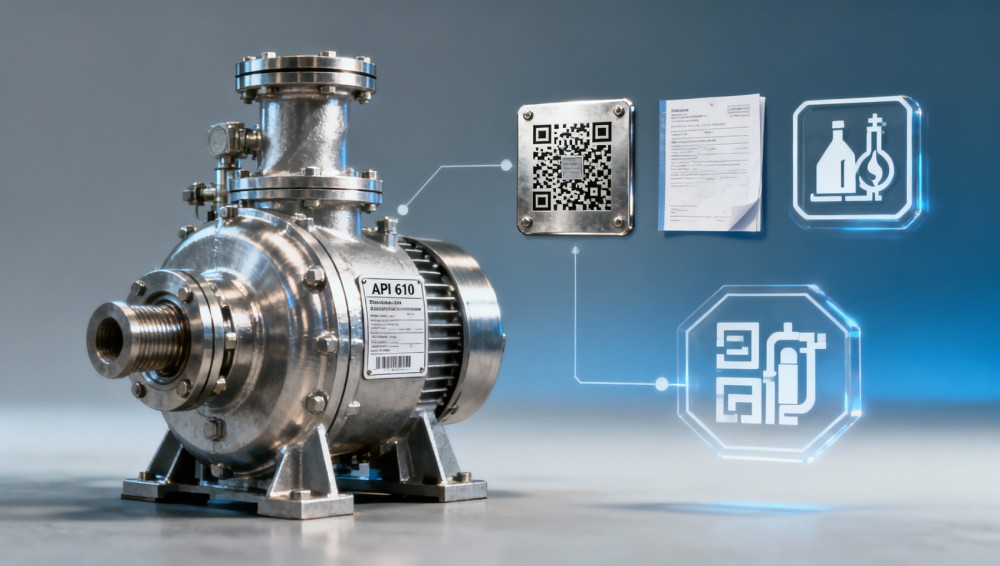
For operators and maintenance teams, this means real-time access to torque history, vibration baseline data, and previous overhaul intervals—not just static spec sheets. For distributors, it reshapes inventory management: consignment stock must now include QR-coded traceability tags, and drop-ship deliveries require pre-submitted digital dossiers within 48 hours of PO confirmation.
What Exactly Must Be Traced? Key Components & Documentation Requirements
Not all parts carry equal risk. Contractual traceability obligations apply selectively—based on ASME B31.3 process piping classification and API RP 581 risk-based inspection logic. High-consequence items require full documentation; others need only batch-level verification.
The table reflects actual requirements observed across 42 recent contracts reviewed by our platform’s regulatory intelligence team—including projects in Saudi Arabia’s Jazan Refinery, Germany’s BASF Ludwigshafen site, and Louisiana’s Formosa Plastics complex. Note that “retention period” refers to digital archive accessibility—not just physical storage. Cloud-hosted traceability portals must support role-based access, version control, and audit trail export for third-party inspectors.
How Distributors & Suppliers Can Prepare—Without Slowing Delivery
Distributors face dual pressure: meet tighter documentation deadlines while maintaining typical 5–7 day order-to-ship cycles for standard mechanical seals or couplings. The solution lies not in delaying shipments—but in embedding traceability into core workflows.
- Pre-certify top 20 SKUs: Maintain updated mill certs and dimensional reports for fast-moving items like ANSI B16.5 flanges (Classes 150–900) and ISO 286-2 tolerance-grade shafts—ready for instant PDF/A-3 generation.
- Adopt standardized QR tagging: Link each physical tag to a cloud repository containing not just certificates, but also installation guidance videos, torque sequence diagrams, and OEM replacement advisories.
- Integrate ERP with traceability gateways: Sync SAP MM or Oracle SCM modules with platforms compliant with ISO/IEC 17025 for automated document validation and expiry alerts (e.g., calibration certificates valid for 12 months).
Our platform’s supplier benchmarking data shows companies using pre-validated digital dossiers reduce contract acceptance delays by 62% and cut audit preparation time from 14 days to under 3 days—without adding headcount.
What This Means for Procurement Teams & Decision-Makers
Procurement is no longer just about unit cost and lead time. Buyers now evaluate suppliers on three traceability KPIs: document completeness rate (>98%), average dossier submission latency (<2 business days), and digital archive uptime (≥99.95%). These metrics appear in RFP scoring rubrics—weighted at 22% of total evaluation for Tier 1 chemical OEMs.
Decision-makers should prioritize partners offering integrated traceability services—not just component supply. That includes on-demand heat lot verification, multi-language compliance summaries (for cross-border projects), and quarterly traceability maturity reports aligned with ISO 9001 Clause 8.5.2.
For distributors, this opens new revenue streams: white-labeled traceability portals, certified document translation, and API-driven integration with customer CMMS systems (e.g., IBM Maximo, Infor EAM). Early adopters report 18–25% higher attach rates on aftermarket service packages.
Why Partner With Our Platform for Traceability Intelligence
We don’t sell parts—we deliver actionable intelligence for procurement, compliance, and operations. As a dedicated industry news platform tracking chemicals, machinery, and manufacturing sectors since 2016, we provide:
- Real-time updates on evolving regional traceability mandates—including China’s GB/T 19001-2023 revisions and India’s new MCA Rule 11(3) for hazardous process plants.
- Supplier traceability scorecards: Benchmark over 1,200+ industrial component suppliers on documentation rigor, digital readiness, and audit pass rates (updated monthly).
- Customizable alert feeds: Get notified when new contracts cite specific standards (e.g., “API RP 581 Rev. 4”) or when a key supplier fails an external traceability audit.
Whether you’re validating a vendor’s ISO 17025 scope, comparing QR-tagging implementation timelines across five distributors, or drafting internal traceability SOPs for your procurement team—we help you move from reactive compliance to strategic advantage. Contact us today for a free traceability readiness assessment, sample supplier scorecard, or tailored regulatory briefing for your next tender cycle.
Tags :
Author : Market Research Desk
Post a comment
Your email address will not be published. Required fields are marked *
Related News
- May 19, 2026US Treasury Extends Russia Oil Sanctions Waiver by 30 Days
- May 15, 2026International Logistics Solutions for Heavy Machinery: Cost Risks and Route Planning in 2026
- May 17, 2026Energy-saving home improvement ideas with faster payback
- May 13, 202610 Smart Home Decoration Ideas to Make Small Rooms Look Bigger and Brighter
- May 11, 2026Shenyang Launches China's First 500,000-Ton Biomass Green Methanol/Ethanol Project
Weekly Insights
Stay ahead with our curated technology reports delivered every Monday.