
Industrial Digitalization Trends: From Cloud Analytics to Edge AI





Industrial Digitalization Trends: From Cloud Analytics to Edge AI
Industrial digitalization trends are changing how connected factories, intelligent equipment, and data infrastructure are evaluated. Cloud analytics supports fleet-wide comparisons and scalable processing. Edge AI moves inference closer to machines, reducing response delays and dependence on external connectivity. The practical question is no longer simply where to put computing power. It is which decisions belong near equipment, which benefit from centralized analysis, and how both remain manageable throughout their operating life.
For technical teams, that distinction matters more than an impressive demonstration. A vision model that identifies defects under controlled lighting may struggle after a material change. A cloud dashboard can reveal recurring failures across plants but cannot compensate for unreliable sensor timestamps. Evaluating these technologies requires attention to operating conditions, integration effort, cybersecurity, and ownership—not just model accuracy or processor specifications.
The shift is toward distributed intelligence, not a cloud replacement
Cloud-centric industrial systems made it easier to consolidate production records, equipment telemetry, and maintenance histories. Centralized infrastructure remains useful for comparing assets, training models, storing selected historical data, and connecting operational performance with business planning. Those functions do not disappear when edge AI enters a factory.
What changes is the placement of time-sensitive work. Sending every camera frame or high-frequency vibration signal to a remote service can create avoidable bandwidth, latency, and availability constraints. Processing those signals locally allows a system to classify an event, retain relevant evidence, and transmit a smaller result upstream.
A practical hybrid architecture separates responsibilities:
- Machine and control layer: established controllers handle deterministic sequences, interlocks, and safety functions.
- Edge layer: local devices preprocess signals, run inference, buffer data, and support nearby applications.
- Cloud or central platform: services aggregate information, compare sites, manage approved model versions, and support longer-term analysis.
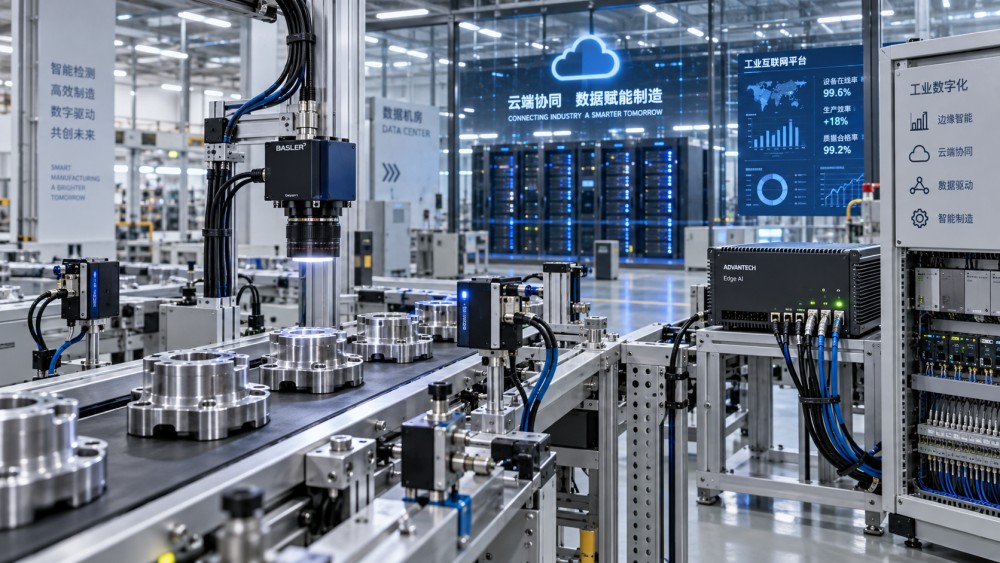
The boundaries must be explicit. Running AI beside a production line does not make it suitable for safety-critical control. Any connection between an inference result and machine action needs an engineered response, validation, and a defined fallback. Local processing alone does not guarantee deterministic behavior.
Where edge AI earns its place—and where it may not
Visual inspection illustrates why compute placement matters. Packaging, electronics, and building-material production can generate image streams that are expensive or impractical to transmit continuously. Local inference can identify a suspected defect while retaining selected images for review. Central analysis can then help compare defect patterns across lines or investigate whether a supplier or process change coincides with quality problems.
The evaluation should cover more than average classification accuracy. False rejects consume material and operator attention; missed defects create downstream risk. Test performance across product variants, lighting conditions, line speeds, surface finishes, and realistic contamination. A model’s behavior on unfamiliar inputs matters as much as its score on familiar ones.
Condition monitoring offers a different trade-off. Local processing can extract features from vibration or acoustic signals without uploading every raw sample. However, unusual operating modes can resemble faults. Maintenance records, machine load, speed, and operating context are needed to interpret alerts. In some applications, a well-tuned threshold or conventional statistical method may be easier to maintain than machine learning.
Energy analysis often has less demanding response requirements. Comparing consumption across shifts, facilities, or production schedules may fit centralized analytics well. Edge processing becomes more relevant when connectivity is limited, data volumes are high, or a local response is required. Architecture should follow the decision being supported, not the popularity of the technology.
Interoperability is becoming a lifecycle question
Connecting a machine is not the same as making its data usable. Industrial sites combine equipment from different generations and suppliers, often with inconsistent naming, sampling intervals, and access permissions. A temperature reading without units, equipment identity, calibration context, or a trustworthy timestamp has limited analytical value.
Protocols such as OPC UA and MQTT can support integration, but naming a protocol does not establish end-to-end compatibility. Evaluators still need to check supported profiles, information models, security settings, delivery behavior, and gateway requirements. A successful connection during a demonstration may hide substantial mapping work.
Ask suppliers to demonstrate a complete data journey: from a machine signal through local processing to a central application, including units, timestamps, quality flags, and equipment identifiers. Then test what happens when the network disconnects, an edge device restarts, or buffered records arrive late. These events expose integration weaknesses that a live dashboard can conceal.
Portability deserves the same scrutiny. Can historical data be exported in a usable form? Can models run on alternative hardware without extensive redevelopment? Who owns the transformation logic? The cost of replacing a platform may lie less in moving files than in rebuilding undocumented relationships between machines, data, and applications.
The operating burden moves closer to the plant
Edge computing can keep selected production data onsite, but it also distributes software, credentials, and maintenance responsibilities across more physical locations. Devices may sit in cabinets with limited cooling, share power with industrial equipment, or be accessible to contractors. Cybersecurity and maintainability therefore belong in the architecture review, not in a checklist completed after installation.
Evaluate device identity, network segmentation, least-privilege access, update authentication, remote-access controls, and recovery procedures. IEC 62443 provides a recognized framework for industrial automation and control system security, but any supplier claim should be checked for its precise scope. Component certification, where applicable, does not automatically establish the security of the deployed system.
Models introduce another maintenance layer. Cameras move, tooling wears, recipes change, and incoming materials vary. Performance can deteriorate without an obvious software failure. A deployment therefore needs version tracking, review criteria, rollback capability, and a named owner for investigating changes in results.
A useful acceptance question is simple: if the latest model produces excessive rejects during production, who can restore the previous approved version, and how will that action be recorded? If the answer depends on an unavailable specialist, the operating model is not ready.
Read the market through deployment economics
Industrial digitalization trends are often presented through processor capability, AI features, or platform announcements. For investment decisions, the more revealing comparison is total deployment effort. Edge devices add hardware, installation, spares, power, and field maintenance. Cloud services add recurring compute, storage, connectivity, and potentially data-transfer charges. Hybrid systems can incur both.
Compare alternatives using the same workload and operating assumptions. Include data preparation, integration engineering, labeling, operator training, security administration, and model support. Apparent savings from reducing cloud traffic can be offset by maintaining a dispersed device fleet. Conversely, centralized processing may become unattractive when continuous high-volume uploads are necessary.
Hardware availability also shapes architecture. A technically capable accelerator is less useful if replacements require a different software stack or cannot meet the project’s delivery schedule. Check supported operating temperatures, enclosure requirements, storage endurance, software support periods, and migration options. Peak inference throughput is only one part of equipment suitability.
Cross-border deployments add further questions about local support, remote access, data transfers, and hardware sourcing. Requirements vary by location and application; they need project-specific review rather than assumptions based on another site.
This is where broader industrial intelligence complements technical testing. Hantecorg.com covers technology alongside supplier developments, trade updates, regulations, and supply chain conditions, helping readers connect architecture choices with sourcing and operating risks. That market context can inform an evaluation, but it does not replace supplier documentation, site validation, or applicable legal advice.
Make the pilot prove operability, not just inference
A useful pilot starts with one operational decision: detect a defined defect, prioritize a maintenance inspection, or identify abnormal consumption. Establish the existing baseline and decide what evidence would justify expansion. Avoid combining several loosely related objectives into a demonstration that produces attractive charts but no clear acceptance decision.
Test the whole path from sensor to action. For inspection, that includes image acquisition, preprocessing, inference, communication, and the physical reject mechanism—not merely the model’s execution time. Measure response under realistic load and examine delayed results, dropped inputs, and resource contention. Average latency can hide occasional delays that matter operationally.
- Challenge the inputs: include product changes, incomplete records, sensor faults, and conditions outside the training set.
- Interrupt the infrastructure: test connectivity loss, device replacement, restart behavior, and reconciliation after recovery.
- Validate ownership: assign responsibility for alerts, patches, model approval, and support escalation.
- Price the rollout: distinguish reusable configuration from engineering work that must be repeated at each site.
The most useful direction is not “everything to the edge.” It is a clearer division of responsibilities between machines, local intelligence, and central systems. Before expanding a pilot, require evidence that it survives routine production changes, has an affordable support model, and can fail without creating an uncontrolled operating condition. Those tests reveal more about long-term value than a successful demonstration alone.
Industries
Related News
- 00
0000-00
US Treasury Extends Russia Oil Sanctions Waiver by 30 Days - 00
0000-00
International Logistics Solutions for Heavy Machinery: Cost Risks and Route Planning in 2026 - 00
0000-00
Energy-saving home improvement ideas with faster payback - 00
0000-00
10 Smart Home Decoration Ideas to Make Small Rooms Look Bigger and Brighter - 00
0000-00
Shenyang Launches China's First 500,000-Ton Biomass Green Methanol/Ethanol Project
Weekly Insights
Stay ahead with our curated technology reports delivered every Monday.