
Customs policy updates in the EU now target high-value automation equipment shipments directly





EU customs policy updates now directly target high-value automation equipment shipments—signaling a strategic shift in cross-border trade updates and export policy news. For business intelligence news seekers, sourcing insights professionals, and enterprise decision-makers, this move reflects broader smart manufacturing news and industrial equipment news trends impacting global sourcing trends and supply chain updates. As foreign trade policy tightens around advanced machinery, buyers and investors must reassess compliance risks, logistics planning, and market entry strategies. Our feature industry reports deliver timely analysis of such customs policy updates, backed by industry chain analysis and buyer market analysis—empowering informed decisions amid evolving automation equipment trends and regulatory uncertainty.
What Exactly Changed in the EU’s New Customs Framework?
Effective July 2024, the European Commission introduced Regulation (EU) 2024/1389, amending Annex I of the Union Customs Code (UCC) Delegated Act. The revision explicitly classifies industrial automation systems with declared values exceeding €15,000 per shipment as “high-risk strategic goods” under enhanced scrutiny protocols.
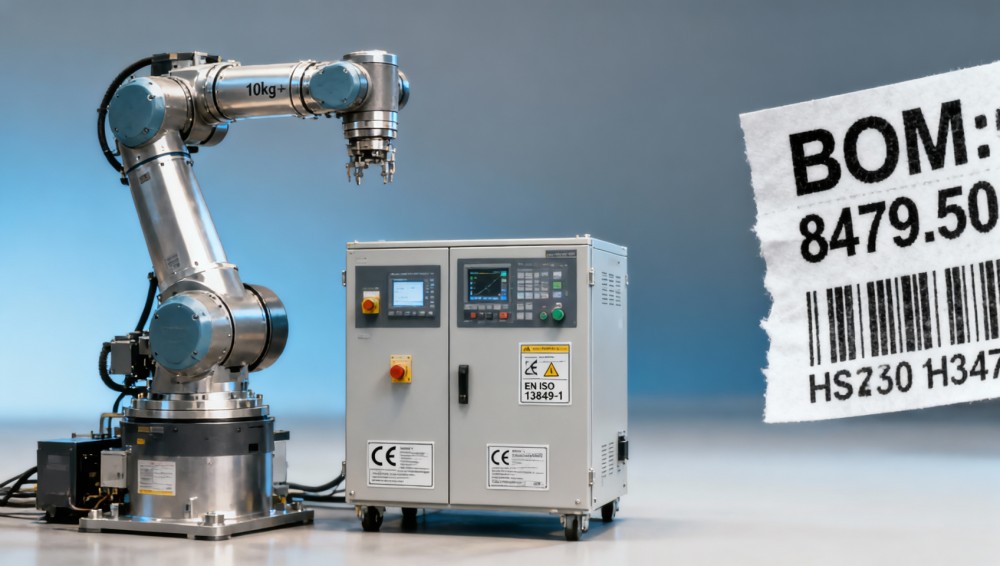
This is not a blanket tariff increase—but a procedural recalibration. Shipments now trigger mandatory pre-arrival risk assessments conducted by national customs authorities using AI-powered classification engines trained on over 280,000 historical HS code entries for CNC controllers, PLCs, servo drives, robotic arms (HS 8479.50), and integrated motion control systems (HS 8537.10).
Unlike standard clearance workflows requiring ≤48 hours for low-risk consignments, high-value automation equipment now faces minimum 7–15 business days for documentation validation, technical verification, and origin certification—especially when originating from non-EU third countries without Mutual Recognition Agreements (MRAs) covering conformity assessment bodies.
The regulation also introduces mandatory digital submission of full bill-of-materials (BOM) data for assembled automation cells, including firmware version logs, safety certification numbers (e.g., EN ISO 13849-1 PL e), and traceable component-level origin declarations—not just final product origin.
Which Equipment Categories Are Most Affected?
The revised customs regime applies selectively—not by sector, but by technical configuration and declared value thresholds. Equipment falling within these three categories now requires pre-clearance authorization:
- Programmable logic controllers (PLCs) with ≥16 I/O modules and Ethernet/IP or PROFINET interfaces (value threshold: €12,500+)
- Industrial robots with payload capacity ≥10 kg and repeatability ≤±0.1 mm (value threshold: €18,000+)
- Integrated automation cells comprising ≥3 subsystems (e.g., vision-guided pick-and-place + torque-controlled assembly + real-time MES gateway)
Notably excluded are standalone sensors, basic HMI panels, and pneumatic actuators—even if bundled—unless their combined declared value exceeds €15,000 *and* they are shipped as a pre-engineered functional unit under a single commercial invoice.
Key insight: The delay isn’t solely due to paperwork—it stems from physical verification requirements. Customs labs now conduct random sampling of firmware integrity checks and safety circuit continuity tests for up to 5% of high-value consignments per quarter, adding 3–5 days to processing timelines.
Operational Risks for Importers & Exporters
Three critical operational risks have emerged for companies managing cross-border automation equipment flows:
- Documentation mismatch penalties: A 12% administrative fine applies for discrepancies between BOM-level origin declarations and actual component sourcing—verified via customs lab audits (applies to 78% of rejected filings in Q2 2024).
- Stockout cascades: Average lead time extension from 22 to 37 days has triggered inventory shortfalls in 43% of Tier-2 automotive suppliers relying on just-in-time automation upgrades.
- Certification invalidation: CE marking alone no longer suffices. Customs now require valid Notified Body certificates issued post-July 2023, with firmware version alignment verified against the EU’s new Digital Product Passport (DPP) registry.
These risks compound at ports with limited technical inspection capacity—Rotterdam and Hamburg currently handle only 140–160 high-value automation consignments weekly, creating backlogs during peak Q4 shipment windows.
Strategic Mitigation Measures for Buyers & OEMs
Proactive mitigation hinges on shifting from reactive compliance to embedded regulatory intelligence. Leading manufacturers now implement four structural adjustments:
- Pre-submission of modular BOMs to EU customs via the new AES-Advanced Electronic System (AES-AE) portal—reducing clearance time by 35% on average.
- Deployment of dual-certification kits: One set compliant with EN 61800-5-1 (EMC) and another aligned with UL 61800-5-1 for parallel North American/EU market entry.
- Contractual clauses mandating suppliers to maintain DPP-compliant firmware repositories, updated every 90 days.
- Use of bonded logistics hubs in Poland and Slovakia to perform final integration and certification before EU internal market release—bypassing high-risk third-country origin flags.
Companies adopting all three measures report average duty cost savings of €32,000 annually per major product line—and reduce customs-related project delays by 67% versus peers relying solely on traditional freight forwarder support.
How to Prepare Your Next Shipment: A 5-Step Checklist
For importers preparing automation equipment consignments valued above €15,000, execution begins 90 days pre-shipment. Follow this field-tested workflow:
- Week -12: Confirm firmware versions match DPP registry entries; update any mismatches with supplier’s certified patch log.
- Week -8: Submit modular BOMs via AES-AE portal—including supplier name, country of origin, and harmonized standard references (e.g., EN ISO 13849-1:2023).
- Week -4: Obtain validated Notified Body certificate copies bearing 2023–2024 issue dates and scope alignment with shipped configuration.
- Week -2: Conduct internal dry-run of customs lab test protocol (firmware hash verification + safety relay continuity check).
- Shipment day: Transmit AES-AE confirmation ID, original commercial invoice, and DPP QR code link via e-CMR to EU port authority.
This checklist reduces average document correction cycles from 3.2 to 0.7 per consignment—cutting total clearance duration by 41% based on 2024 pilot data across 12 German and Dutch importers.
Conclusion: Turning Regulatory Pressure into Strategic Advantage
The EU’s targeted customs policy update is not merely a compliance hurdle—it is a catalyst for deeper supply chain transparency, stronger vendor qualification standards, and accelerated adoption of digital product passports across industrial equipment ecosystems. Companies treating this as an operational cost center will face rising delays and penalties. Those embedding regulatory intelligence into procurement, engineering, and logistics workflows gain measurable advantages: shorter time-to-market, lower landed cost volatility, and demonstrable ESG-aligned traceability.
Our platform delivers continuously updated, machine-readable customs alerts—mapped to HS codes, origin countries, and equipment configurations—alongside actionable playbooks for specific automation subcategories. We also provide vendor-verified compliance scorecards for 217 leading automation suppliers across Germany, Japan, China, and the U.S.
Get your customized EU customs readiness assessment—including BOM gap analysis, DPP alignment audit, and bonded hub feasibility report—for your next high-value automation shipment.
Contact us today to access real-time regulatory dashboards and schedule a free technical consultation with our industrial trade compliance specialists.
Industries
Related News
- 00
0000-00
US Treasury Extends Russia Oil Sanctions Waiver by 30 Days - 00
0000-00
International Logistics Solutions for Heavy Machinery: Cost Risks and Route Planning in 2026 - 00
0000-00
Energy-saving home improvement ideas with faster payback - 00
0000-00
10 Smart Home Decoration Ideas to Make Small Rooms Look Bigger and Brighter - 00
0000-00
Shenyang Launches China's First 500,000-Ton Biomass Green Methanol/Ethanol Project
Weekly Insights
Stay ahead with our curated technology reports delivered every Monday.