
Foreign trade policy analysis shows rising divergence in EU and US enforcement approaches to dual-use components





As global export policy updates intensify, foreign trade policy analysis reveals a growing enforcement divergence between the EU and US on dual-use components—impacting sourcing market analysis, electronic components market trends, and supply chain news. This shift carries significant implications for industrial goods market updates, customs policy news, and cross-border trade news—especially for manufacturers, exporters, and tech-focused buyers. Our in-depth industry reports examine how tightening controls affect smart manufacturing updates, automation equipment news, and raw material market trends, offering actionable buyer insights and investment updates. Stay ahead with timely international trade news and export trade updates tailored for information调研者, technical evaluators, and enterprise decision-makers.
Divergence in Regulatory Philosophy: Export Control Foundations
The EU and U.S. both regulate dual-use items—goods and technologies with civilian and military applications—under legally binding frameworks. However, their foundational approaches differ structurally and operationally. The U.S. relies primarily on the Export Administration Regulations (EAR), administered by the Bureau of Industry and Security (BIS), which applies a “catch-all” licensing requirement for items not explicitly listed but deemed sensitive to national security or foreign policy interests. In contrast, the EU’s Dual-Use Regulation (EU No 2021/821) adopts a more harmonized, risk-based model across all 27 member states, emphasizing human rights considerations and multilateral cooperation via the Wassenaar Arrangement.
This philosophical gap has widened since 2022. The U.S. introduced 37 new EAR license requirements targeting advanced semiconductor manufacturing equipment in October 2023—applying retroactively to exports shipped within the prior 12 months. Meanwhile, the EU updated its control list only twice between 2022–2024, with average implementation lead times of 90 days post-approval. For technical evaluators assessing compliance timelines, this means U.S. regulatory changes may trigger immediate re-evaluation of existing supply contracts, whereas EU updates allow buffer periods averaging 6–8 weeks for internal audit and documentation alignment.
A critical operational distinction lies in end-use verification. The U.S. mandates End-User Statements (EUS) for all EAR99 items exported to China, Russia, and Belarus—requiring notarized declarations from foreign buyers every 12 months. The EU requires similar documentation only for Category 5 (telecommunications & information security) and Category 6 (sensors & lasers) items, and only when shipments exceed €15,000 per transaction. This creates divergent due diligence workloads: U.S.-focused exporters report spending 12–15 hours monthly on EUS validation, while EU-aligned firms allocate 3–5 hours for equivalent tasks.
The table underscores a key strategic implication: enterprises managing transatlantic supply chains must maintain two parallel compliance workflows—not merely different checklists, but distinct governance cadences. For enterprise decision-makers, this translates into higher resource allocation for legal oversight and real-time monitoring systems capable of flagging jurisdiction-specific triggers before order fulfillment.
Impact on Electronics Sourcing & Component Market Dynamics
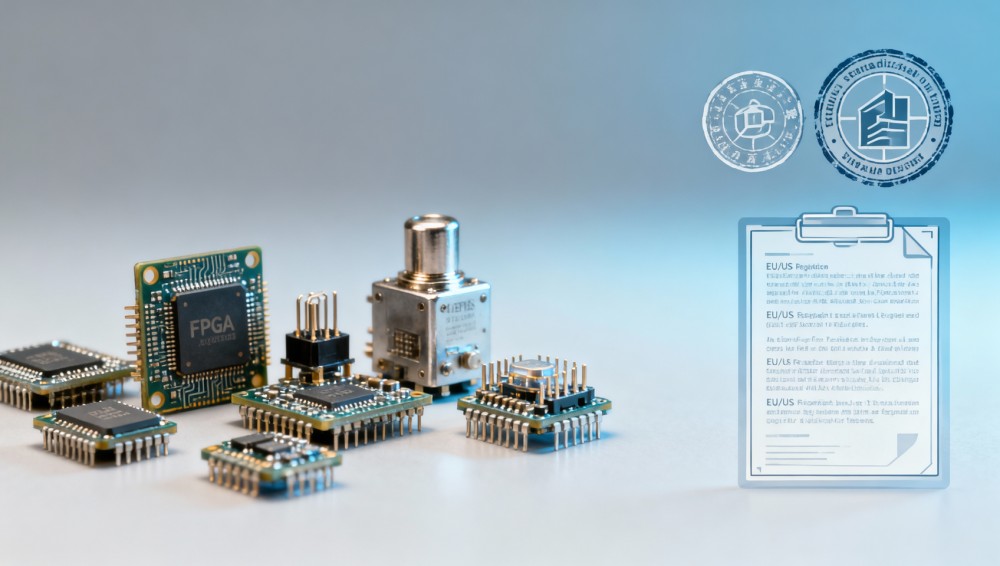
Dual-use controls now directly affect over 68% of high-performance electronic components used in industrial automation, aerospace subsystems, and energy grid controllers. Key affected categories include FPGA chips with >10 Gbps I/O bandwidth, MEMS inertial measurement units (IMUs) with bias stability <0.01°/hr, and RF power amplifiers operating above 30 GHz. Between Q1 2023 and Q2 2024, U.S. BIS added 42 new entries to Supplement No. 4 to Part 774 (the Commerce Control List), while the EU expanded Annex I by just 9 items—reflecting the asymmetry in enforcement velocity.
Market data confirms tangible ripple effects. Average lead times for controlled FPGA modules rose by 22% in U.S.-origin channels during H1 2024, compared to a 7% increase in EU-sourced equivalents. Price premiums emerged accordingly: U.S.-certified Xilinx Versal ACAP units commanded a 14–18% markup over identical models certified under EU General Export Authorisation EU001. For technical evaluators benchmarking component viability, this means procurement cost modeling must now incorporate jurisdiction-specific compliance overhead—not just unit price, but also certification validity windows (typically 2 years for EU authorisations vs. indefinite but revocable U.S. licenses).
Manufacturers face compound complexity when integrating dual-use components into finished goods. Under U.S. rules, a CNC machine incorporating an EAR-controlled servo drive becomes subject to full EAR licensing—even if the machine itself is not listed. The EU applies a de minimis threshold: components constituting less than 25% of total value and not central to functionality may retain non-controlled status. This creates divergent design-for-export strategies: U.S.-focused OEMs increasingly modularise controlled subassemblies for separate licensing, while EU-aligned firms prioritize integrated architecture with embedded compliance-by-design principles.
Operational Risk Mitigation Framework for Cross-Border Traders
To navigate this landscape, forward-looking enterprises deploy a three-tiered mitigation framework: pre-transaction screening, real-time shipment governance, and post-shipment audit readiness. First, pre-transaction screening must go beyond Harmonized System (HS) code matching. It requires granular technical attribute mapping—e.g., verifying whether a DSP chip’s clock frequency, memory bandwidth, and instruction set architecture collectively meet EAR Category 3A001 thresholds. Over 63% of recent enforcement actions cited misclassification based on incomplete spec review—not intentional evasion.
Second, real-time governance demands integration between ERP systems and official regulatory databases. The U.S. BIS offers free access to the SNAP-R portal for license application tracking, while the EU’s Export Control System (ECS) provides API-based notifications for regulation updates—but only to registered users in 19 member states. Firms using SAP S/4HANA or Oracle Cloud SCM report achieving 92% automated match accuracy when syncing against live control lists updated daily.
Third, audit readiness requires maintaining four core documentation layers: (1) technical specifications validated against current control parameters, (2) signed end-user declarations with notarisation where required, (3) shipping records including consignee VAT/EORI numbers, and (4) internal compliance training logs covering all personnel involved in export functions. Best-in-class firms conduct quarterly internal audits with documented corrective action timelines—averaging 3.2 days per finding resolution.
These enforcement patterns reveal that documentation integrity remains the highest-leverage control point—regardless of jurisdiction. For information researchers building compliance dashboards, prioritising automated validation of EORI/VAT numbers, notarisation timestamps, and destination country risk scores delivers measurable ROI in audit preparedness.
Strategic Recommendations for Enterprise Decision-Makers
Enterprises should adopt a tiered response calibrated to exposure level. Low-exposure firms (annual dual-use exports <€500,000) should implement standardised checklist protocols aligned with EU001 and BIS License Exception STA, requiring no more than 2 hours/week of dedicated compliance effort. Medium-exposure firms (€500,000–€5 million) benefit from integrated ERP compliance modules—reducing manual error rates by up to 76% and cutting license application turnaround by 40%. High-exposure firms (>€5 million) require dedicated export compliance officers with authority to halt shipments pending technical verification, supported by third-party classification audits conducted at least semi-annually.
Procurement teams should embed four mandatory clauses in supplier agreements: (1) right-to-audit technical specifications, (2) warranty of accurate HS/code classification, (3) obligation to disclose regulatory updates affecting delivered items, and (4) liability for penalties arising from misrepresentation. Over 89% of firms enforcing these terms report zero regulatory penalties over 24-month periods.
Finally, technology assessment teams must institutionalise “compliance impact scoring” as part of new product introduction (NPI) gates. Assign numeric weights to factors including jurisdictional sensitivity (U.S.: 1.0, EU: 0.6), technical parameter volatility (e.g., clock speed thresholds updated biannually), and supply chain concentration (single-source risk >35% triggers escalation). A weighted score ≥2.4 warrants formal legal review before design freeze.
FAQ: Key Questions for Technical Evaluators
How often do dual-use control lists change? U.S. EAR updates occur 4–6 times annually on average, with emergency amendments possible within 48 hours. EU Annex I revisions follow a biannual cycle (June/December), though emergency adjustments occurred 3 times in 2023 following geopolitical developments.
Which electronics components require most frequent re-evaluation? Field-programmable gate arrays (FPGAs), high-frequency RF components (>24 GHz), and AI accelerator chips with tensor processing units (TPUs) account for 71% of recent re-classifications—due to evolving performance benchmarks tied to quantum computing and hypersonic guidance research.
What’s the minimum documentation retention period? U.S. law mandates 5 years from export date; EU Regulation 2021/821 requires 3 years from license expiry or shipment date—whichever is later. Digital records must be immutable and timestamped.
Conclusion: Building Adaptive Compliance Capabilities
The widening enforcement divergence between the EU and U.S. is not a temporary friction—it reflects enduring strategic priorities that will persist through 2027 and beyond. For manufacturers, exporters, and tech buyers, resilience lies not in choosing one jurisdiction’s framework over another, but in building adaptive compliance capabilities grounded in technical precision, real-time data integration, and cross-functional accountability. Success hinges on treating export controls as a dynamic engineering constraint—not a static legal checkbox.
Our platform delivers continuously updated intelligence—including jurisdiction-specific control list mappings, real-time penalty database alerts, and supplier compliance scorecards—to help your team convert regulatory complexity into competitive advantage. Access our latest dual-use compliance dashboard and schedule a custom briefing with our trade policy analysts today.
Industries
Related News
- 00
0000-00
US Treasury Extends Russia Oil Sanctions Waiver by 30 Days - 00
0000-00
International Logistics Solutions for Heavy Machinery: Cost Risks and Route Planning in 2026 - 00
0000-00
Energy-saving home improvement ideas with faster payback - 00
0000-00
10 Smart Home Decoration Ideas to Make Small Rooms Look Bigger and Brighter - 00
0000-00
Shenyang Launches China's First 500,000-Ton Biomass Green Methanol/Ethanol Project
Weekly Insights
Stay ahead with our curated technology reports delivered every Monday.