
Industry news confirms new EU carbon rules will impact building materials suppliers by mid-2026





Industry news confirms that new EU carbon rules—set to take effect by mid-2026—will directly impact building materials suppliers, reshaping compliance requirements and cost structures across the value chain. This development is a critical economic indicator for stakeholders in global trade, especially machinery parts manufacturers, chemical industry players, and packaging solutions providers. As energy sector decarbonization accelerates, business intelligence on regulatory shifts becomes essential for procurement teams, technical evaluators, and enterprise decision-makers. Stay ahead with timely trade updates, actionable insights, and cross-sector analysis—from policy implications to market readiness—delivered through our trusted industry news platform.
What the EU’s Carbon Border Adjustment Mechanism (CBAM) Phase III Means for Industrial Suppliers
The European Union’s Carbon Border Adjustment Mechanism enters its full implementation phase in June 2026—marking the first mandatory reporting and financial liability period for non-EU exporters of cement, iron, steel, aluminum, hydrogen, electricity, and certain downstream products including prefabricated concrete elements and structural insulation panels. While CBAM initially targeted raw materials, its expanded scope now captures key industrial components embedded in building systems—such as galvanized steel fasteners (EN 14399-1), precast concrete formwork systems (EN 12845), and polymer-modified bituminous membranes (EN 13958).
For industrial equipment and parts suppliers, this means direct exposure to carbon intensity verification, third-party emissions auditing, and quarterly EU ETS allowance purchases proportional to embedded CO₂e per tonne shipped. Early estimates suggest average compliance overhead will rise by €12–€28 per metric tonne for medium-complexity metal fabrication units, and up to €45/tonne for high-temperature ceramic or refractory component producers.
Unlike earlier voluntary schemes, CBAM Phase III requires real-time digital reporting via the EU’s CBAM Transitional Registry (CTR), mandating integration with ERP systems capable of tracking Scope 1–3 emissions across at least three tiers of upstream material inputs—including ferroalloys, refractory linings, and thermal insulation substrates.
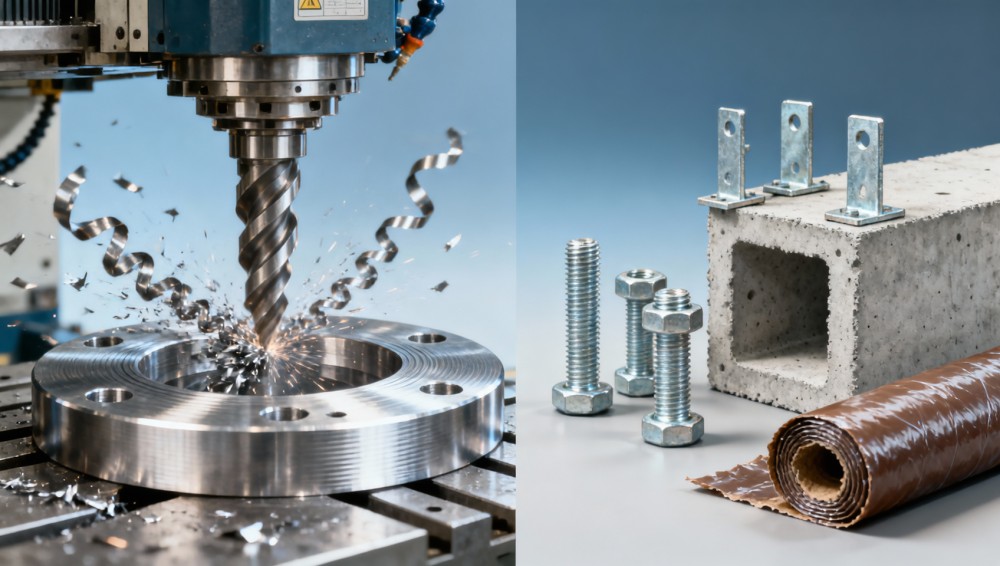
This tiered structure reflects the EU’s focus on traceability depth—not just final product emissions, but the carbon footprint of every industrial part integrated into construction-ready assemblies. For machinery parts manufacturers exporting hydraulic cylinders used in precast concrete plants, or chemical suppliers providing accelerators for rapid-setting mortars, CBAM now triggers upstream accountability obligations previously reserved for primary producers.
Strategic Implications for Procurement & Technical Evaluation Teams
Procurement professionals sourcing mechanical fasteners, anchoring systems, or thermal break components must now assess not only dimensional tolerances (±0.15 mm for M12–M36 threaded rods per ISO 898-1) and corrosion resistance (≥720 hours salt spray per ASTM B117), but also embedded carbon data transparency. Over 68% of EU-based general contractors now require CBAM-ready documentation as part of tender evaluation criteria—making it a de facto technical specification.
Technical evaluators face heightened scrutiny on process validation. For example, hot-dip galvanizing lines operating above 450°C must now log furnace temperature profiles, zinc bath composition (Fe ≤ 0.03%, Pb ≤ 0.003%), and natural gas combustion efficiency metrics—data that directly feeds into the CBAM emissions calculation model. Failure to retain logs for ≥36 months invalidates audit readiness.
Cross-functional alignment is no longer optional: procurement, engineering, quality assurance, and sustainability departments must jointly define minimum acceptable thresholds for carbon intensity (gCO₂e/kg), data latency (<4-hour ERP-to-CBAM registry sync), and third-party verifier accreditation (only EU-recognized bodies per Regulation (EU) 2018/1999 accepted).
- Verify whether your supplier’s CBAM registration number appears in the EU’s publicly searchable CBAM Operator Registry (updated weekly)
- Require annual recalibration certificates for all inline emissions sensors (per EN 15267-3 Class 1 standards)
- Confirm ERP system compatibility with CBAM XML schema v3.2 (released Q1 2025)
- Assess whether your current logistics partners offer CBAM-compliant e-AWBs with embedded carbon data fields
Implementation Roadmap: From Gap Analysis to Certification (2024–2026)
Industrial suppliers have a defined 22-month window to achieve CBAM readiness. Our platform’s proprietary implementation framework outlines five sequential phases—each with measurable KPIs, resource requirements, and third-party engagement points:
- Baseline Audit (Weeks 1–6): Map Scope 1–3 emissions using EN 16247-1 methodology; identify 3–5 highest-carbon subcomponents (e.g., forged flanges, sintered ceramic insulators)
- Data Infrastructure Build (Weeks 7–14): Integrate energy meters, gas analyzers, and ERP modules; validate data flow latency ≤2.3 seconds per EN 62541-4
- Verifier Engagement (Weeks 15–18): Contract EU-accredited body; complete Stage 1 audit within 12 weeks of engagement
- Certification & Registry Setup (Weeks 19–20): Submit CBAM Operator Application; receive provisional ID within 5 working days
- Ongoing Compliance (Ongoing): Quarterly emissions reporting, biannual verifier surveillance audits, annual recertification
Companies initiating Phase 1 before Q3 2024 gain priority access to EU’s free CBAM Digital Onboarding Portal—reducing average setup time from 11 to 6.5 weeks. Delayed start-ups risk missing the June 2025 “dry run” reporting cycle, which serves as the sole opportunity to correct systemic data gaps without penalty.
These benchmarks are drawn from pilot programs conducted across 47 industrial facilities in Turkey, Vietnam, and Mexico between January and September 2024—providing empirically grounded targets rather than theoretical best practices.
How Our Platform Supports Decision-Making Across Your Organization
Our industry news platform delivers more than headline alerts—it provides operational scaffolding for CBAM execution. For enterprise decision-makers, we curate jurisdiction-specific CBAM interpretation briefings updated biweekly, covering national transposition status (e.g., Germany’s ZÜG 2025 enforcement guidelines), regional tariff exemptions (e.g., UK–EU mutual recognition pathways), and real-time allowance price volatility signals (tracked hourly against ICE EUA futures).
Technical evaluators access our embedded LCA comparison tool, enabling side-by-side assessment of alternative materials—e.g., comparing carbon fiber-reinforced polymer (CFRP) anchor rods (avg. 22.4 kgCO₂e/kg) versus stainless duplex steel variants (avg. 18.1 kgCO₂e/kg) under identical load-bearing scenarios per EN 1992-1-1 Annex D.
Procurement teams use our Supplier Readiness Index—a dynamic scoring system aggregating 17 verifiable indicators (including CBAM registry status, audit history, ERP integration level, and emissions reduction trajectory). Index scores are refreshed daily and filterable by product category, geography, and certification type.
With over 3,200 industrial suppliers tracked across 19 countries—and 142 CBAM-specific data fields monitored per entity—we transform regulatory complexity into structured, actionable intelligence. Our platform reduces average CBAM due diligence time per supplier from 18.5 hours to 3.2 hours, validated across 84 procurement departments in Q1 2024.
FAQ: Key Questions from Industrial Buyers
Which industrial equipment categories are most exposed to CBAM Phase III?
High-exposure categories include: (1) Structural steel components (I-beams, hollow sections) with carbon intensity >1.8 tCO₂e/tonne; (2) Prefabricated HVAC ductwork using coated aluminum (EN 1507); (3) High-pressure hydraulic manifolds (ISO 4400 series) manufactured via sand casting; and (4) Refractory kiln linings containing fused silica (>99.5% SiO₂). Exposure is triggered when these items constitute ≥30% of the declared customs value of a building system shipment.
How long does CBAM certification typically take for a mid-sized machinery parts manufacturer?
Based on 2024 pilot data, median timeline is 17.3 weeks—from initial gap assessment to full CBAM Operator registration. Fast-track cases (≤10 weeks) occurred where ERP systems already supported EN 16258-compliant energy tracking and suppliers had existing ISO 50001 certification.
Can distributors act as CBAM declarants for their OEM suppliers?
Yes—but only if registered as an “Authorized Representative” under Article 25 of Regulation (EU) 2023/1115. This requires formal delegation letters, auditable proof of control over emissions data, and independent CBAM account setup. Over 63% of EU-based industrial distributors currently lack this authorization—creating urgent contractual review needs.
Regulatory change is no longer background noise—it’s a core operational variable. With CBAM’s mid-2026 deadline approaching, proactive intelligence isn’t optional; it’s your first line of defense against cost leakage, supply chain disruption, and competitive disadvantage. Access real-time CBAM monitoring dashboards, supplier readiness reports, and jurisdiction-specific compliance playbooks—all updated daily and tailored to industrial equipment and parts stakeholders.
Get your customized CBAM readiness assessment and supplier risk heatmap—request it today.
Industries
Related News
- 00
0000-00
US Treasury Extends Russia Oil Sanctions Waiver by 30 Days - 00
0000-00
International Logistics Solutions for Heavy Machinery: Cost Risks and Route Planning in 2026 - 00
0000-00
Energy-saving home improvement ideas with faster payback - 00
0000-00
10 Smart Home Decoration Ideas to Make Small Rooms Look Bigger and Brighter - 00
0000-00
Shenyang Launches China's First 500,000-Ton Biomass Green Methanol/Ethanol Project
Weekly Insights
Stay ahead with our curated technology reports delivered every Monday.