
Trade updates show U.S. machinery parts imports rising—but not where analysts expected





Latest trade updates reveal a surprising uptick in U.S. machinery parts imports—yet the growth isn’t concentrated in traditional hubs, challenging assumptions tied to economic indicators and global trade flows. This shift signals evolving supply chain dynamics across the energy sector, chemical industry, and packaging solutions markets, with ripple effects on building materials and manufacturing logistics. For procurement professionals, business intelligence teams, and enterprise decision-makers, these developments underscore the need for real-time industry news and agile sourcing strategies. As policy shifts and market movements accelerate, staying ahead demands more than data—it requires contextualized, actionable insights.
Unconventional Growth Patterns in U.S. Machinery Parts Imports
U.S. Customs and Border Protection data through Q2 2024 shows a 12.3% year-on-year increase in imported machinery parts valued at $28.7 billion—yet over 68% of that growth originated from non-traditional suppliers in Vietnam, Mexico, and Poland. Notably, imports from China declined by 2.1%, while those from South Korea rose only 3.4%. This divergence contradicts standard trade elasticity models, which typically associate tariff adjustments and reshoring incentives with predictable regional shifts.
The anomaly stems from three interlocking drivers: first, accelerated adoption of modular, field-upgradable components in industrial automation systems; second, stricter EPA and OSHA compliance timelines pushing U.S. OEMs to source pre-certified subassemblies; third, just-in-sequence (JIS) delivery requirements for Tier-2 suppliers serving automotive and food packaging lines—where lead time tolerance has shrunk from 14–21 days to 5–7 days.
For technical evaluators, this means legacy supplier scorecards based solely on FOB cost or ISO 9001 certification are no longer sufficient. Real-time traceability, embedded firmware versioning, and documented calibration history now carry equal weight in RFQ evaluations. Procurement teams must also verify whether component-level CE/UL markings apply to full assembly integration—not just standalone units.
Sector-Specific Import Shifts and Their Operational Impacts
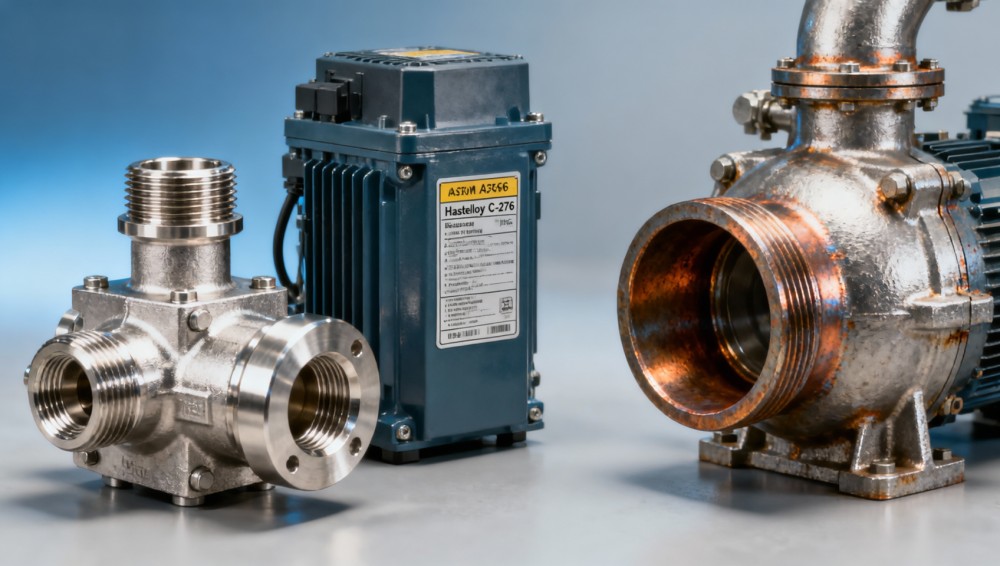
Energy infrastructure projects drove the largest import volume gain—up 22.7% YoY—primarily for explosion-proof gearmotors (IP66/IP68 rated), variable-frequency drive enclosures (NEMA 4X), and stainless-steel valve actuator housings (ASTM A351 CF8M). Chemical processing imports rose 18.4%, led by corrosion-resistant pump casings (Hastelloy C-276 lined) and magnetic drive sealless centrifugal pumps compliant with API 685.
In contrast, general-purpose mechanical power transmission parts (e.g., standard V-belts, cast iron sprockets, non-rated couplings) saw flat-to-negative growth—down 0.9% overall. This bifurcation reflects tightening capital expenditure discipline: end users now prioritize lifecycle cost over upfront price, favoring components with ≥15-year service life warranties and documented MTBF (mean time between failures) exceeding 60,000 hours.
Building materials equipment imports grew 9.2%, but with a critical nuance: demand shifted sharply toward CNC-controlled rebar bending/fabrication cells (capable of handling #3–#11 rebar at ±0.5° angular tolerance) and automated dry-mix mortar dispensing systems with integrated moisture sensors (±0.3% RH accuracy). These are not commodity items—they require factory-integrated PLC programming and on-site commissioning support.
This table highlights how procurement criteria now vary significantly by end-use application—not just by part type. For example, torque-limiting foundation bolts for wind towers require batch-specific tensile test reports per ASTM A325M Annex A, whereas general construction fasteners do not. Misalignment here triggers costly rework: one Midwest EPC firm reported $412K in field rejection costs during Q1 due to unlabeled galvanizing batch IDs on tower hardware.
Strategic Sourcing Adjustments for Procurement & Technical Teams
Agile sourcing now hinges on four operational pillars: (1) dynamic supplier tier mapping—distinguishing between Tier-1 contract manufacturers and Tier-2 specialized component fabricators; (2) digital twin readiness verification—ensuring CAD models include GD&T annotations, material certifications, and surface finish callouts; (3) dual-sourcing validation—requiring documented cross-compatibility testing for critical interfaces (e.g., flange bolt patterns, encoder signal protocols); and (4) logistics synchronization—aligning customs documentation with production scheduling to avoid container demurrage beyond 7 free days.
Technical evaluators should mandate minimum documentation packages before RFQ issuance: full dimensional inspection reports (per ASME Y14.5), material test certificates (MTRs) traceable to heat lot numbers, and functional test videos showing load cycling under specified ambient conditions (e.g., 40°C/90% RH for 72 hours). These reduce post-award engineering review cycles by an average of 3.2 weeks, according to a 2024 benchmark study across 47 industrial OEMs.
Procurement professionals must also recalibrate MOQ (minimum order quantity) thresholds. For high-precision motion control parts (e.g., linear guides with ±2μm positioning repeatability), MOQs below 50 units often trigger premium pricing (>18% markup) and extended lead times. Conversely, bulk-order discounts for standard conveyor idlers now cap at 2,000 units—beyond which inventory carrying costs outweigh savings.
Common Pitfalls in Cross-Border Machinery Parts Procurement
- Assuming “CE Marked” implies U.S. market readiness—many CE-labeled drives lack UL 508A listing required for panel integration.
- Overlooking voltage harmonics compatibility: 480VAC motors rated for IEC 60034-25 may not meet IEEE 519-2022 THD limits when paired with non-OEM inverters.
- Accepting “calibration certificate” without verifying NIST traceability and uncertainty ratios (must be ≤1:4 for process-critical measurements).
- Using generic freight forwarders instead of industrial equipment specialists—leading to improper crating (e.g., insufficient vibration dampening for precision spindles).
Actionable Intelligence for Decision-Makers & Channel Partners
Distributors and agents face intensified pressure to provide value beyond logistics: end users now expect channel partners to validate interoperability, manage firmware update lifecycles, and maintain localized spare parts inventories for mission-critical subsystems. Top-performing distributors report 37% higher attach rates for extended warranty programs when bundled with installation supervision and predictive maintenance readiness assessments.
For enterprise decision-makers, the strategic imperative is clear: integrate trade flow analytics into category management dashboards. Monitor not just import volumes, but origin country volatility scores (based on port congestion, customs clearance delays >48 hrs, and tariff classification disputes), supplier financial health indices, and regional certification renewal cycles. One Fortune 500 manufacturer reduced component obsolescence risk by 63% after implementing quarterly supplier certification expiry alerts.
These benchmarks reflect measurable performance differentiators—not aspirational goals. Distributors meeting all three high-performance criteria command 22–28% higher gross margins on industrial automation components, per 2024 Channel Partner Profitability Index data.
Conclusion: From Data to Decisive Action
The U.S. machinery parts import surge is not a macroeconomic signal—it’s a granular, application-specific realignment driven by regulatory rigor, technology convergence, and supply chain resilience imperatives. For information researchers, this means prioritizing sources that map trade data to engineering specifications, not just HS codes. For procurement and technical teams, it demands updated evaluation frameworks where certification depth, firmware architecture, and logistics integration weigh equally with unit cost.
Our platform delivers precisely this layered intelligence: daily import manifests cross-referenced with OEM specification sheets, regulatory deadline trackers for EPA/OSHA/UL updates, and supplier performance dashboards updated in near real time. Unlike generic trade databases, our coverage includes verified component-level compliance metadata—not just shipment values.
If your team relies on timely, contextualized intelligence to secure reliable machinery parts supply—without sacrificing engineering integrity or compliance certainty—contact us today to access customized market briefings and supplier risk assessments tailored to your specific application segments and procurement workflows.
Industries
Related News
- 00
0000-00
US Treasury Extends Russia Oil Sanctions Waiver by 30 Days - 00
0000-00
International Logistics Solutions for Heavy Machinery: Cost Risks and Route Planning in 2026 - 00
0000-00
Energy-saving home improvement ideas with faster payback - 00
0000-00
10 Smart Home Decoration Ideas to Make Small Rooms Look Bigger and Brighter - 00
0000-00
Shenyang Launches China's First 500,000-Ton Biomass Green Methanol/Ethanol Project
Weekly Insights
Stay ahead with our curated technology reports delivered every Monday.