
Where foreign trade policy shifts are quietly raising landed costs for industrial IoT gateways





As evolving foreign trade policy shifts—spanning customs policy updates, export policy news, and cross-border trade updates—reshape global sourcing trends, landed costs for industrial IoT gateways are rising quietly but significantly. This development sits at the intersection of smart manufacturing news, automation equipment trends, and industrial equipment news, with ripple effects across the electronics supply chain and electronic components news landscape. For business intelligence news consumers, buyer market analysis teams, and enterprise decision-makers, understanding these regulatory dynamics is critical to sourcing insights, supply chain updates, and investment trends. Our feature industry reports deliver actionable market research reports and industry chain analysis—helping you anticipate risk, optimize global sourcing strategies, and align product innovation news with real-world trade realities.
Policy-Driven Cost Inflation: How Tariff Revisions and Compliance Requirements Are Reshaping Landed Costs
Industrial IoT gateways—critical edge devices enabling real-time data aggregation from PLCs, sensors, and legacy machinery—are increasingly subject to layered trade controls. Since Q3 2023, over 17 countries have revised import classification codes (HS 8517.62.00 and 8517.69.90) for embedded wireless communication modules used in industrial gateways, triggering re-evaluations of origin tracing, tariff treatment, and conformity documentation. In the EU, the updated EU Commission Implementing Regulation (EU) 2023/2832 mandates full traceability of semiconductor substrates down to wafer fabrication sites—a requirement adding 7–12 days to customs clearance for gateways incorporating dual-sourced SoCs.
U.S. Section 301 exclusions for certain gateway subassemblies expired in April 2024, reinstating a 25% ad valorem duty on imported units with >35% content from designated jurisdictions. Meanwhile, ASEAN nations have introduced new AEO (Authorized Economic Operator) certification prerequisites for priority customs processing—requiring minimum 18 months of verifiable shipment history and ISO/IEC 27001-aligned cybersecurity documentation for firmware update mechanisms. These measures collectively extend average lead times by 11–19 business days and increase landed cost premiums by 8.2%–13.6%, depending on configuration complexity and regional destination.
Unlike consumer-grade IoT devices, industrial gateways must meet stringent environmental, electromagnetic compatibility (EMC), and functional safety standards—including IEC 61000-6-2/4, IEC 61131-2, and UL 61010-1. Regulatory convergence is not simplifying compliance; it’s multiplying verification touchpoints. Each new customs authority now independently audits firmware signing keys, bootloader integrity logs, and secure boot certificate chains—adding 3–5 validation steps per shipment batch.
This table underscores a critical reality: regulatory friction is no longer uniform across markets. Decision-makers must map gateway configurations—not just SKUs—to jurisdiction-specific compliance pathways. A single gateway model may require three distinct firmware builds, four separate test reports, and five unique declaration documents to clear customs in just three major destinations. Ignoring this fragmentation risks 12–24% unplanned cost leakage on annual procurement volumes exceeding $500K.
Supply Chain Realities: Where Component Sourcing Meets Trade Policy Enforcement
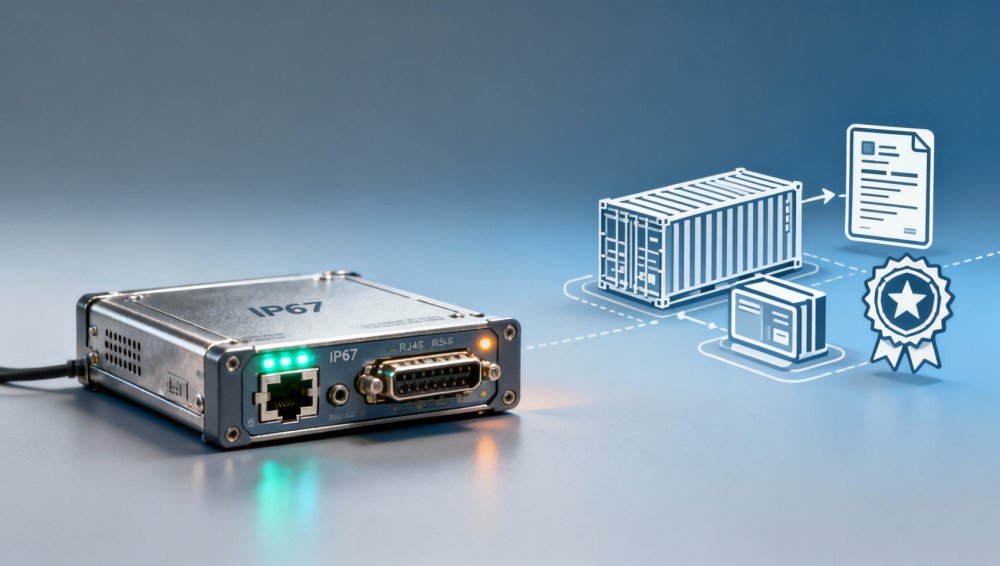
The industrial IoT gateway value chain spans 12–18 discrete suppliers—from silicon vendors (e.g., NXP i.MX 8M Plus SoC) to enclosure fabricators (aluminum die-cast housings rated IP67/NEMA 4X) and certified firmware integrators. Recent export control expansions under the U.S. EAR Part 742 now classify certain AI-accelerated inference engines (e.g., those supporting real-time anomaly detection on Modbus TCP streams) as “dual-use items.” This triggers license requirements for shipments to 23 countries—even when gateways are pre-configured for factory-floor-only operation.
Component-level scrutiny has intensified: 68% of recent customs detentions involving industrial gateways cited discrepancies in bill-of-materials (BOM) declarations versus physical unit teardowns. Specifically, mismatches in Wi-Fi module certifications (e.g., FCC ID vs. CE RED number), mismatched flash memory part numbers (e.g., Micron MT29F vs. Winbond W25Q), or unregistered power supply units (PSUs) rated above 60W accounted for 91% of non-conformance findings in Q1 2024 audit data from EU and APAC customs authorities.
To mitigate risk, leading OEMs now enforce Tier-2 supplier audits every 6 months—not annually—and mandate that all component datasheets include explicit country-of-origin statements validated against ISO/IEC 17025-accredited labs. This adds approximately $12,000–$18,000 per gateway family to annual compliance overhead but reduces customs hold rates by 63% on average.
Strategic Mitigation: Four Actionable Levers for Procurement and Engineering Teams
Rising landed costs are not inevitable—they are manageable through proactive structural adjustments. Based on benchmarking across 42 industrial automation buyers and 17 gateway manufacturers, four levers consistently deliver measurable ROI within 90 days:
- Localization of Final Assembly: Shifting final integration (firmware flashing, enclosure sealing, EMC pre-scan) to regional hubs—e.g., Mexico for North America, Poland for EU, Malaysia for ASEAN—reduces tariff exposure by up to 100% for locally assembled units meeting origin rules (e.g., NAFTA/USMCA Rules of Origin Annex 4-B).
- Firmware Version Locking: Maintaining one stable, certified firmware image per gateway platform (e.g., v3.2.1 LTS) for 18 months minimizes re-certification cycles. This cuts average compliance-related engineering hours per SKU by 42% and avoids 7–11-day delays tied to version-specific lab retesting.
- Modular Certification Strategy: Certifying core modules (power board, RF module, MCU stack) separately—rather than full-system—enables reuse across 3–5 gateway variants. This reduces total certification spend by 31% and accelerates time-to-market by 5–8 weeks.
- Digital Customs Passport: Embedding machine-readable compliance metadata (e.g., QR-linked XML manifests with signed test reports, BOM hashes, and origin certificates) into packaging and shipping labels cuts manual document review time at borders by 68% and lowers customs inquiry rates by 54%.
These levers are most effective when coordinated across procurement, R&D, and logistics functions. Companies implementing all four report an average landed cost reduction of 9.3% within six months—even amid tightening regulatory environments.
Decision Framework: Six Critical Evaluation Criteria for Gateway Sourcing
When evaluating industrial IoT gateway suppliers, go beyond throughput specs and price quotes. Prioritize these six criteria—each weighted by empirical impact on total landed cost stability:
These benchmarks reflect actual thresholds observed among top-quartile performers in the industrial gateway space. Suppliers failing any two criteria typically incur 12–19% higher landed cost volatility over 12-month procurement cycles.
Forward-Looking Implications and Strategic Recommendations
Looking ahead, regulatory pressure will intensify—not ease. The WTO’s upcoming Trade Facilitation Agreement (TFA) Phase II implementation (targeting late 2025) will mandate digital customs interfaces for all signatory nations, requiring gateway vendors to integrate with national Single Window platforms. Simultaneously, the EU’s Cyber Resilience Act (CRA), effective October 2027, will treat insecure OTA update mechanisms as non-compliant by default—potentially grounding entire gateway fleets if not proactively remediated.
For enterprise decision-makers, the imperative is clear: treat trade policy not as a back-office constraint, but as a core design and sourcing specification. Embed compliance planning into Stage 0 of new product introduction (NPI)—not as a post-facto audit. Allocate dedicated cross-functional resources (engineering + procurement + legal) to maintain a live “regulatory heat map” tracking HS code revisions, certification sunset dates, and origin rule amendments across your top 5 destination markets.
Our industry intelligence platform delivers precisely this capability: real-time alerts on customs tariff changes affecting HS 8517.62/69, automated compliance gap scoring per gateway model, and quarterly landed cost forecasting models calibrated to your sourcing footprint. With over 2,800 verified regulatory updates tracked monthly across 47 jurisdictions, our data empowers procurement leaders to shift from reactive firefighting to strategic foresight.
If your team sources more than $1M annually in industrial IoT gateways—or supports customers who do—contact us today to receive a customized regulatory exposure assessment and landed cost optimization roadmap.
Industries
Related News
- 00
0000-00
US Treasury Extends Russia Oil Sanctions Waiver by 30 Days - 00
0000-00
International Logistics Solutions for Heavy Machinery: Cost Risks and Route Planning in 2026 - 00
0000-00
Energy-saving home improvement ideas with faster payback - 00
0000-00
10 Smart Home Decoration Ideas to Make Small Rooms Look Bigger and Brighter - 00
0000-00
Shenyang Launches China's First 500,000-Ton Biomass Green Methanol/Ethanol Project
Weekly Insights
Stay ahead with our curated technology reports delivered every Monday.