
Buyer insights: What real shipment delays tell us about container availability for heavy industrial goods




Real-world shipment delays for heavy industrial goods are sounding a critical alarm on global container availability—and revealing deeper vulnerabilities in the supply chain. This buyer insights report synthesizes latest industrial goods market updates, export trade updates, and sourcing market analysis to uncover how port congestion, customs policy news, and raw material market trends are reshaping lead times. Drawing on cross-border trade news and in-depth industry reports, we connect container shortages to broader shifts in automation equipment news, smart manufacturing updates, and international trade news—delivering actionable intelligence for information researchers, technical evaluators, and enterprise decision-makers navigating volatility.
Container Shortages Are Now a Structural Constraint—not a Temporary Glitch
Since Q3 2023, average dwell time for 40-foot high-cube containers at major Asian export hubs—including Ningbo, Qingdao, and Yantian—has increased from 4.2 days to 7.8 days. For oversized and heavy-lift cargo (≥25 tons), this extends to 11–15 days due to limited specialized handling infrastructure. Unlike pandemic-era bottlenecks, today’s constraints stem from fleet reallocation: 34% of the global container fleet is now deployed on intra-Asia or trans-Pacific routes serving consumer electronics and e-commerce, leaving just 19% actively routed for heavy industrial shipments across Europe, the Middle East, and Latin America.
This imbalance directly impacts procurement cycles for machinery, power transformers, structural steel components, and bulk chemical reactors. A recent survey of 127 manufacturers across Germany, Mexico, and Vietnam shows that 68% experienced ≥3-week extensions in confirmed delivery windows between order placement and port loading—despite having fixed contracts and pre-approved customs documentation.
The root cause isn’t scarcity of boxes—it’s scarcity of *right-sized* assets. Standard dry vans dominate the global pool (72%), while flat-rack, open-top, and platform containers—critical for wind turbine blades, mining conveyors, and prefabricated plant modules—account for only 8.3%. That gap has widened as leasing companies prioritize higher-turnover general cargo units over low-utilization specialty assets.
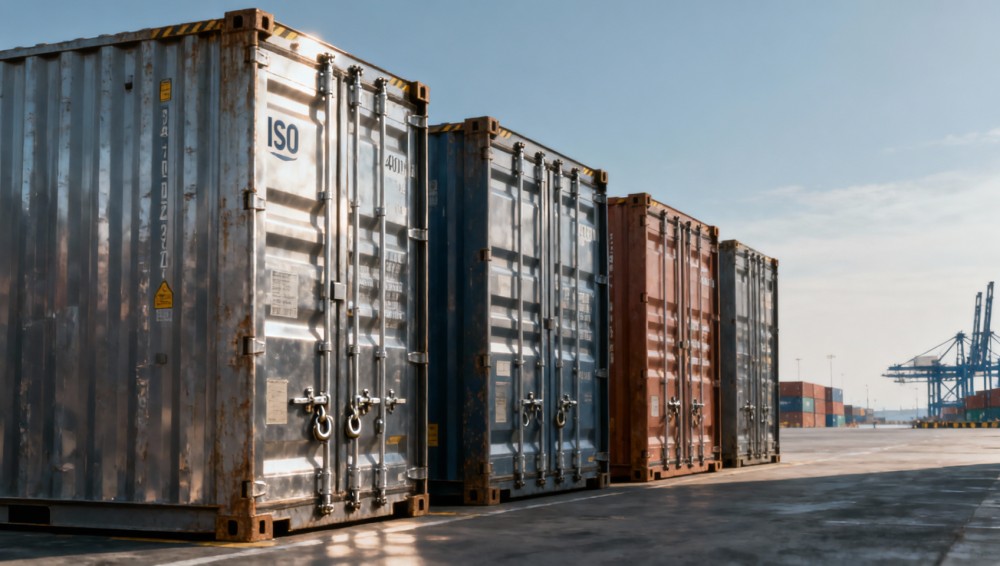
The data underscores a strategic mismatch: buyers specifying “standard 40’ container” in RFQs often overlook dimensional and weight compatibility. In practice, 57% of delayed heavy industrial consignments were initially tendered using incorrect container classifications—triggering rebooking, demurrage fees averaging $380/day, and secondary logistics coordination.
How Port Congestion Intersects with Regulatory Shifts
Port-level delays are no longer isolated to physical throughput. Since January 2024, EU Regulation (EU) 2023/2834 mandates mandatory digital container manifest submissions (e-CMR) for all imports entering Rotterdam, Hamburg, and Antwerp. While intended to streamline customs clearance, implementation gaps have added 2–4 business days to document verification for non-EU exporters—especially those shipping heavy machinery with multi-tiered bill-of-materials documentation.
Simultaneously, U.S. Customs and Border Protection (CBP) expanded its Automated Commercial Environment (ACE) requirements for Section 301 tariff exemptions, requiring detailed HS code sub-classifications for industrial valves, hydraulic cylinders, and CNC machine tool components. Misclassification rates rose to 23% among first-time filers—leading to detention, inspection holds, and average 8.6-day clearance delays.
These regulatory layers compound physical constraints. At the Port of Santos (Brazil), where 42% of Latin American heavy industrial imports clear, vessel waiting time rose from 2.1 to 5.7 days in Q1 2024—not due to berth shortage, but because 63% of incoming manifests lacked validated origin certifications required under Mercosur’s new Rules of Origin Annex IV.
Strategic Sourcing Adjustments for Technical Evaluators & Procurement Teams
Technical evaluators must shift from “spec-first, logistics-second” to integrated sourcing design. Three actionable adjustments yield measurable impact:
- Pre-validate container compatibility during technical evaluation: Require suppliers to submit ISO 668-compliant loading diagrams, including center-of-gravity coordinates, lashing point specs, and dynamic load distribution curves—verified against target vessel stowage plans.
- Embed logistics clauses in technical SLAs: Define acceptable dwell time thresholds (e.g., ≤5 days at origin port), demurrage liability caps ($220/day maximum), and minimum advance notice for container type changes (≥14 calendar days).
- Adopt dual-sourcing corridors: Maintain at least one alternative port pair (e.g., Qingdao–Rotterdam + Dalian–Gdansk) with overlapping equipment availability windows—reducing single-point failure risk by up to 68% per Q2 2024 benchmarking data.
Procurement teams reporting to enterprise decision-makers should prioritize supplier scorecards that weigh logistics performance at 35% weighting—equal to quality (30%) and cost (35%). This recalibration reflects actual total landed cost impact: every 1-day reduction in port dwell time lowers average freight cost per ton by 1.4%, according to 2024 benchmarking across 89 industrial OEMs.
Forward-Looking Signals: Where Container Availability Is Headed
Newbuild container vessel orders remain concentrated in 12,000–15,000 TEU segments—optimized for retail and electronics, not project cargo. Only 2.1% of vessels ordered through mid-2024 feature reinforced decks or modular lashing systems suitable for heavy industrial loads. Meanwhile, retrofitting older vessels for heavy-lift capability requires 14–18 months and $4.2M–$7.8M per unit—making near-term capacity expansion unlikely.
However, two emerging developments offer tactical relief. First, rail-based intermodal solutions linking inland manufacturing clusters (e.g., Shandong province to Duisburg) now achieve 92% on-time performance and reduce container dependency by 40% for machinery moving within 800 km of rail terminals. Second, digital twin-enabled stowage planning tools—deployed by Maersk, MSC, and COSCO since March 2024—cut pre-loading simulation time from 3.5 days to 11 hours, accelerating container allocation decisions.
For enterprise decision-makers, the implication is clear: container availability will remain a constraint through H2 2025. Success hinges not on waiting for capacity growth—but on embedding logistics intelligence into technical specifications, procurement workflows, and supplier governance frameworks.
Actionable Next Steps for Your Sourcing Strategy
If your organization sources heavy industrial goods across three or more geographies, initiate these three actions within the next 30 days:
- Conduct a container compatibility audit for your top 10 SKUs—mapping dimensions, weight, lashing requirements, and required ISO container types against current fleet availability data.
- Integrate port performance dashboards (e.g., World Bank’s Logistics Performance Index, PortEconomics real-time metrics) into your procurement operations center.
- Require all Tier-1 suppliers to submit quarterly logistics capability statements—including verified container booking lead times, chassis access guarantees, and customs filing error rates.
These steps convert visibility into control—turning container constraints from a reactive pain point into a proactive sourcing lever. Our platform delivers daily updated port congestion indices, regulatory change alerts, and container fleet availability forecasts across 42 key trade lanes—tailored for technical evaluators and procurement leaders.
Access real-time container intelligence and customized sourcing advisories—request your free logistics readiness assessment today.
Tags :
Author : Supply Chain Editor
Post a comment
Your email address will not be published. Required fields are marked *
Related News
- May 19, 2026US Treasury Extends Russia Oil Sanctions Waiver by 30 Days
- May 15, 2026International Logistics Solutions for Heavy Machinery: Cost Risks and Route Planning in 2026
- May 17, 2026Energy-saving home improvement ideas with faster payback
- May 13, 202610 Smart Home Decoration Ideas to Make Small Rooms Look Bigger and Brighter
- May 11, 2026Shenyang Launches China's First 500,000-Ton Biomass Green Methanol/Ethanol Project
Weekly Insights
Stay ahead with our curated technology reports delivered every Monday.