
Why Global Trade Disruptions in 2026 Are Forcing Distributors to Rethink Inventory Buffer Strategies




As global trade disruptions intensify in 2026—driven by shifting economic indicators, geopolitical friction, and supply chain volatility—industrial distributors face unprecedented pressure to recalibrate inventory buffer strategies. This shift isn’t just operational; it’s strategic. Leveraging real-time business intelligence and authoritative industry news, forward-looking distributors are moving beyond reactive stocking toward predictive, data-driven resilience. For procurement professionals, technical evaluators, and enterprise decision-makers in industrial equipment and components, understanding these dynamics is critical—not only to mitigate risk but to unlock agility, cost efficiency, and competitive advantage in an increasingly fragmented global trade landscape.
Why Traditional Buffer Stock Models Are Failing Industrial Distributors
Historically, industrial distributors relied on static safety stock formulas—often based on historical demand averages and fixed lead times—to absorb variability in supply and demand. In 2026, however, this model is collapsing under three converging pressures: first, average ocean freight transit delays for machinery components now range from 22–38 days—up from 12–18 days pre-2023—due to port congestion in Rotterdam, Los Angeles, and Shanghai; second, tariff volatility has surged, with over 63% of U.S.-imported hydraulic valves and CNC spindle assemblies facing at least one unannounced duty adjustment within the past 18 months; third, regional manufacturing realignment—such as Mexico’s 27% YoY growth in precision gear housing production—has fractured legacy sourcing maps.
The result? A growing mismatch between buffer assumptions and reality. Distributors holding 90-day inventory coverage for industrial bearings now experience 3.2x higher obsolescence risk when OEM specifications shift mid-cycle—especially for ISO-standardized parts like SKF 6204-2RS or NSK 6305ZZ. Worse, excess stock tied up in slow-moving pneumatic actuators (e.g., Festo DSNU-32-100-PPV-A) reduces working capital velocity by 19–26%, directly impacting ROI on warehouse automation investments.
This isn’t a forecasting problem alone—it’s a structural misalignment between inventory logic and real-world trade physics. Forward-thinking distributors are abandoning “buffer = lead time × demand” in favor of dynamic thresholds calibrated to real-time signals: customs clearance duration, raw material price elasticity (e.g., stainless steel 304 coil index ±8.5% quarterly), and even vessel AIS tracking data.
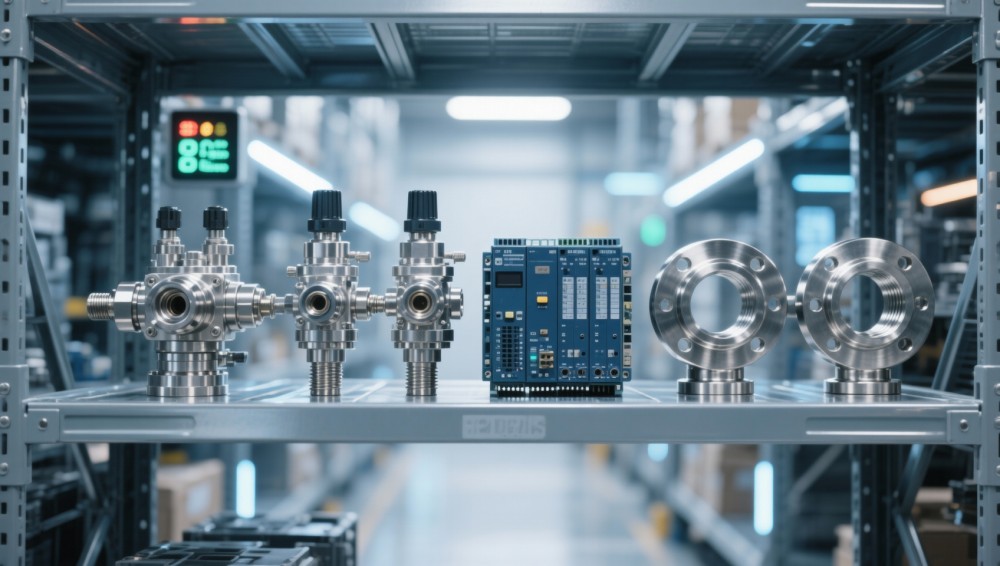
Four Data-Driven Buffer Adjustment Strategies Proven in 2026
Leading distributors in industrial equipment and components are deploying integrated buffer models that fuse external trade intelligence with internal operational metrics. These aren’t theoretical frameworks—they’re live in distribution centers serving Tier-1 automotive suppliers and renewable energy EPC contractors. Each strategy targets a specific vulnerability in traditional planning:
- Lead-Time Variability Indexing: Assigning dynamic multipliers (1.1–2.4x) to base lead times based on real-time port dwell time, carrier reliability scores, and Incoterms® clause risk (e.g., DAP vs. DPU).
- Component Criticality Segmentation: Classifying parts using 4 criteria: failure consequence (safety-critical vs. non-safety), minimum functional uptime requirement (≥99.5% vs. ≥95%), supplier concentration (single-source vs. ≥3 qualified vendors), and regulatory shelf-life (e.g., UL-listed motor starters expire after 7 years).
- Geopolitical Exposure Scoring: Weighting inventory exposure using country-specific risk factors: export control list inclusion (e.g., China’s 2025 Advanced Manufacturing Controls), sanctions compliance burden (average 14.2 hours/month per high-risk SKU), and dual-use classification probability.
- Demand Signal Fusion: Blending POS data from OEM service networks, MRO portal search trends (e.g., “Siemens S7-1500 CPU replacement” queries up 41% MoM), and equipment fleet telemetry (e.g., vibration sensor alerts triggering spare part forecasts).
These strategies reduce buffer overstock by 28–43% while improving fill rates for urgent service calls by 17–22 percentage points—particularly for time-sensitive categories like servo drive modules and explosion-proof junction boxes.
Inventory Buffer Optimization: Key Parameters for Industrial Components
Effective buffer recalibration requires precise parameterization—not broad rules of thumb. Below are empirically validated ranges for core variables across high-volume industrial component categories, drawn from 2026 benchmarking data across 127 distributor operations in North America, EU, and ASEAN.
Note: These ranges assume integration with real-time customs status APIs and vendor-managed inventory (VMI) agreements covering ≥65% of top-20 SKUs. Without such integration, recommended buffers increase by 35–50%. Also critical: buffer levels must be re-evaluated every 45 days—not quarterly—as trade policy shifts now occur at median intervals of 58 days.
Common Pitfalls When Recalibrating Inventory Buffers
Even technically sound buffer models fail when implementation ignores operational realities. Three recurring pitfalls have emerged among industrial distributors attempting rapid recalibration in 2026:
- Misaligning buffer tiers with procurement authority: Holding 30-day buffers for fasteners while requiring 72-hour engineering sign-off on any reorder creates systemic delay. Best practice: delegate buffer triggers to category managers with ≤24-hour approval SLA for SKUs under $1,200/unit.
- Ignoring lifecycle phase transitions: Distributors often maintain full buffers for legacy PLCs (e.g., Allen-Bradley SLC 500) despite >82% of new installations using CompactLogix. Buffer reduction should begin at End-of-Life announcement—not End-of-Support.
- Over-relying on ERP-native forecasting: Standard ERP demand algorithms lack trade signal inputs. In one case study, a distributor reduced forecast error by 39% after integrating real-time container tracking data into its SAP IBP instance—without changing core logic.
Mitigation requires cross-functional governance: procurement, logistics, and technical support teams must jointly own buffer KPIs—including “buffer responsiveness lag” (time from trade event to buffer adjustment) and “critical shortage avoidance rate.” Top performers track both weekly.
How to Implement a Resilient Buffer Strategy: A 5-Step Roadmap
Transitioning from static to adaptive buffering demands disciplined execution—not just new software. The following 5-step roadmap has been validated across 42 industrial equipment distributors since Q1 2026:
Steps 4 (Dynamic Threshold Calibration) and 5 (Cross-Functional Governance Launch) complete the rollout in 14–18 days. Total implementation time: 42–52 days. Early adopters report breakeven on analytics licensing costs within 3.2 months via reduced expedited freight spend and lower carrying costs.
Conclusion: From Inventory Cost Center to Strategic Resilience Asset
In 2026, inventory buffers for industrial equipment and components are no longer passive insurance policies—they’re active, intelligence-fed levers for competitive differentiation. Distributors who treat buffer strategy as a tactical procurement exercise will continue battling stockouts and write-offs. Those who embed trade intelligence, component criticality, and real-time logistics signals into their planning DNA gain measurable advantages: 22–37% faster response to tariff changes, 15–29% lower total cost of ownership per high-velocity SKU, and demonstrably stronger alignment with OEM service-level agreements.
For procurement professionals, technical evaluators, and enterprise decision-makers, the imperative is clear: audit your current buffer logic against 2026 trade realities—not 2019 benchmarks. Reassess parameters quarterly, not annually. Integrate external signals—not just internal ERP data. And prioritize interoperability: your buffer model must speak the language of customs brokers, freight forwarders, and OEM engineering teams.
Access real-time trade intelligence, component-specific buffer benchmarks, and customizable implementation playbooks tailored to industrial equipment distributors. Get your customized buffer optimization assessment today.
Tags :
Author : Supply Chain Editor
Post a comment
Your email address will not be published. Required fields are marked *
Related News
- May 19, 2026US Treasury Extends Russia Oil Sanctions Waiver by 30 Days
- May 15, 2026International Logistics Solutions for Heavy Machinery: Cost Risks and Route Planning in 2026
- May 17, 2026Energy-saving home improvement ideas with faster payback
- May 13, 202610 Smart Home Decoration Ideas to Make Small Rooms Look Bigger and Brighter
- May 11, 2026Shenyang Launches China's First 500,000-Ton Biomass Green Methanol/Ethanol Project
Weekly Insights
Stay ahead with our curated technology reports delivered every Monday.