
Choosing Industrial IoT Solutions for Legacy Machines: A Technical Checklist





The best industrial IoT solutions for legacy machines are not necessarily those with the longest protocol list or the most advanced dashboards. They are the ones that can extract trustworthy data without disrupting machine control, continue collecting during network failures, and deliver usable information to existing systems without making future changes dependent on a single supplier.
A retrofit should therefore pass two tests before platform features influence the decision: can it obtain the signals required for the intended application, and can it do so within the machine’s operating and safety constraints? A gateway that connects successfully but misinterprets production states, overloads an aging controller, or loses timestamps during outages has not solved the underlying problem.
Define the measurement requirement before selecting hardware
“Connect the machine” is not a sufficient specification. Monitoring utilization, calculating energy per part, and detecting bearing deterioration require different signals, sampling rates, and context. Selecting a platform before defining these requirements can produce a technically functional installation that cannot answer the operational question.
For each application, document the signal source, required resolution, acceptable delay, and interpretation rules. A useful requirement identifies both the measurement and the decision it supports:
- Utilization: distinguish running, idle, faulted, and planned downtime; define how brief stops and changeovers are classified.
- Energy per part: align energy readings with valid production counts and specify how rejected parts and batch boundaries affect the calculation.
- Condition monitoring: identify the failure mode, sensor position, measurement bandwidth, and operating conditions needed to interpret changes.
Current draw can indicate that a motor is energized, but it does not independently prove that the machine is producing acceptable parts. Likewise, a controller’s cycle counter may include setup cycles. These distinctions belong in the acceptance criteria, not in a later dashboard customization exercise.
Prove compatibility at the machine interface
A supplier’s statement that it supports Modbus, OPC UA, or an industrial Ethernet protocol is only a starting point. Compatibility depends on the exact controller model, firmware, available interface, communication role, and access permissions. An older controller may require an optional communication module, licensed functionality, or engineering software that is no longer readily available.
Request a compatibility matrix tied to the actual equipment inventory. It should identify the driver version, supported functions, connection limits, known restrictions, and whether acquisition requires changes to the controller program. For register-based interfaces, verify addresses, data types, byte order, scaling, and counter rollover behavior. For serial links, confirm wiring, termination, baud rate, parity, and bus ownership.
Polling frequency must be evaluated against controller capacity. Reading many tags through repeated requests can consume communication resources even when each request is read-only. Check scan-cycle behavior, communication errors, and HMI responsiveness under the proposed acquisition load.
Where an existing serial master already controls communication, adding another active master can create contention. A passive monitoring device may avoid that problem, but it must be electrically suitable and capable of decoding the traffic. “Nonintrusive” should describe a verified implementation, not a product category.
Choose between controller access, external sensing, and a hybrid retrofit
Direct controller access provides machine context: operating mode, alarms, recipe identifiers, and production counters. External sensors can capture physical conditions that the controller does not measure, or provide a path when controller access is unavailable. Neither approach is universally superior.
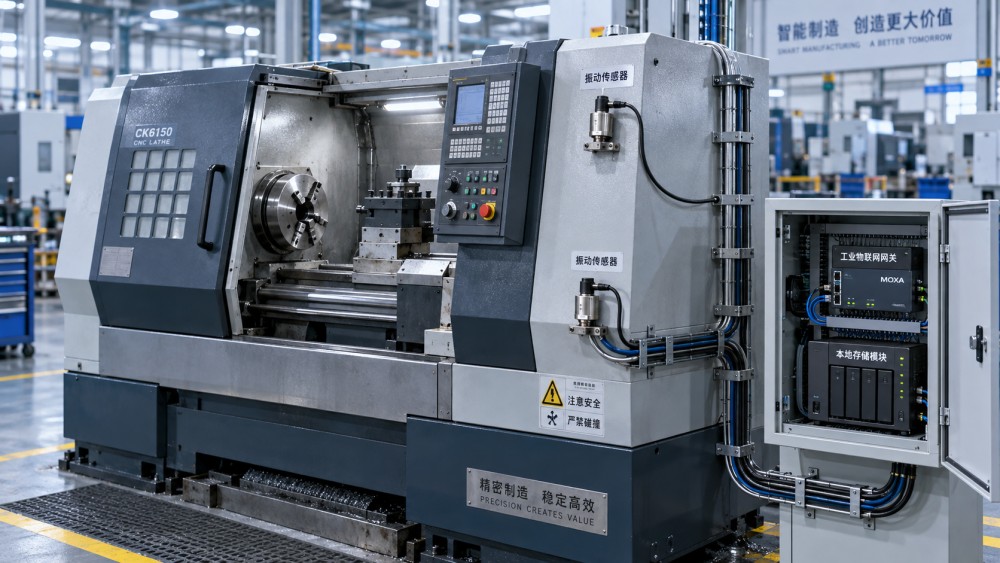
A vibration retrofit, for example, needs an appropriate sensor, mounting method, acquisition bandwidth, and signal processing—not merely a gateway accepting occasional vibration values. If only summary metrics are transmitted, establish whether raw waveforms can be retained for diagnosis and how the summaries are calculated.
Electrical installation also needs scrutiny. Verify input isolation, sensor power, grounding, enclosure suitability, temperature limits, and resistance to the installation’s electrical noise. Modifications to machine wiring should undergo the required engineering and safety review. An IoT gateway must not become an unvalidated component of an emergency-stop or protective control circuit.
A common architecture keeps the monitoring path separate from machine control: controller data and independent sensors feed a local acquisition layer, which sends validated records through a controlled network boundary to storage and business applications. Any proposed command path back to the machine requires a separate risk assessment.
Check data meaning, timing, and quality—not just successful transmission
A connected tag is not necessarily a reliable measurement. Require each important value to carry a defined unit, source identifier, timestamp, and quality status. Missing readings, stale values, disconnected sensors, and controller communication failures must remain distinguishable from genuine zero values.
Ask where timestamps originate. A timestamp assigned when a cloud service receives a message does not identify when the machine event occurred. For stop analysis or correlation across assets, capture time close to the source and establish the achievable synchronization accuracy. NTP may be sufficient for coarse event tracking; tighter coordination may require PTP or another suitable method, with supporting hardware and network configuration.
Sampling and aggregation must match the phenomenon being measured. A brief fault can disappear between slow polls, while averaging can conceal short peaks. Verify whether the system supports event-driven collection, controller-side latching, or counters where polling alone would miss relevant activity.
For derived states, request the actual logic. Thresholds, debounce periods, hysteresis, and reset rules should be visible and version-controlled. Otherwise, two gateways can produce different downtime totals from identical machine behavior, making comparisons unreliable.
Specify what happens when connectivity or power fails
“Offline capable” should mean more than keeping a dashboard open. Establish which collection, processing, alarming, and storage functions remain available when the cloud connection fails—and distinguish that event from losing the gateway’s connection to the machine.
Local buffering needs a measurable retention capacity. Estimate storage from record size, collection frequency, tag count, and the longest outage the design must tolerate, allowing for metadata and filesystem overhead. High-frequency waveform capture requires a different storage calculation from periodic temperature readings.
Request explicit answers on:
- Whether buffered data survives a gateway restart or sudden power loss.
- What happens when storage fills: oldest records overwritten, acquisition stopped, or another documented policy.
- How backlog transfer is throttled so reconnection does not overwhelm the network.
- How duplicate and out-of-order records are handled by downstream systems.
- Whether local rules continue operating without subscription validation or cloud access.
MQTT delivery settings alone do not guarantee an accurate end-to-end historical record. Broker persistence, application acknowledgments, database writes, and deduplication all matter. Test recovery across the complete data path rather than accepting a protocol feature as proof.
Evaluate cybersecurity as an operating capability
Legacy machines should not become directly reachable from the internet simply because a gateway has been installed. Define network zones, permitted communication paths, and administrative access before deployment. An outbound connection can reduce exposure, but it still requires destination restrictions, credential protection, and appropriate monitoring.
Supplier evidence should cover unique device identities, encrypted transport, certificate renewal, role-based access, audit logs, and removal of default credentials. Remote support should be explicitly authorized, time-limited where practicable, and revocable by the site. Confirm whether it creates any path from the supplier’s service infrastructure into the control network.
Patchability is equally important. Ask for supported software versions, security-update procedures, vulnerability notification arrangements, and a stated support period. Signed updates, rollback capability, and recovery procedures help manage changes without turning an unsuccessful update into prolonged loss of monitoring.
IEC 62443 can provide a useful framework for industrial cybersecurity evaluation, but a reference to the standard is not evidence that an entire installation is secure. Check the scope of any claimed certification: the named product, version, assessed requirements, and relevant conditions of use. Component assurance does not replace system-level risk assessment or site configuration controls.
Test integration and exit options with real data
Open protocols reduce some barriers, but they do not eliminate vendor lock-in. A gateway may publish through MQTT while using undocumented payloads, proprietary asset models, or cloud-only processing. Evaluate whether another application can interpret the exported data without the supplier’s software.
Request payload schemas, API documentation, authentication requirements, rate limits, and examples containing timestamps, units, quality flags, and asset identifiers. Verify integration with the intended historian, MES, or other destination using representative records rather than a preconfigured demonstration dashboard.
The data model must also handle operational changes. Machine replacement, tag renaming, firmware upgrades, and reassignment to another production line should not silently break historical comparisons. Determine how configuration versions and asset identities are preserved.
Exit rights need technical and contractual evidence. Confirm ownership and exportability of raw data, derived records, configuration, and relevant metadata. Check bulk-export charges and formats. A CSV download is insufficient if it omits the state definitions or quality information required to interpret the history.
Make the pilot reproduce failure conditions
A pilot should cover the difficult machine interfaces, not only the newest controller with the cleanest documentation. Include representative legacy equipment and operate through startup, production, changeover, downtime, and maintenance states.
Set pass/fail thresholds before testing. Values should follow application needs and machine constraints rather than a universal benchmark.
Failure injection should be planned with operations and performed under controlled conditions. Disconnecting an uplink can test buffering; unsafe interference with control communication is not an acceptable shortcut.
Compare lifecycle cost only after technical gates are passed
Purchase price excludes much of a retrofit’s cost. Include installation downtime, controller licenses, engineering work, sensor calibration, gateway storage, network changes, cybersecurity administration, cloud ingestion, retention, and ongoing support. Examine how charges change with tag count, message frequency, additional sites, and historical exports.
Fleet management deserves a practical test: can configurations be deployed consistently, credentials renewed, failed units replaced, and updates scheduled without visiting every machine? Also verify spare-device availability and the consequences of discontinued hardware or unsupported drivers.
Treat production interference, unacceptable security exposure, unreliable data, and failure to meet outage-retention requirements as disqualifying conditions, not weaknesses that a better dashboard can offset. Among solutions that pass those gates, compare integration effort, maintainability, and lifecycle cost. The strongest choice is the one whose claims remain demonstrable on the installed machines—including during faults, recovery, and eventual migration.
Industries
Related News
- 00
0000-00
US Treasury Extends Russia Oil Sanctions Waiver by 30 Days - 00
0000-00
International Logistics Solutions for Heavy Machinery: Cost Risks and Route Planning in 2026 - 00
0000-00
Energy-saving home improvement ideas with faster payback - 00
0000-00
10 Smart Home Decoration Ideas to Make Small Rooms Look Bigger and Brighter - 00
0000-00
Shenyang Launches China's First 500,000-Ton Biomass Green Methanol/Ethanol Project
Weekly Insights
Stay ahead with our curated technology reports delivered every Monday.