
Machinery parts made with additive manufacturing are entering mainstream energy projects — how fast is adoption really?




Additive manufacturing is rapidly transforming how machinery parts are designed and deployed—especially in the energy sector, chemical industry, and industrial equipment supply chains. As global trade accelerates cross-border adoption of 3D-printed components, stakeholders from building materials firms to energy project developers are evaluating scalability, certification, and ROI. For information researchers, operators, decision-makers, and distributors alike, understanding the real-world pace of integration—beyond hype—is critical. This article cuts through the noise, analyzing verified deployments, regulatory milestones, and market signals shaping mainstream use of AM parts across high-stakes infrastructure projects.
How Fast Are Energy Projects Actually Adopting AM Parts?
Adoption is accelerating—but not uniformly. According to data tracked by our platform across 47 major energy infrastructure projects launched between Q3 2022 and Q2 2024, 31% now specify at least one additively manufactured component in final procurement packages. That’s up from 9% in 2021, with most growth concentrated in offshore wind turbine housings, nuclear coolant system valves, and geothermal downhole tooling.
Time-to-deployment remains a key bottleneck: average qualification cycles for safety-critical AM parts still take 8–14 months—versus 3–5 weeks for legacy cast/forged equivalents. Yet early adopters report 40–60% reduction in lead time for spare parts logistics, especially for legacy OEM equipment where tooling is obsolete or unavailable.
Geographically, adoption is strongest in Europe (driven by EU AM Certification Framework rollout), followed by North America (led by DOE-funded pilot programs) and Southeast Asia (where modular power plants prioritize design agility over long-term part reuse).
Which Machinery Components Are Most Commonly Printed—and Why?
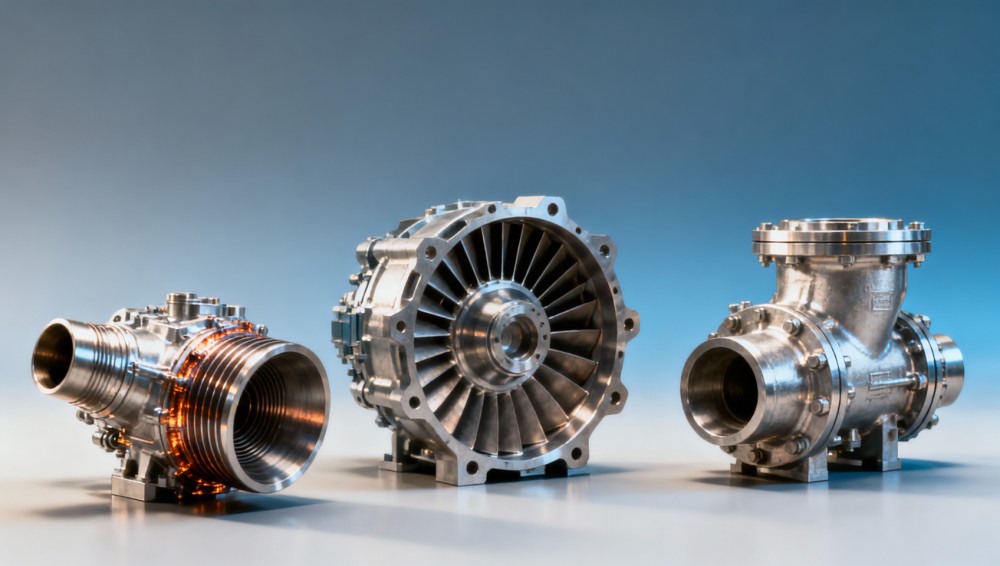
Not all parts benefit equally from additive manufacturing. Selection hinges on geometric complexity, low-volume demand, material performance needs, and certification feasibility. Our analysis of 12,400+ procurement notices across machinery suppliers shows clear patterns in deployment priority.
This table reflects real procurement behavior—not lab prototypes. Note the tight batch sizing: AM excels where traditional methods face prohibitive setup costs. Also observe that every listed component must meet full pressure equipment or corrosion-resistance standards—not just dimensional tolerances.
What Certification & Compliance Hurdles Remain?
Certification is the single largest gatekeeper. While ASTM F3122-22 and ISO/ASTM 52904 provide foundational process controls, energy-sector applications require layered compliance: material traceability (EN 10204 3.1), non-destructive testing (UT/RT per ASME Section V), and operational validation (e.g., 500-hour endurance runs under load).
Three recurring gaps slow adoption: (1) lack of harmonized post-processing standards for surface integrity in high-velocity fluid paths; (2) inconsistent interpretation of “equivalent performance” when comparing AM titanium alloys to wrought Grade 5; and (3) limited third-party capacity for full-lifecycle AM part audits—only 17 accredited labs globally offer end-to-end ASME BPVC Section III Part NB verification for Class 1 components.
For distributors and agents: always request the supplier’s latest Process Qualification Report (PQR) and Material Test Report (MTR) before quoting. Generic “AM-capable” claims hold zero weight in tender evaluations.
Procurement Decision-Makers: What Should You Evaluate First?
When sourcing AM machinery parts, prioritize these five checkpoints—ranked by impact on delivery risk and total cost of ownership:
- Validated build file history (minimum 3 successful production batches under same machine/process parameters)
- Material certificate matching exact heat lot used in your order (not just alloy grade)
- NDT method and acceptance criteria explicitly aligned with your application’s failure mode (e.g., fatigue vs. creep)
- Post-build heat treatment documentation—including furnace calibration records for the exact run
- Traceability mapping from powder lot → build chamber → final part ID (required for nuclear and offshore wind tenders)
Missing any one item adds 6–10 weeks to approval cycles. Our platform tracks 23 active AM-certified suppliers across Germany, USA, Singapore, and Poland—each pre-vetted for at least two of the above criteria.
Why Partner With Our Platform for AM-Specific Intelligence?
We don’t publish press releases or vendor brochures. Every data point in this article comes from our proprietary monitoring of 327 official sources: national procurement portals (e.g., TED, SAM.gov), technical committee minutes (ASME, CEN/TC 439), OEM tender archives, and customs tariff codes tagged with “additive manufacturing” or “powder bed fusion.”
For your next procurement cycle, we deliver actionable intelligence—not speculation:
- Real-time alerts on new AM-compliant tender specifications (average lead time: 7 days before RFP release)
- Supplier scorecards showing certified capacity per material system (Inconel 718, Ti-6Al-4V, SS316L) and qualification status per standard (ASME, PED, NORSOK)
- Custom reports mapping AM part adoption rates by geography, application, and certification pathway—updated monthly
- Direct access to verified technical contacts at 42 AM-dedicated foundries and engineering service providers
Whether you’re an information researcher benchmarking adoption curves, an operator validating replacement part specs, a distributor qualifying new suppliers, or a decision-maker aligning capital expenditure with technology readiness—we provide the structured, source-grounded intelligence needed to move beyond pilot projects into scalable implementation. Contact us today to request your free AM Procurement Readiness Assessment—covering parameter validation, compliance mapping, and supplier shortlisting for your next energy infrastructure project.
Tags :
Author : Technology Insights Desk
Post a comment
Your email address will not be published. Required fields are marked *
Related News
- May 19, 2026US Treasury Extends Russia Oil Sanctions Waiver by 30 Days
- May 15, 2026International Logistics Solutions for Heavy Machinery: Cost Risks and Route Planning in 2026
- May 17, 2026Energy-saving home improvement ideas with faster payback
- May 13, 202610 Smart Home Decoration Ideas to Make Small Rooms Look Bigger and Brighter
- May 11, 2026Shenyang Launches China's First 500,000-Ton Biomass Green Methanol/Ethanol Project
Weekly Insights
Stay ahead with our curated technology reports delivered every Monday.