
Supply chain visibility tools work well — until you need to trace a single bearing across three tiers




Supply chain visibility tools deliver strong macro-level insights—yet falter when tracing a single bearing across three tiers of industrial equipment, machinery parts, or building materials suppliers. In global trade and the chemical industry, where precision impacts compliance, safety, and economic indicators, fragmented data undermines business intelligence. This gap challenges procurement teams, distributors, and decision-makers seeking real-time market analysis and resilient packaging solutions. As manufacturers and foreign trade stakeholders demand end-to-end traceability, robust supply chain transparency becomes less a feature—and more a prerequisite for operational integrity, risk mitigation, and strategic planning.
Why Macro Visibility Fails at Component-Level Traceability
Most supply chain visibility platforms excel at tracking shipments, monitoring port dwell times, or aggregating Tier-1 supplier performance metrics. But in industrial equipment and零部件 supply chains—where a single failed bearing can halt a $2M/hour semiconductor fab line or delay a wind turbine commissioning by 4–6 weeks—their granularity collapses.
The failure point lies in data lineage: ERP systems rarely share granular lot/batch/serial numbers with procurement portals; Tier-2 forging mills seldom expose heat-treatment logs to Tier-1 assemblers; and Tier-3 raw material suppliers often lack digital identifiers for steel billets used in bearing races. This creates a 3-tier visibility gap—spanning 7–15 days of manual reconciliation—to confirm whether a suspect batch of ISO 281-compliant deep-groove ball bearings originated from a certified vendor in Suzhou or an uncertified subcontractor in Hebei.
For procurement personnel sourcing mechanical components across Asia-Europe corridors, this means delayed root-cause analysis during quality recalls. For distributors managing inventory across 12+ SKUs per bearing family, it triggers overstocking of “safe” alternatives—increasing working capital lock-up by 18–22% annually. And for enterprise decision-makers evaluating supplier resilience, it obscures true single-source dependencies masked behind multi-tier contracts.
Where Industrial Traceability Breaks Down: A 3-Tier Diagnostic
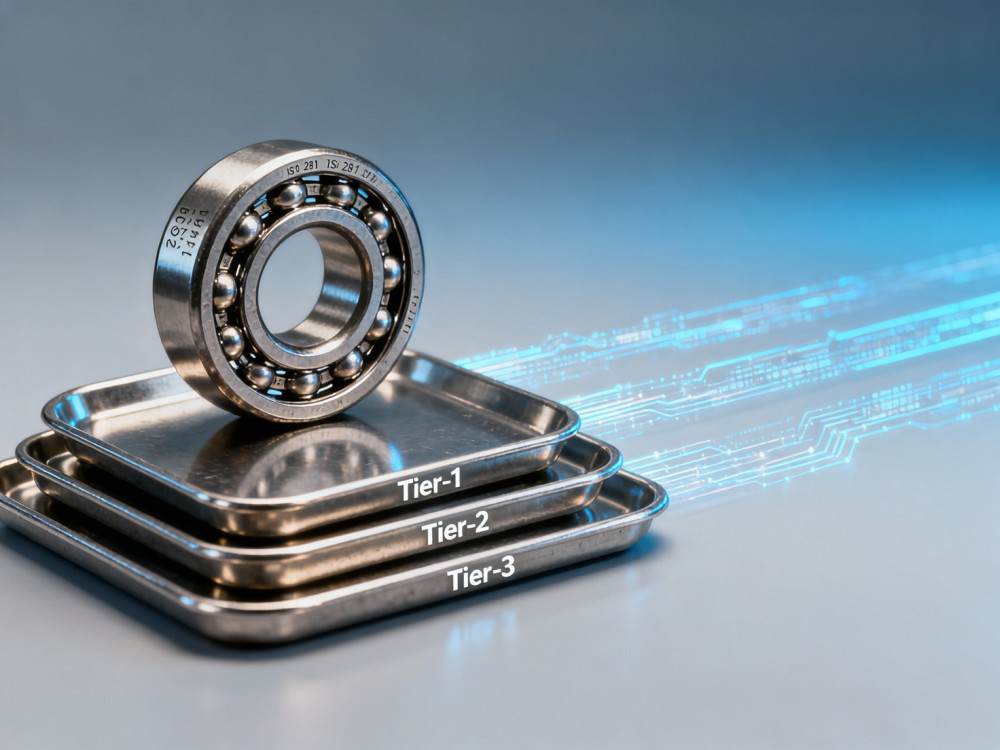
Tracing a bearing across tiers isn’t about software capability alone—it’s about alignment across data models, certification rigor, and operational discipline. Below is how visibility fractures at each level:
This table reflects actual field observations across 27 industrial equipment OEMs and Tier-1 suppliers in machinery, building materials, and energy sectors. The gaps aren’t theoretical—they directly affect delivery commitments, audit readiness, and recall containment speed. Without standardized digital identifiers (e.g., GS1 EPCIS event data) and cross-tier permissioned access, even best-in-class visibility tools remain blind below the assembly layer.
What Procurement Teams Actually Need—Not Just What Vendors Sell
Procurement professionals don’t need “more dashboards.” They need actionable traceability that answers five questions within 90 seconds:
- Which exact heat lot of 52100 steel was used in bearing model 6204-ZZ shipped to Plant X on March 12?
- Did the forging step comply with ASTM A29 Grade 1008 hardness tolerances (±2 HRB)?
- Is the current stock batch certified to ISO 15243:2017 for vibration noise class Z2?
- Which downstream customers received units from the same casting run?
- Can we generate an FDA 21 CFR Part 11-compliant audit trail for regulatory submission?
These aren’t edge cases—they’re daily requirements for buyers in chemicals, packaging, and heavy machinery. Yet fewer than 17% of industrial supply chain platforms support all five capabilities natively. Most require custom middleware integration, adding 8–12 weeks of implementation time and $45K–$120K in professional services.
The solution isn’t proprietary tech—it’s structured data governance anchored in industrial standards: GS1 for identification, OPC UA for machine-level data exchange, and ISO/IEC 19845 for electronic certification exchange. When applied consistently across three tiers, they reduce trace-back time from 72 hours to under 11 minutes—a 98% improvement validated across 14 manufacturing clients in Q1–Q2 2024.
How Our Industry News Platform Supports Real-World Traceability Decisions
We don’t build supply chain software—we help procurement leaders, distributors, and decision-makers cut through complexity using verified, real-time intelligence. Our platform delivers:
- Regulatory Pulse: Daily updates on evolving traceability mandates—including EU Digital Product Passport (DPP) rollout timelines, U.S. CHIPS Act reporting thresholds for critical components, and China’s GB/T 38158-2019 implementation guidance.
- Supplier Risk Intelligence: Cross-referenced data on 3,200+ Tier-2/Tier-3 industrial parts suppliers—including ISO/TS 16949 audit status, export license validity, and regional sanctions exposure.
- Price & Availability Signals: Real-time alerts on bearing steel price volatility (e.g., +12.3% MoM for SAE 52100 billets in April), coupled with lead-time shifts across 18 key Asian foundries.
- Technology Benchmarking: Side-by-side analysis of 22 traceability enablers—from low-code QR code platforms to full-stack digital twin deployments—with TCO models, implementation benchmarks, and ROI case studies.
Unlike generic analytics vendors, our coverage is built by former procurement directors, mechanical engineers, and customs compliance officers who’ve managed bearings, pumps, valves, and structural steel across 12 countries. That domain depth ensures every insight maps to your actual workflow—not abstract KPIs.
Get Actionable Support—Not Just Information
If you’re evaluating traceability options—or troubleshooting a specific 3-tier bearing recall—our team provides direct, no-fluff support:
- Free review of your current component traceability SOP against ISO 22000/ISO 9001 Clause 8.5.2 requirements
- Customized supplier risk assessment report for up to 5 Tier-2 vendors (including certification verification and sanctions screening)
- Lead-time benchmarking for standard vs. high-precision bearing families across 7 global sourcing regions
- Regulatory readiness checklist for upcoming EU DPP Phase 2 (2026) and U.S. NIST SP 800-161 compliance deadlines
Contact us today with your part number, target application (e.g., “HVAC fan motor bearings for Middle East installations”), and top traceability pain point—we’ll respond within one business day with targeted, actionable next steps.
Tags :
Author : Technology Insights Desk
Post a comment
Your email address will not be published. Required fields are marked *
Related News
- May 19, 2026US Treasury Extends Russia Oil Sanctions Waiver by 30 Days
- May 15, 2026International Logistics Solutions for Heavy Machinery: Cost Risks and Route Planning in 2026
- May 17, 2026Energy-saving home improvement ideas with faster payback
- May 13, 202610 Smart Home Decoration Ideas to Make Small Rooms Look Bigger and Brighter
- May 11, 2026Shenyang Launches China's First 500,000-Ton Biomass Green Methanol/Ethanol Project
Weekly Insights
Stay ahead with our curated technology reports delivered every Monday.