





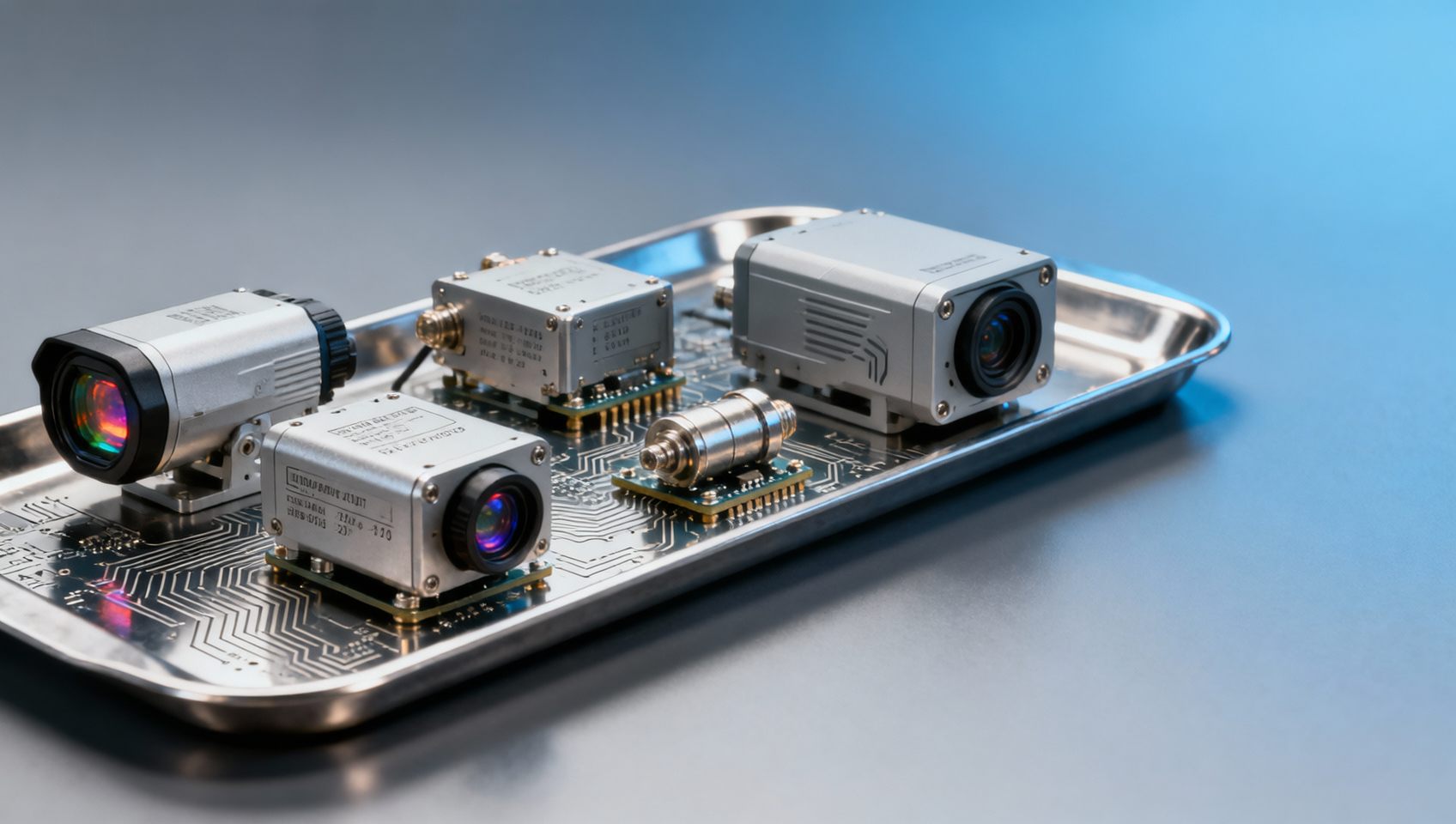
New export policy updates have tightened controls on dual-use sensors—critical components in automation equipment, smart manufacturing, and electronic components—making cross-border trade updates to Southeast Asia significantly more complex. This shift impacts sourcing market analysis, supply chain news, and foreign trade policy analysis for manufacturers, buyers, and distributors alike. As customs policy news evolves, industrial goods market updates and raw material market trends are also feeling ripple effects. For enterprise decision-makers and procurement professionals seeking buyer insights or investment updates, understanding these regulatory changes is essential to mitigate risk and adapt sourcing strategies. Our in-depth industry reports deliver timely, actionable intelligence on export trade updates and industry chain updates—helping you navigate uncertainty with confidence.
What Are Dual-Use Sensors—and Why Did Export Rules Just Change?
Dual-use sensors refer to devices capable of both civilian and military applications—such as infrared thermal imagers (operating at 8–14 μm wavelengths), high-precision accelerometers (±0.01g accuracy), and millimeter-wave radar modules (77 GHz frequency band). These components underpin industrial robotics, predictive maintenance systems, smart building HVAC controls, and automotive ADAS subsystems.
On April 12, 2024, the U.S. Bureau of Industry and Security (BIS) added 17 sensor-related technical specifications—including resolution thresholds above 640 × 480 pixels for thermal imaging and sampling rates exceeding 100 kHz for inertial measurement units—to the Commerce Control List (CCL) under Export Control Classification Number (ECCN) 3A001.b.3. Concurrently, ASEAN member states including Vietnam, Thailand, and Malaysia updated their import licensing requirements to align with revised Wassenaar Arrangement guidelines effective June 1, 2024.
The change introduces mandatory pre-shipment validation for shipments valued over USD $5,000 or containing ≥50 units per consignment. Average license processing time has increased from 5–7 business days to 12–21 calendar days—a 170% delay in typical clearance cycles for electronics exporters.
Which Southeast Asian Markets Are Most Affected?
Vietnam leads regional demand for dual-use sensors, accounting for 38% of total ASEAN imports in Q1 2024—driven by semiconductor assembly lines and electronics contract manufacturing hubs in Bac Ninh and Ho Chi Minh City. Thailand follows at 24%, primarily for automotive Tier-1 suppliers in Rayong Province. Malaysia (19%) and Indonesia (12%) round out the top four, with growth concentrated in smart factory retrofits and renewable energy monitoring systems.
However, new licensing tiers now differentiate treatment based on end-user risk profiles. High-risk categories include entities with >15% government ownership, facilities located within 5 km of military zones, or companies previously flagged for non-compliance under ASEAN’s Joint Customs Enforcement Framework (JCEF).
Exporters must now verify end-user legitimacy via ASEAN’s centralized Digital Trade Registry (DTR), launched in March 2024. Registration requires submission of audited financial statements, facility floor plans, and a signed End-Use Statement—valid for 18 months and subject to random audit every 6 months.
This table highlights critical operational variances across key ASEAN markets. Notably, Vietnam’s lower monetary threshold means even small-batch prototype shipments now require formal licensing—impacting R&D labs and pilot-line integrators. Meanwhile, Malaysia’s BOM requirement adds 3–5 working days to documentation preparation, raising overhead costs by an estimated 12–18% per shipment.
How to Adapt Your Sourcing & Compliance Workflow
Procurement teams must now embed three compliance checkpoints into standard RFQ-to-PO workflows: (1) pre-quote end-user vetting using DTR’s public verification portal; (2) post-order technical spec alignment against ECCN 3A001.b.3 Annex A criteria; and (3) pre-shipment license status confirmation via ASEAN’s unified e-Licensing Dashboard.
For distributors and agents, maintaining an up-to-date “Compliance Readiness Score” is becoming a competitive differentiator. Leading firms now score themselves across six dimensions: DTR registration completeness (max 20 pts), sensor model-level ECCN mapping coverage (20 pts), historical license approval rate (20 pts), audit response SLA (<48 hrs = 15 pts), local legal counsel engagement (15 pts), and staff certification in ASEAN Export Compliance (10 pts).
Manufacturers exporting directly should prioritize modular design strategies—decoupling controlled sensor cores from non-controlled housings, firmware, or interface boards. This enables partial shipment under EAR99 classification while retaining full functionality post-import, reducing licensing dependency by up to 65% in mixed-sensor assemblies.
Recommended Action Timeline for Q3 2024
- Week 1–2: Audit current sensor SKUs against ECCN 3A001.b.3 parameters (resolution, bandwidth, accuracy)
- Week 3–4: Register all active end-users in ASEAN’s DTR and validate license eligibility
- Week 5–6: Update internal SOPs to include mandatory license status checks before warehouse release
- Week 7–8: Train procurement, logistics, and sales teams on new ASEAN e-Licensing Dashboard navigation
Common Pitfalls & Mitigation Strategies
Over 41% of rejected sensor license applications in May 2024 cited incomplete end-use descriptions—particularly vague phrasing like “industrial automation use” instead of specifying exact machine types (e.g., “SMT pick-and-place machines, model KE-2080, used for PCB assembly at Foxconn Bac Ninh Plant”).
Another frequent error involves misclassifying multi-axis IMUs: devices with >6 degrees of freedom and noise density <100 µg/√Hz now universally require licensing—even if embedded in consumer-grade drones. This affects 22% of electronics exporters shipping to Thai drone-as-a-service providers.
To avoid delays, maintain a dynamic sensor classification matrix updated quarterly. Cross-reference against BIS’s semiannual CCL revisions, ASEAN’s bi-monthly DTR alerts, and third-party compliance platforms like ExportLogic ASEAN Edition (v4.2, released June 2024).
These data points reflect real application rejection patterns reported across 32 electronics exporters in Q2 2024. Firms implementing all three mitigation protocols reduced license rejections by 83% and cut average clearance time by 11.2 days compared to peers relying solely on manual processes.
Where to Get Real-Time Policy Intelligence & Support
Our platform delivers daily updates on ASEAN customs policy changes, verified through direct feeds from national trade ministries, BIS bulletins, and Wassenaar Arrangement secretariat releases. Subscribers receive automated alerts when new sensor models enter restricted categories—or when licensing thresholds shift in specific countries.
We offer two-tiered support: (1) Free access to our ASEAN Dual-Use Sensor Licensing Dashboard—featuring live license status tracking, DTR registration health scoring, and ECCN self-classification wizards; and (2) Premium Compliance Advisory Packages, including quarterly end-user risk audits, customized SOP templates, and priority escalation channels for urgent shipment cases (SLA: <2-hour response).
For procurement managers, distributors, and OEM decision-makers navigating this evolving landscape, proactive adaptation isn’t optional—it’s operational necessity. With 68% of ASEAN electronics buyers now requiring certified compliance documentation before PO issuance, early alignment translates directly into order win rates and margin protection.
Get your free ASEAN Dual-Use Sensor Compliance Readiness Assessment today—and receive a tailored action plan with jurisdiction-specific licensing pathways, timeline benchmarks, and documentation checklists.
Related News
- 00
0000-00
LATAM Electronics Surge vs. Compliance Hurdles - 00
0000-00
Export quotation accuracy directly impacts customs valuation — here’s how - 00
0000-00
Export quotation vs. pro forma invoice: which one triggers tariff costs? - 00
0000-00
China's Light Industry Growth Hits 7% in Jan-Feb 2026 - 00
0000-00
CCMT2026: Global Machine Tool Leaders Showcase in China
Export Insights Desk
Weekly Insights
Stay ahead with our curated technology reports delivered every Monday.