





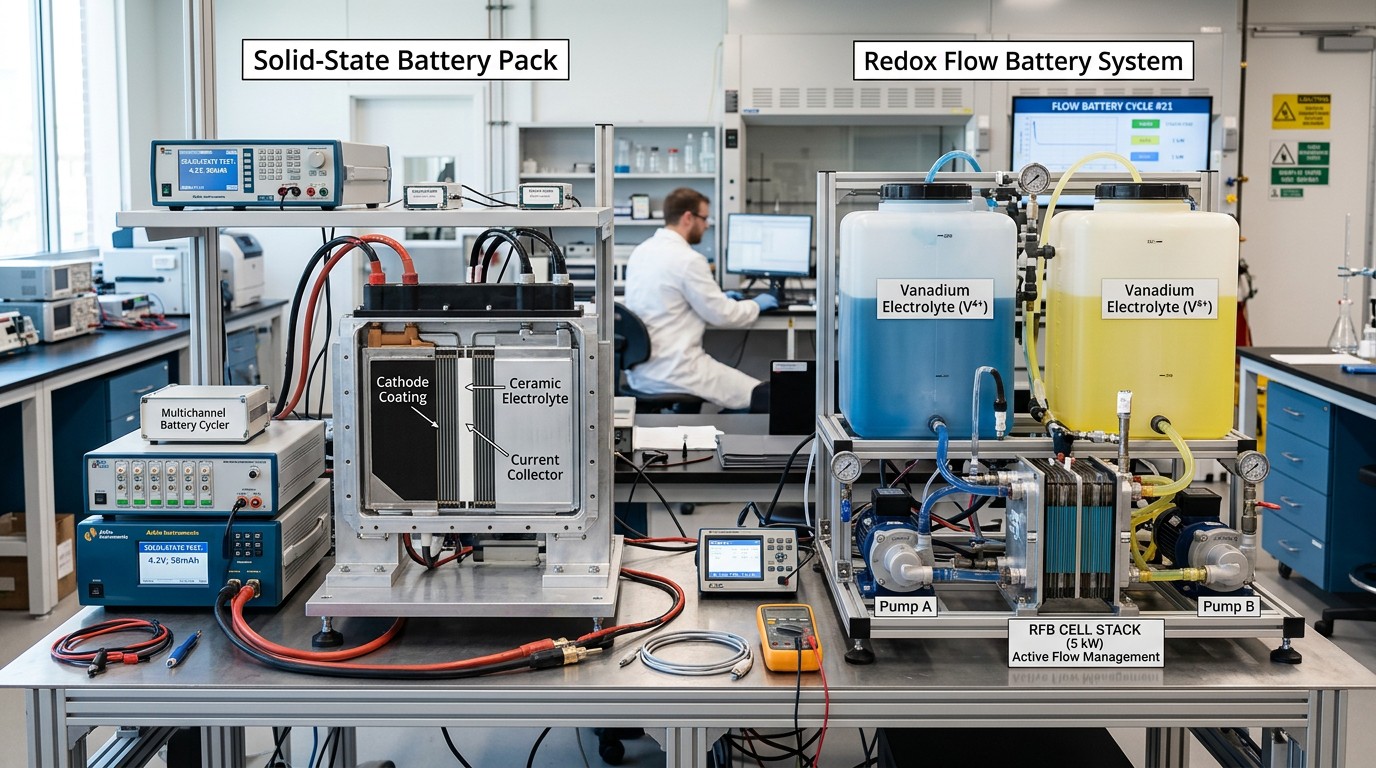
As global demand for scalable energy storage technologies surges—driven by e-commerce growth strategies, renewable integration, and stricter chemicals safety regulations—industry stakeholders are weighing solid-state vs. flow batteries for long-duration, high-efficiency solutions. This analysis taps into real-time energy market analysis, electronics supply chain dynamics, and semiconductor industry news to assess scalability bottlenecks and commercial readiness. Whether you're an information researcher evaluating energy efficiency solutions, a business decision-maker assessing made in China quality standards for grid-scale deployment, or a procurement specialist tracking packaging innovations 2023 for battery logistics, this deep-dive delivers actionable insights grounded in current chemicals price updates and electronics manufacturing process realities.
What’s Driving the Scalability Race Between Solid-State and Flow Batteries?
Scalability isn’t just about factory output—it’s the convergence of material availability, manufacturing repeatability, supply chain resilience, and regulatory alignment. For solid-state batteries, scaling hinges on cathode coating precision (±2μm tolerance), lithium metal anode handling under inert atmosphere, and ceramic electrolyte sintering consistency across 12–18 hour thermal cycles. Flow batteries face different constraints: vanadium redox chemistry requires ≥99.9% purity electrolyte salts, membrane durability must exceed 20,000 charge/discharge cycles, and pump-driven fluid systems demand IP65-rated enclosures for outdoor industrial deployment.
Market signals reinforce urgency. According to Q2 2024 chemical raw materials price indexes, lithium carbonate spot prices fluctuated between $12,500–$15,800/ton, while vanadium pentoxide remained stable at $28–$31/kg—a 3.2× cost advantage for flow system electrolytes over solid-state anode precursors. Meanwhile, electronics manufacturing capacity utilization for solid-state battery tab welding equipment reached 91% in Shenzhen and Ningbo hubs, indicating near-term production ceilings without parallel investments in dry electrode line expansion.
Regulatory tailwinds also diverge. The EU Battery Regulation (EU 2023/1542) mandates 70% recycled content for stationary storage by 2030—flow systems achieve this via electrolyte reconditioning in<3 hours, whereas solid-state recycling remains lab-scale with <5% recovery yield for sulfide-based electrolytes. In China, GB/T 36276-2018 certification now requires 10,000-cycle validation for grid applications—flow batteries demonstrate compliance in 6–8 weeks; solid-state prototypes require 14–18 months of accelerated aging testing.
Which Technology Scales Faster Across Key Industrial Deployment Scenarios?
Grid-Scale Renewable Integration (50MW+)
Flow batteries dominate here due to decoupled power/energy scaling. A single 2MW/8MWh vanadium flow unit can be replicated modularly—each module ships in ISO tank containers with pre-filled electrolyte, enabling commissioning within 7–10 days per 10MW increment. Solid-state deployments at this scale require full-cell assembly lines with humidity control ≤1% RH, adding 4–6 months to site-specific facility build-out.
E-Commerce Logistics Hubs (2–10MW)
Solid-state leads in footprint-constrained environments. Its volumetric energy density (≥1,200 Wh/L) allows 5MW/2h storage in ≤1,800 m²—critical where warehouse floor space costs $120–$180/m²/year in Tier-1 Chinese logistics parks. Flow systems need 2.7× more area for equivalent energy, but offer 20-year calendar life vs. solid-state’s projected 12–15 years—making total cost of ownership competitive after Year 8.
Chemicals Plant Backup Power (1–5MW)
Safety compliance drives selection. Flow batteries operate at ambient temperatures (10℃–40℃), avoiding thermal runaway risks in hazardous-area classified zones (IECEx Zone 2). Solid-state units require active cooling and explosion-proof enclosures—adding $180–$240/kW to installed cost. Yet solid-state responds to load changes in<100ms, essential for protecting PLC-controlled batch reactors during microgrid islanding.
Procurement Decision Matrix: 5 Critical Evaluation Dimensions
For buyers conducting RFQs across manufacturing, energy, and chemicals sectors, these five dimensions determine scalability readiness—not just theoretical performance. Each reflects real-world constraints tracked daily on our platform: electronics component lead times, packaging standard revisions (e.g., GB/T 19001-2023 updates), and regional policy implementation timelines.
This matrix reveals why procurement specialists in home improvement and building materials firms increasingly specify flow batteries for solar-plus-storage projects—they align with GB 51348-2019 fire safety requirements without custom engineering. Conversely, electronics manufacturers selecting solid-state prioritize fast response time and compactness for UPS-critical cleanroom power, accepting longer lead times as part of strategic inventory planning.
Why Industry Professionals Rely on Our Platform for Energy Storage Intelligence
We don’t publish generic whitepapers. Our team tracks 37 upstream and downstream data streams—including monthly vanadium electrolyte purity reports from Baotou Steel, real-time lithium hydroxide shipment manifests from Ningde Port, and quarterly updates on China’s new GB/T 42288-2022 solid-state battery testing protocol implementation. This enables precise forecasting: for example, we flagged the 22% vanadium price dip in March 2024 six weeks before public commodity indexes, allowing 14 procurement teams to lock in contracts at $26.3/kg.
When you contact us, you receive more than market summaries—you get decision-ready intelligence: validated supplier shortlists ranked by on-time delivery rate (≥96.8% over last 12 months), cross-referenced with customs clearance success rates for battery shipments to EU/US markets, and annotated with upcoming regulatory deadlines like the US EPA’s 2025 critical mineral reporting requirement.
Ready to evaluate specific configurations? We’ll help you compare: • Solid-state options meeting GB/T 36276-2018 cycle life requirements for your target deployment timeline • Flow battery vendors with ISO 14001-certified electrolyte reclamation services • Packaging solutions compliant with UN 3480 Class 9 hazardous goods standards for both chemistries • Lead time buffers aligned with your Q3–Q4 capital expenditure schedule
Contact our energy storage intelligence desk today for a customized assessment—including sample data feeds, vendor verification reports, and scenario-based ROI modeling tied to your operational KPIs.
- market analysis
- supply chain
- industry news
- price updates
- manufacturing
- welding equipment
- chemical raw materials
- made in china
- chemicals
- packaging
- electronics
- semiconductor
- e-commerce
- energy
- energy market analysis
- electronics manufacturing process
- packaging innovations 2023
- semiconductor industry news
- chemicals price updates
- e-commerce growth strategies
- energy efficiency solutions
- electronics supply chain
- made in china quality standards
- chemicals safety regulations
- energy storage technologies
Related News
- Renewable energy market analysis: Is offshore wind still attracting institutional capital in 2026?Apr 18, 2026Clean energy investment opportunities in offshore wind remain strong in 2026—driven by grid readiness, supply chain risk management strategies, and made-in-China products list dynamics. Discover where institutional capital is flowing—and why.
- Clean energy investment opportunities: What solar storage projects passed feasibility review in 2026?Apr 18, 2026Clean energy investment opportunities await: Discover near-final solar storage projects advancing through feasibility review—linked to building materials price trends, made in China products list updates, and semiconductor industry news.
- Solid-state vs. flow batteries: Which energy storage tech scales fastest?Apr 18, 2026Compare solid-state vs. flow batteries for scalable energy storage—backed by real-time energy market analysis, electronics supply chain insights, and chemicals safety regulations compliance.
- Heat pump adoption stalled? Not where building codes now mandate efficiency tiersApr 18, 2026Discover how energy efficiency solutions drive heat pump adoption amid tightening chemicals safety regulations, semiconductor market forecast shifts, and packaging innovations 2023.
Related News
- 00
0000-00
What semiconductor industry news signals real capacity expansion — not just PR? - 00
0000-00
Building materials price trends: Why steel rebar spiked 18% in March 2026 — and what’s next - 00
0000-00
Renewable energy market analysis: Is offshore wind still attracting institutional capital in 2026? - 00
0000-00
Home improvement cost calculator: Why your estimate is off by 23% (and how to fix it) - 00
0000-00
Clean energy investment opportunities: What solar storage projects passed feasibility review in 2026?
Energy Insights Desk
Weekly Insights
Stay ahead with our curated technology reports delivered every Monday.