





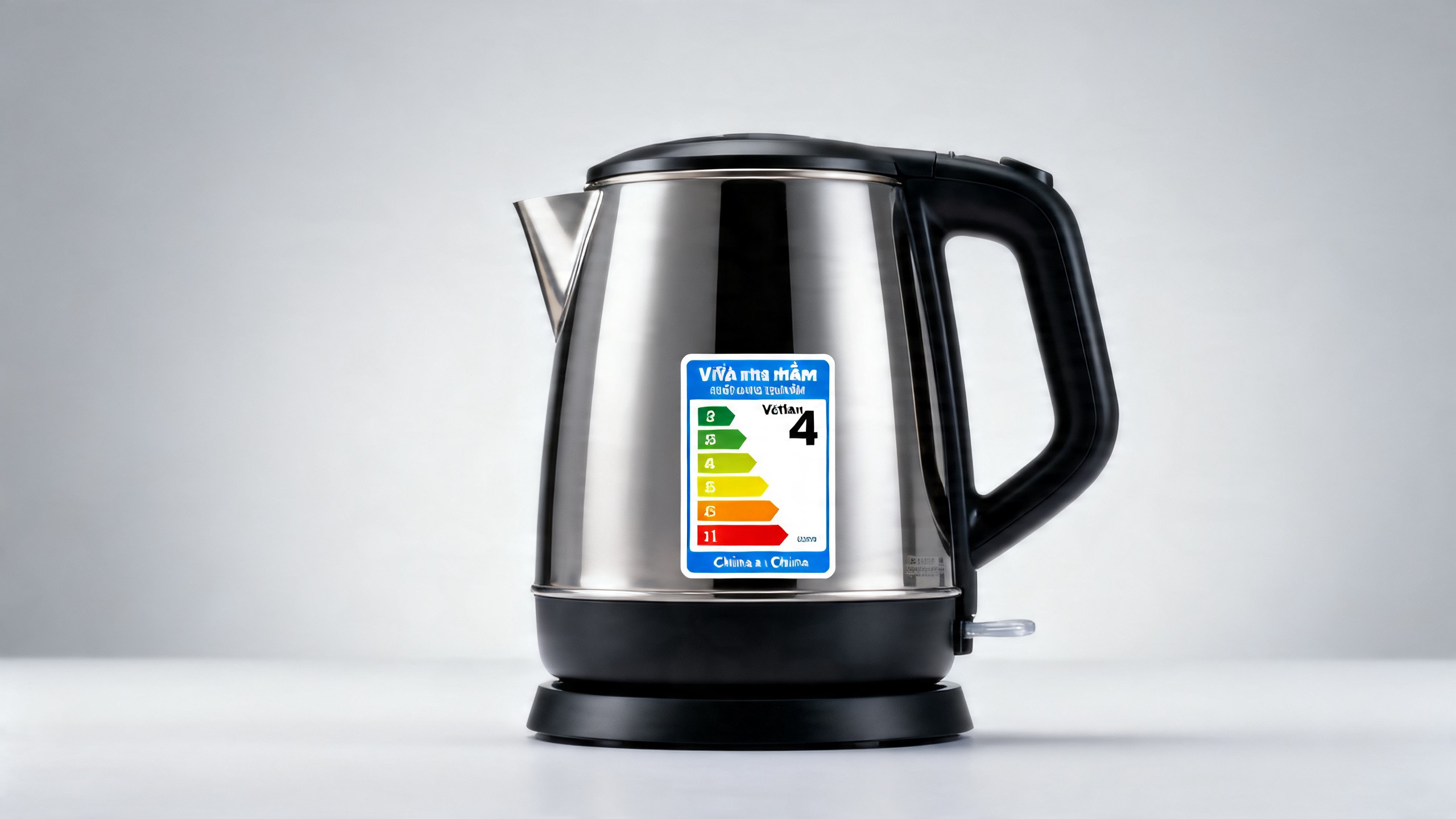
Vietnam’s Ministry of Industry and Trade officially implemented the 2026 Energy Efficiency Labeling Decree for Electrical and Electronic Products on April 15, 2026. This regulation mandates four-tier energy efficiency labeling for small household appliances and lighting equipment sold in Vietnam — triggering urgent compliance actions for over 2,000 Chinese export manufacturers, primarily based in Guangdong and Zhejiang provinces. The 90-day transition period (ending July 15, 2026) means non-compliant products will be barred from customs clearance, making this a critical near-term operational concern for exporters, importers, and supply chain stakeholders serving the Vietnamese market.
Event Overview
On April 15, 2026, Vietnam’s Ministry of Industry and Trade formally enforced the 2026 Energy Efficiency Labeling Decree for Electrical and Electronic Products. The decree requires mandatory application of a four-level energy efficiency label to all small household appliances and lighting equipment placed on the Vietnamese market. A 90-day transition period applies, ending on July 15, 2026. After that date, products without compliant labels will not be permitted to clear Vietnamese customs. The measure directly affects more than 2,000 small appliance exporters from China, especially those located in Guangdong and Zhejiang provinces.
Which Subsectors Are Affected
Direct Export Trading Enterprises
These are companies that ship finished goods from China to Vietnam under their own brand or as OEM/ODM suppliers. They face immediate risk of shipment rejection at Vietnamese ports if labels are missing or misaligned with the new four-tier classification. Impact manifests as delayed deliveries, increased documentation review time, and potential storage or demurrage costs at destination ports.
Manufacturing Enterprises (OEM/ODM Factories)
Factories producing small appliances for export — particularly those without in-house energy testing capacity — must now coordinate third-party verification and label design revisions. Since label content is tied to verified test reports, any delay in obtaining accredited Vietnamese or internationally recognized test results (e.g., IEC 62301, IEC 62612) directly extends lead time for label approval and packaging updates.
Import Distributors & Channel Operators in Vietnam
Local importers and distributors bear legal responsibility for labeling compliance under Vietnamese law. They are required to verify supplier-provided test reports and ensure label placement, format, and language meet local requirements. Non-compliance may result in administrative penalties or product withdrawal from shelves — affecting inventory planning and second-quarter sales forecasts.
Supply Chain Service Providers (Testing Labs, Certification Agents, Logistics Forwarders)
Third-party labs and certification support providers are seeing rising demand for Vietnam-specific energy testing and label registration services. Logistics forwarders handling cross-border shipments must now validate label compliance prior to booking — adding a new checkpoint before container loading. Delays in this verification layer can cascade across the entire shipment schedule.
What Relevant Companies or Practitioners Should Focus On — and How to Respond Now
Verify existing test reports against Vietnamese technical requirements
Not all internationally accepted energy test reports qualify under Vietnam’s decree. Importers and exporters should confirm whether current reports follow standards referenced in the decree (e.g., specific versions of IEC or TCVN standards) and whether testing was conducted by an accredited body recognized by Vietnam’s National Authority on Standards, Metrology and Quality (STAMEQ).
Confirm label design and placement compliance before mass printing
The decree specifies exact dimensions, font size, color contrast, and bilingual (Vietnamese–English) content for the four-tier label. Suppliers must finalize label artwork aligned with these specifications — not just generic energy class indicators — and validate it with local partners or agents before committing to packaging reprints.
Map the full labeling timeline against current production and shipping schedules
Given the July 15, 2026 deadline, companies should audit all open orders scheduled for Vietnam delivery between June and August 2026. Any order confirmed after mid-May 2026 must include verified label-ready units; otherwise, delays or customs hold-ups are likely. Adjust procurement and production planning accordingly.
Assign accountability for label registration within the supply chain
Under Vietnamese law, the importer of record is ultimately liable. However, label data submission often relies on manufacturer-submitted test reports and technical files. Clarify roles early: who submits test data? Who validates label content? Who bears cost and timeline risk if submissions are rejected?
Editorial Perspective / Industry Observation
From an industry perspective, this regulation is less about technical novelty — Vietnam has had energy labeling schemes since 2013 — and more about enforcement rigor and shortened adaptation time. The 90-day window signals a deliberate shift toward stricter market surveillance, rather than merely introducing a new standard. Analysis来看, it reflects Vietnam’s broader policy alignment with ASEAN energy efficiency harmonization efforts, though implementation remains nationally administered. Current more suitable understanding is that this is an operational inflection point — not yet a structural barrier, but one requiring precise coordination across testing, labeling, logistics, and regulatory representation layers. Continued monitoring of STAMEQ’s official guidance updates — especially on accepted test labs and label registration procedures — remains essential through Q2 2026.
This notice underscores how rapidly evolving national energy policies in emerging markets can compress response windows for global exporters. For small appliance supply chains, it highlights the growing importance of embedded regulatory readiness — not just product compliance — as a core component of export competitiveness. Rather than representing a long-term strategic shift, it functions more as a near-term execution test: one where clarity, speed, and cross-border coordination determine whether compliance becomes a routine process or a disruptive bottleneck.
Source: Official Gazette of Vietnam’s Ministry of Industry and Trade (Decree No. [unspecified], effective April 15, 2026); publicly announced transition timeline (July 15, 2026 deadline). Note: Specific technical annexes, lab accreditation lists, and label submission portals remain under active publication — ongoing observation recommended through STAMEQ’s official channels.
Related News
- Gaode Launches First Quadruped Robot for Global Industrial UseApr 15, 2026Gaode's first global quadruped robot for industrial inspection & warehouse logistics—CE/FCC-certified, API-open, multilingual. POC in SEA & ME Q3 2026.
- China to Improve Drug Price Mechanism, Boost API Export StabilityApr 15, 2026China's new drug price mechanism targets API export stability—key for cephalosporins, vitamins & antipyretic-analgesics. Stay ahead of global supply shifts.
- US Naval Restrictions Disrupt Iran Port Access, Reshaping China's Chemical ExportsApr 15, 2026US naval restrictions on Iran's ports disrupt China's chemical exports—caustic soda, soda ash, PVC face delays & 12% freight hikes. Act now to secure supply chains.
- EU PPWR Regulation Effective April 2026: Impact on China's Paper Packaging ExportsApr 15, 2026EU PPWR Regulation impacts China's paper packaging exports from April 2026 — 30% recycled fiber required, PFAS banned. Key for Shandong/Jiangsu manufacturers & global brands.
Related News
- 00
0000-00
Gaode Launches First Quadruped Robot for Global Industrial Use - 00
0000-00
China to Improve Drug Price Mechanism, Boost API Export Stability - 00
0000-00
US Naval Restrictions Disrupt Iran Port Access, Reshaping China's Chemical Exports - 00
0000-00
EU PPWR Regulation Effective April 2026: Impact on China's Paper Packaging Exports - 00
0000-00
Shanghai Port Launches Export Compliance Pre-Inspection Channel
Manufacturing Insights Desk
Weekly Insights
Stay ahead with our curated technology reports delivered every Monday.