





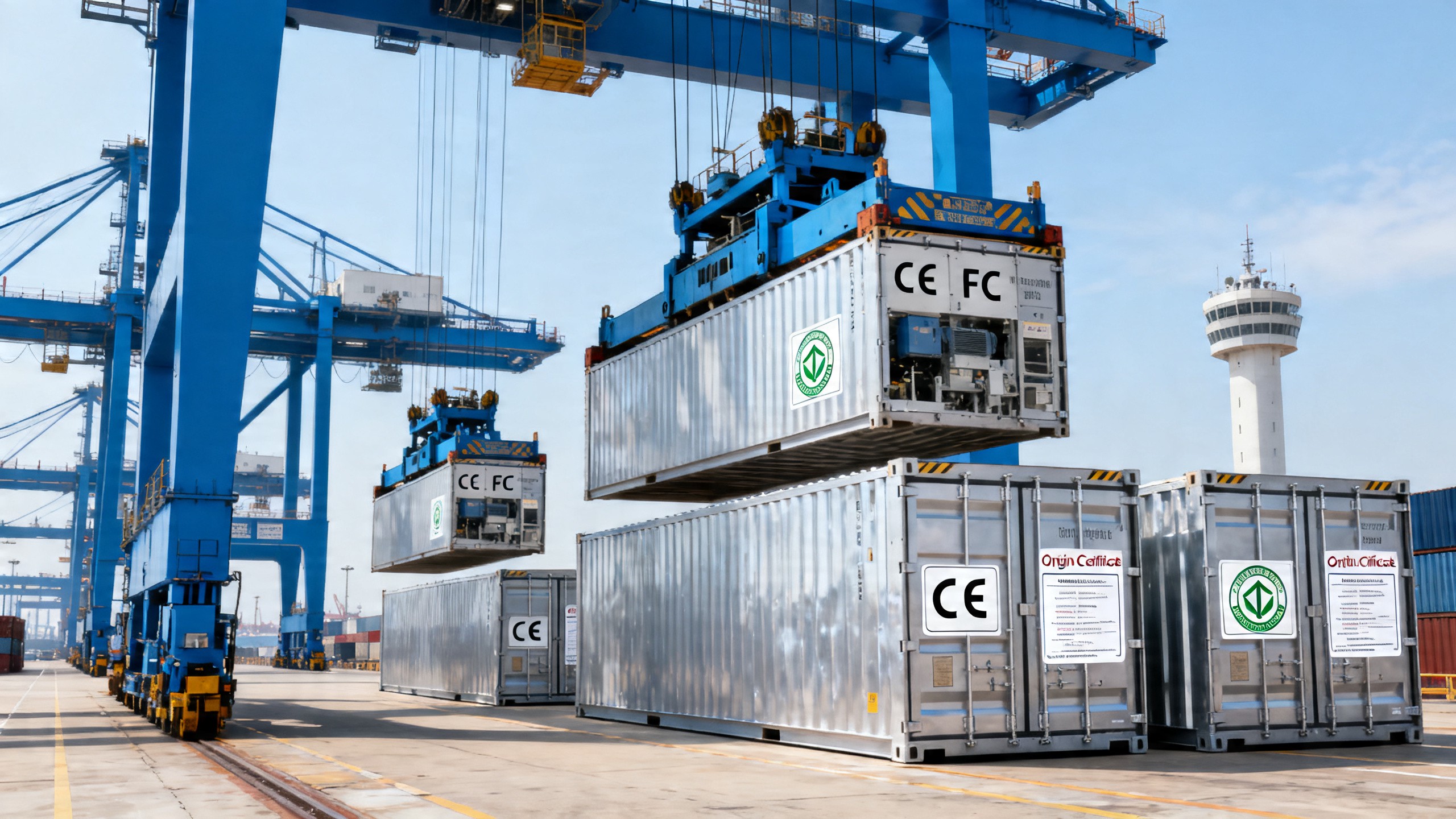
Starting April 1, 2026, Shanghai Port has piloted an ‘Export Compliance Pre-Inspection Channel’ for机电 equipment, construction-grade steel, and prefabricated building components—aiming to shorten average export clearance time by 30%. This initiative directly affects exporters targeting the EU, Middle East, and Australia, where certification compliance (e.g., CE, FCC, origin documentation, hazardous goods declarations) is both stringent and time-sensitive.
Event Overview
Effective April 1, 2026, Shanghai Port began trialing the ‘Export Compliance Pre-Inspection Channel’ for specific export cargo categories: electromechanical equipment, construction steel, and prefabricated structural components. The channel enables advance verification of key regulatory documents—including certificates of origin, CE/FCC conformity certifications, and hazardous goods declarations—before physical shipment. According to official information, this process reduces average customs clearance time for eligible goods by 30%.
Industries Affected by This Initiative
Direct Exporters (Trading Companies)
These enterprises bear primary responsibility for document preparation and regulatory submission. As the pre-inspection channel prioritizes certified, high-value exports, trading firms handling EU-, Middle East-, or Australia-bound electromechanical or engineering construction goods face heightened pressure to ensure documentation accuracy and timeliness—even before cargo arrives at port. Delays in certificate issuance or inconsistencies between declared and verified data may now trigger earlier bottlenecks, not later-stage holds.
Manufacturers (Electromechanical & Building Materials Producers)
For manufacturers supplying certified equipment or structural components, product-level compliance readiness becomes a prerequisite—not just a post-production formality. CE or FCC certification must be finalized and verifiable prior to shipment scheduling; similarly, origin statements must align precisely with production records and supply chain tracing. Incomplete or retroactively issued certifications are unlikely to qualify under the pre-inspection workflow.
Supply Chain & Logistics Service Providers
Freight forwarders and customs brokers engaged in high-compliance export lanes will need to adjust coordination timelines. Document collection, internal compliance checks, and port system submissions must now occur earlier in the order cycle—potentially shifting handoff points from ‘pre-booking’ to ‘pre-manufacturing planning’. Service differentiation will increasingly hinge on ability to manage cross-border certification workflows—not just transport execution.
Key Points for Enterprises and Practitioners to Monitor
Track official scope expansion and eligibility criteria
The current trial covers only three cargo types and specified markets. Enterprises should monitor announcements from Shanghai Customs and the Shanghai International Port Group for updates on expanded commodity coverage, additional certification requirements, or geographic extensions—especially whether GCC, UKCA, or AS/NZS standards will be integrated into future phases.
Validate certification validity and alignment ahead of shipment scheduling
Under the pre-inspection model, discrepancies between declared certifications and official databases (e.g., EU NANDO, FCC ID registry) may result in automatic rejection—not re-submission opportunities. Exporters should confirm that all referenced certificates are active, correctly scoped, and match product descriptions down to model number and manufacturing site.
Distinguish between policy signal and operational readiness
This is a pilot—not a nationwide mandate. While the 30% clearance reduction reflects measured results within the trial cohort, it does not guarantee uniform performance across all terminals, shifts, or filing channels. Enterprises should assess actual throughput and exception rates over Q2 2026 before adjusting long-term logistics SLAs or contract lead times.
Align procurement and production planning with documentation lead times
Certification processes (e.g., CE technical file review, FCC lab testing) often require weeks or months. Manufacturers and exporters should map these durations against planned shipping windows—and build buffer time for document verification cycles under the new channel, rather than treating certification as a final step.
Editorial Perspective / Industry Observation
From an industry perspective, this initiative is better understood as a procedural calibration—not a regulatory relaxation. It shifts compliance verification upstream, rewarding preparedness over reactive correction. Analysis来看, its significance lies less in immediate time savings and more in signaling a broader trend: customs authorities are increasingly treating certification integrity as a precondition for streamlined processing, not a parallel track. Observation来看, the focus on EU/Middle East/Australia markets suggests alignment with external regulatory expectations, not just domestic efficiency goals. Current more appropriate interpretation is that this pilot tests feasibility of integrating third-party certification validation into core customs workflows—a capability that, if scaled, would raise baseline compliance expectations across multiple export sectors.
Shanghai Port’s pre-inspection channel does not lower regulatory thresholds—but reshapes timing, accountability, and preparation requirements for compliant exports. Its value emerges not from speed alone, but from increased predictability for complex, certification-dependent shipments. At this stage, it functions primarily as a readiness filter: identifying gaps earlier, not eliminating them.
Information Sources:
— Official notice issued by Shanghai Customs (April 2026)
— Public announcement by Shanghai International Port (Group) Co., Ltd.
— Pending observation: Formal evaluation report and potential national rollout timeline remain unconfirmed and subject to further official disclosure.
Related News
- PCB assembly moved inland in China — what’s behind the shift from Shenzhen to Chengdu?Apr 17, 2026Explore PCB assembly shift from Shenzhen to Chengdu—impacts on electronics supply chain, energy efficiency solutions, semiconductor market forecast, chemicals safety regulations & made in China quality standards.
- Sheet metal fabricators report rising scrap rates after switching to lower-cost alloysApr 17, 2026Cross border trade & direct factory sourcing face hidden costs: rising scrap rates in sheet metal fabrication due to low-cost alloys—impact FOB price, procurement management, and industrial energy efficiency.
- Metal fabrication shops increasingly reject drawings without GD&T annotationsApr 16, 2026Boost cross border trade success: GD&T-compliant drawings cut delays & costs for metal fabrication, solar panels, architectural glass, and industrial control systems.
- Mold making timelines stretch unpredictably when material certificates arrive lateApr 16, 2026Cross-border trade & direct factory sourcing hit delays when material certificates lag—derailing mold making, FOB/CIF pricing, and B2B e-commerce launches. Act now!
Related News
- 00
0000-00
Red Sea Tensions Lift Asia-Europe Freight Costs 23% Weekly - 00
0000-00
Shanghai Port Launches Export Compliance Pre-Check Channel - 00
0000-00
Vietnam Enforces Bilingual Energy Label for E&E Products from Apr 2026 - 00
0000-00
Indonesia Mandates CNAS Lab Reports for Imported Building Materials from July 2026 - 00
0000-00
USTR Launches Section 301 Review on Chinese Wearables
Manufacturing Insights Desk
Weekly Insights
Stay ahead with our curated technology reports delivered every Monday.