





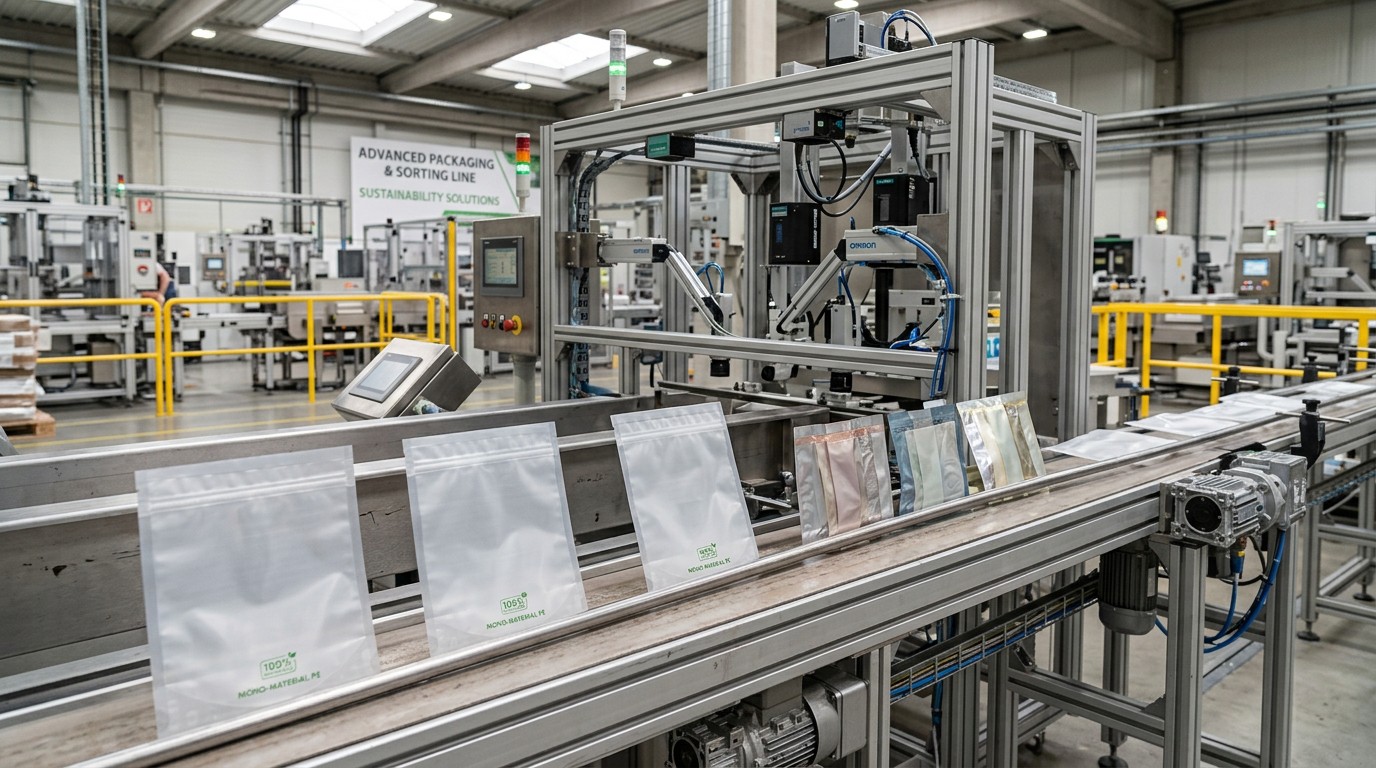
As packaging innovations 2023 accelerate amid tightening chemicals safety regulations and rising demand for electronics recycling methods, mono-material pouches are hailed as a sustainable alternative to traditional laminated films—yet their recyclability claims often crumble in real-world sorting and reprocessing. This breakdown directly impacts electronics supply chain resilience, e-commerce business solutions, and energy efficiency solutions across manufacturing and home decoration trends. With growing scrutiny on made in china quality standards and packaging materials guide compliance, decision-makers need clarity—not marketing hype. We unpack where theory meets infrastructure limits, linking findings to semiconductor market forecast shifts, chemicals price updates, and global e-commerce growth strategies.
Where Do Mono-Material Pouches Actually Get Recycled?
Mono-material pouches—typically polyethylene (PE) or polypropylene (PP) structures—are designed to simplify end-of-life processing by eliminating incompatible polymer layers. In theory, they align with EU Packaging and Packaging Waste Directive (PPWD) targets and China’s GB/T 31268-2023 guidelines for recyclable flexible packaging. But real-world recovery rates tell a different story: only 12–18% of PE-based mono-pouches collected in EU municipal streams reach reprocessing facilities, per the 2023 PREP Alliance audit.
The bottleneck lies not in material chemistry, but in infrastructure readiness. Sorting lines optimized for rigid PET bottles or HDPE containers struggle to identify, separate, and convey thin-film mono-pouches—especially when contaminated with food residue, adhesives, or metallized coatings. Over 60% of European MRFs (Materials Recovery Facilities) lack near-infrared (NIR) sensor calibration for flexible PE films below 50 µm thickness.
For electronics OEMs and e-commerce brands sourcing from China, this gap carries operational risk. A single batch of mono-pouch-packed PCB components rejected at German port customs due to non-compliant recycling labeling can trigger 7–15 days of customs hold, plus €3,200–€8,500 in reprocessing surcharges under Extended Producer Responsibility (EPR) schemes.
Key Infrastructure Gaps Limiting Mono-Pouch Recovery
- Sorting line throughput: Most MRFs process ≤ 3 tons/hour of flexible film—versus 12+ tons/hour for rigid containers.
- NIR detection threshold: Standard sensors misclassify 38% of matte-finish PE pouches as paper or contamination.
- Wash-line compatibility: Only 22% of EU reprocessors accept pouches with ≥5% residual ink coverage (common in electronics anti-static packaging).
- Export restrictions: ASEAN nations now require ISO 14021-compliant recyclability statements—verified via third-party audit, not self-declaration.
Laminated Films: Why “Non-Recyclable” Doesn’t Mean “Non-Managed”
Laminated films—often combining PET/AL/PE or PP/EVOH/PE layers—have long been labeled “non-recyclable” in consumer-facing communications. Yet industrial-scale solutions exist: chemical recycling (e.g., depolymerization of PET layers), aluminum recovery (≥95% yield in dedicated smelters), and mechanical downcycling into composite lumber or insulation boards. The 2023 PlasticsEurope Industrial Recycling Report confirms 41% of post-industrial laminated film waste from electronics assembly lines enters closed-loop reuse channels.
For manufacturers managing multi-tier supply chains, laminated films offer traceable compliance paths. Under China’s “Green Packaging Certification” framework (CQC11-464204-2022), laminated structures with ≥70% recoverable content—and documented downstream partnerships—qualify for preferential export tariffs and priority customs clearance.
Crucially, laminated films maintain barrier integrity critical for electronics: moisture vapor transmission rate (MVTR) stays below 0.5 g/m²·day at 40°C/90% RH over 12 months—whereas mono-PE pouches exceed 3.2 g/m²·day after 6 months under identical conditions, risking component corrosion.
This table underscores a critical insight: recyclability isn’t binary—it’s context-dependent. For high-value electronics shipments, laminated films deliver superior functional performance and clearer regulatory pathways, even if municipal recycling systems aren’t yet equipped to handle them.
How to Evaluate Packaging for Your Specific Supply Chain
Decision-makers must move beyond blanket “recyclable vs. non-recyclable” labels and assess packaging against five operational criteria: (1) destination-market sorting infrastructure maturity, (2) required shelf-life and barrier specs, (3) EPR registration obligations, (4) customs documentation readiness, and (5) supplier verification capacity.
For example, an e-commerce brand shipping lithium battery packs to France must verify that its pouch supplier holds valid UZV (Umweltzeichen Verband) certification—mandatory since Q2 2024 for all flexible packaging entering French retail channels. Meanwhile, a machinery exporter sending hydraulic valve kits to Vietnam needs pouches compliant with TCVN 7223:2022, which permits laminated structures if aluminum recovery is contractually guaranteed.
Procurement teams should request three documents before finalizing any packaging contract: (a) a Material Declaration Form (MDF) aligned with IPC-1752A, (b) proof of downstream reprocessor agreements (not just “we support recycling”), and (c) test reports validating barrier performance under IEC 60068-2-66 humidity cycling protocols.
5 Critical Checks Before Approving Packaging Suppliers
- Confirm NIR-sorting compatibility data—not just “mono-material”—for your target markets’ top 3 MRFs.
- Verify chemical resistance testing against common electronics cleaning solvents (e.g., isopropyl alcohol, flux removers).
- Review EPR fee calculations: laminated films may incur higher initial fees but avoid penalties for mislabeled recyclability claims.
- Check if the supplier maintains dual-certified production lines (e.g., ISO 9001 + ISO 14001) for consistent batch traceability.
- Require samples tested per ASTM D882 (tensile strength) and ASTM F1249 (MVTR) under 40°C/90% RH for 90 days.
Why Choose Our Industry Intelligence Platform for Packaging Decisions?
We don’t sell packaging—we help you navigate its regulatory, technical, and logistical complexity across 12 core industries. Our platform delivers daily updates on chemicals price fluctuations (e.g., PE resin index changes in China’s Dalian Commodity Exchange), real-time policy alerts (like Germany’s new VerpackG enforcement timeline), and verified supplier profiles with audited recycling partnerships.
When evaluating mono-material vs. laminated options, our analysts cross-reference your shipment destinations, product categories, and compliance deadlines to generate prioritized action plans—including recommended certifications, alternative materials with equivalent barrier performance, and verified reprocessor contacts in Europe, Southeast Asia, and North America.
Get started with a free packaging compliance assessment: share your top 3 SKUs, target markets, and current packaging specs. Within 2 business days, receive a customized report covering regulatory exposure, cost implications of switching materials, and step-by-step implementation guidance aligned with your procurement cycle.
- supply chain
- price updates
- manufacturing
- sensors
- cement
- packaging materials
- flexible packaging
- adhesives
- made in china
- machinery
- home decoration
- chemicals
- packaging
- electronics
- semiconductor
- e-commerce
- energy
- e-commerce business solutions
- packaging innovations 2023
- chemicals price updates
- e-commerce growth strategies
- energy efficiency solutions
- electronics supply chain
- packaging materials guide
- home decoration trends
- made in china quality standards
- semiconductor market forecast
- chemicals safety regulations
- electronics recycling methods
Related News
- Mono-material pouches vs. laminated films: Where do recyclability claims break down?Apr 18, 2026Explore packaging innovations 2023, electronics recycling methods, and e-commerce business solutions—debunking recyclability myths in mono-material vs. laminated films.
- Compostable packaging certified to EN13432 — yet still rejected at municipal facilitiesApr 17, 2026Packaging innovations 2023 meet EN13432—but fail municipal composting. Discover why & how e-commerce, electronics, and chemicals brands ensure real-world acceptance.
- Rubber materials vs thermoplastic elastomers: Which delivers better fatigue resistance for logistics packaging?Apr 16, 2026Explore fatigue resistance in rubber materials vs. thermoplastic elastomers for logistics packaging—key insights on coating materials, biodegradable packaging, specialty chemicals & more.
- Logistics packaging durability test: How do recycled plastic resins compare to virgin in drop impact?Apr 16, 2026Explore how recycled plastic resins, coating materials, rubber materials & specialty chemicals perform in logistics packaging drop impact tests—data-driven insights for sustainable, high-performance sourcing.
Related News
- 00
0000-00
Home improvement cost calculator: Why your estimate is off by 23% (and how to fix it) - 00
0000-00
Clean energy investment opportunities: What solar storage projects passed feasibility review in 2026? - 00
0000-00
Chemicals industry trends: Where are specialty polymer prices headed in H1 2026? - 00
0000-00
E-commerce platform comparison: Which one handles cross-border B2B payments most reliably? - 00
0000-00
Why supply chain risk management strategies fail when built on outdated supplier data
Packaging Industry Desk
Weekly Insights
Stay ahead with our curated technology reports delivered every Monday.