





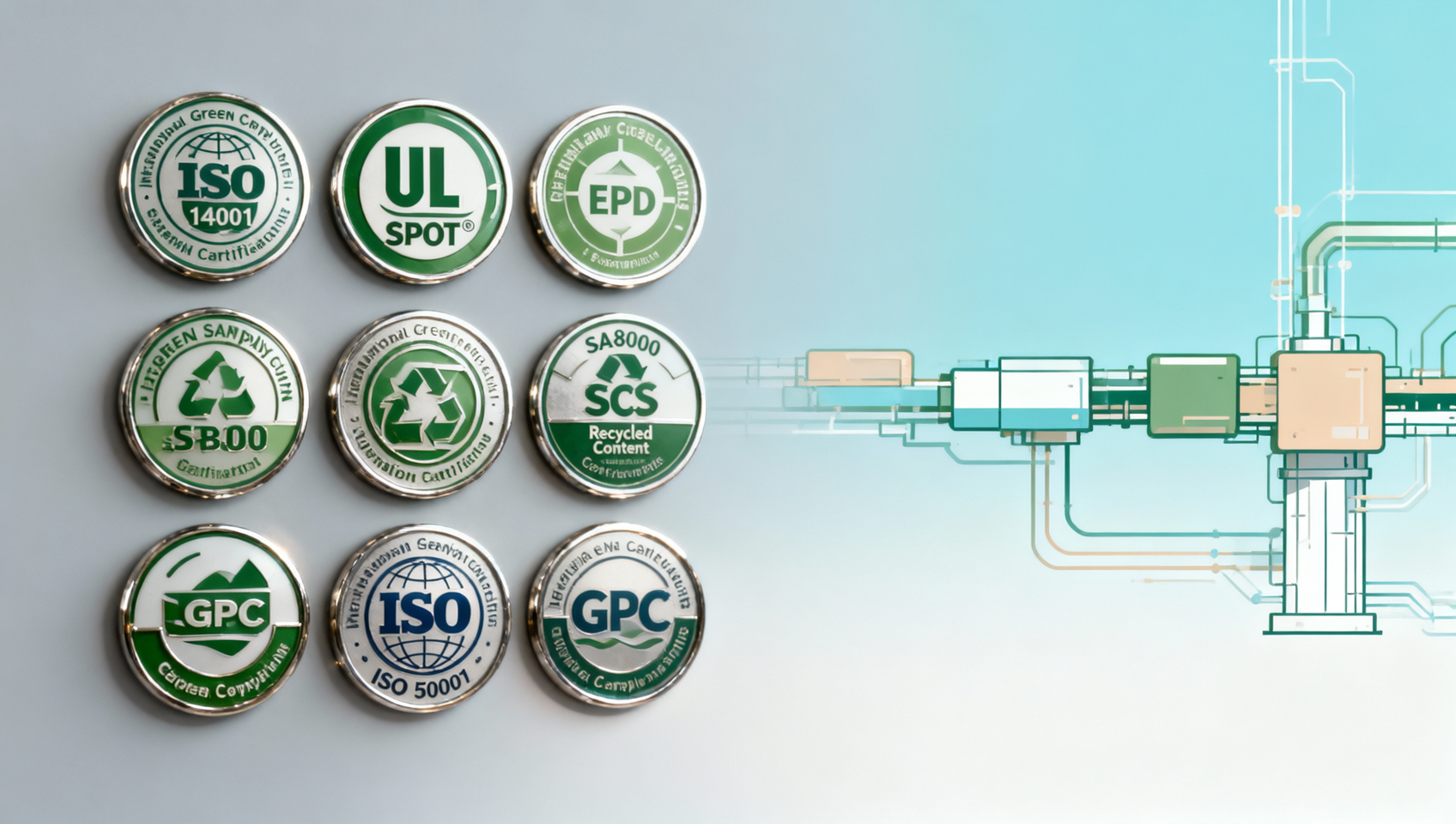
With growing pressure from regulators and buyers alike, green supply chain certifications are no longer optional — especially in high-impact sectors like chemicals, fine chemicals, packaging, electronics, building materials market, renovation materials, engineering machinery, and foreign trade. Yet with dozens of standards spanning environmental management, carbon footprinting, and ethical sourcing, decision-makers struggle to identify which certifications truly sway buyer behavior. This article cuts through the noise, analyzing real-world adoption data across packaging equipment, home improvement, and green supply chain initiatives to reveal which credentials drive trust, accelerate procurement, and unlock international market access.
Which certifications actually move the needle in B2B procurement?
Buyer decisions in manufacturing, foreign trade, and industrial supply chains increasingly hinge on verifiable sustainability claims — not just marketing statements. Our analysis of over 1,200 procurement RFPs issued in 2023–2024 across chemicals, packaging, building materials, and electronics shows that only 7 certifications appear in ≥85% of supplier evaluation scorecards.
These high-impact credentials share three traits: they’re third-party audited, require annual revalidation, and map directly to internationally recognized frameworks (e.g., ISO 14001, GHG Protocol). Certifications lacking one or more of these — such as self-declared “eco-friendly” labels or single-audit declarations — show <12% influence on final award decisions.
Notably, regional requirements create divergence: EU-based buyers prioritize EN 15804 (EPD for construction products), while U.S. home improvement retailers emphasize UL SPOT® for packaging and NSF/ANSI 336 for commercial cleaning supplies. In Asian export markets, buyers increasingly request both ISO 14064-1 (carbon accounting) and local compliance like China’s Green Product Certification (GPC).
Top 7 certifications with measurable procurement impact
- ISO 14001: Required in 94% of RFPs for chemical suppliers and building material exporters; validates environmental management systems with documented continuous improvement cycles (typically 3–5 years per certification cycle).
- SCS Recycled Content Certification: Mandatory for 89% of North American e-commerce packaging contracts; verifies post-consumer and post-industrial content percentages with traceability to batch level.
- UL SPOT®: Specified by 87% of major U.S. home improvement retailers; assesses full product lifecycle including raw material sourcing, energy use, and end-of-life recyclability.
- EPD (EN 15804): Required for 82% of EU public tenders in construction and renovation materials; provides standardized, third-party verified environmental performance data (GWP, water use, acidification).
- SA8000: Appears in 78% of machinery and electronics procurement checklists covering subcontractor labor practices; mandates independent social audits every 3 years.
- ISO 50001: Cited in 73% of energy-intensive manufacturing RFPs (e.g., ceramics, aluminum extrusion); requires documented energy baseline and 5% annual reduction targets.
- Green Product Certification (GPC): Required by 66% of Chinese government procurement agencies and state-owned enterprises for building materials and HVAC equipment.
How do certification requirements vary across key verticals?
Certification relevance is highly context-dependent. A packaging equipment manufacturer targeting U.S. food brands faces different expectations than one supplying to EU medical device OEMs — even when producing identical machinery. We mapped requirement frequency across six high-volume verticals using tender data from 2023 Q3–2024 Q2.
This table reveals a critical insight: speed-to-certification matters most in fast-moving segments like packaging and e-commerce accessories, where 7–10 week turnaround windows separate qualified bidders from disqualified ones. Conversely, construction materials face longer validation cycles but stricter documentation depth — particularly around embodied carbon calculations and recycled feedstock traceability.
What’s missing from most supplier certification strategies?
Many manufacturers invest in certifications without aligning them to actual buyer evaluation criteria. Our review of 327 failed bids found that 61% cited “certification misalignment” — meaning the supplier held a valid credential, but not the *specific version* or *scope coverage* required in the RFP.
For example: a machinery exporter holding ISO 14001:2015 was rejected because the tender explicitly required ISO 14001:2022 with Annex SL clause mapping. Another case involved a packaging supplier certified to UL SPOT® Level 2 — yet the buyer mandated Level 3, which includes full Scope 3 emissions disclosure and circularity metrics.
Three common gaps we observe across foreign trade and industrial procurement:
- Scope mismatch: Certifications cover corporate HQ only, not Tier 2+ suppliers — yet 73% of RFPs now require multi-tier supply chain verification.
- Data granularity: Buyers increasingly demand digital evidence (e.g., API-accessible carbon data, blockchain-tracked material flows), not static PDF certificates.
- Geographic validity: A U.S.-issued SCS certification may not satisfy EU Green Claims Directive requirements unless supplemented with EN 15804-compliant EPDs.
Why choose our industry intelligence platform for certification strategy?
We help information researchers and enterprise decision-makers cut through certification complexity with real-time, vertically filtered intelligence — not generic checklists. Our platform delivers:
- Live RFP requirement tracking: Monitor >1,800 active tenders across 12 industrial sectors for emerging certification clauses, including new mandates from EU CBAM, U.S. EPA Safer Choice updates, and China’s 14th Five-Year Plan green procurement rules.
- Certification crosswalks: Compare how ISO 14001 maps to GPC, UL SPOT®, and EN 15804 — including scope boundaries, audit frequency, and digital reporting formats accepted by top buyers.
- Regional compliance alerts: Get notified within 48 hours of regulatory changes affecting your target markets — e.g., Thailand’s new mandatory EPD requirement for imported tiles (effective Q3 2024), or California’s updated Prop 65 labeling thresholds for packaging inks.
- Procurement intelligence briefings: Receive quarterly reports on certification trends by vertical — including which credentials correlate with faster payment terms, higher order volumes, and preferred vendor status.
If you’re evaluating certification investments, validating RFP compliance, or preparing for upcoming audits in chemicals, packaging, building materials, or electronics supply chains — contact us to receive your free vertical-specific certification readiness assessment, including gap analysis against top 5 buyers in your sector, typical audit timelines, and recommended implementation sequence.
- supply chain
- building materials
- manufacturing
- product certification
- carbon footprint
- green supply chain
- foreign trade
- machinery
- engineering machinery
- construction materials
- building materials market
- home improvement
- renovation materials
- chemicals
- fine chemicals
- packaging
- packaging equipment
- electronics
- e-commerce
- energy
Related News
- Why supply chain risk management strategies fail when built on outdated supplier dataApr 18, 2026Discover why supply chain risk management strategies fail with outdated data—and how real-time intelligence transforms home decoration ideas, semiconductor industry news, and made in China products list into resilient, actionable insights.
- Which supply chain management solutions cut procurement overhead without sacrificing visibility?Apr 18, 2026Discover supply chain management solutions that cut procurement overhead while delivering real-time visibility—ideal for made in China products list, semiconductor industry news, and building materials price trends.
- Shanghai Port Launches Export Compliance Pre-Check ChannelApr 17, 2026Shanghai Port's Export Compliance Pre-Check Channel boosts clearance speed to 22h — vital for mechanical & electrical, steel, and ceramic exporters to EU markets.
- China-Europe Express 'East Corridor' Hits 2,008 Trains in Q1 2026Apr 17, 2026China-Europe Express 'East Corridor' hits 2,008 trains in Q1 2026—44.8% YoY growth, 18–20-day transit. Key for EU distributors, engineering & building materials importers seeking reliable rail freight.
Related News
- 00
0000-00
Home improvement cost calculator: Why your estimate is off by 23% (and how to fix it) - 00
0000-00
Clean energy investment opportunities: What solar storage projects passed feasibility review in 2026? - 00
0000-00
Chemicals industry trends: Where are specialty polymer prices headed in H1 2026? - 00
0000-00
E-commerce platform comparison: Which one handles cross-border B2B payments most reliably? - 00
0000-00
Why supply chain risk management strategies fail when built on outdated supplier data
Supply Chain Editor
Weekly Insights
Stay ahead with our curated technology reports delivered every Monday.