





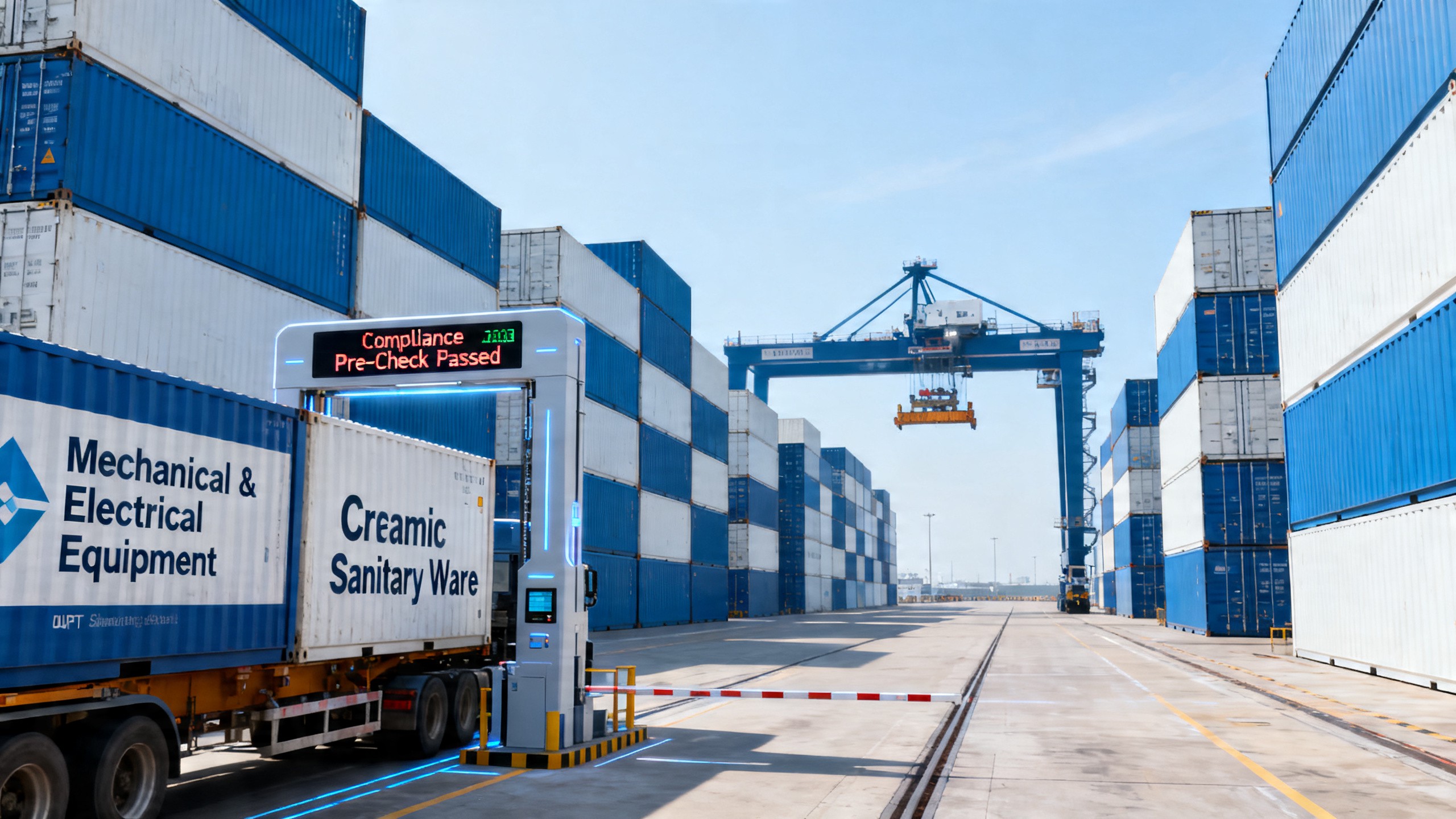
Effective April 1, 2026, Shanghai Customs has fully rolled out the ‘Export Compliance Pre-Check Channel’ across Yangshan and Waigaoqiao ports — a development with direct implications for exporters of mechanical & electrical equipment, construction steel, ceramic sanitary ware, and 9 other key export categories. This initiative signals a measurable shift in customs efficiency and supply chain predictability for industrial goods exporters serving European markets.
Event Overview
Following a successful pilot phase, Shanghai Customs officially launched the ‘Export Compliance Pre-Check Channel’ on April 1, 2026, at Yangshan and Waigaoqiao ports. The channel covers 12 priority export commodity categories, including mechanical and electrical equipment, construction steel, and ceramic sanitary ware. It integrates pre-submission document review, risk-based deployment, and intelligent gate system coordination. As a result, average export clearance time has decreased from 72 hours to within 22 hours, and inspection rates have fallen by 35%. The mechanism is now referenced in procurement SLAs by multiple German and Dutch industrial importers as a core KPI for supplier delivery reliability.
Industries Affected
Direct Export Trading Enterprises
These enterprises handle end-to-end export documentation, customs declarations, and logistics coordination. They are directly impacted because the pre-check channel shifts compliance verification upstream — requiring earlier submission of accurate, audit-ready documentation. Delays or inconsistencies in pre-submitted data now trigger earlier intervention, affecting shipment scheduling and carrier booking windows.
Manufacturing Enterprises (OEM/ODM)
For manufacturers supplying机电 (mechanical & electrical) or building materials, the shortened clearance window tightens the link between production completion, packaging, labeling, and customs readiness. A 22-hour average clearance means minimal buffer remains between factory dispatch and port release — increasing dependency on synchronized internal quality control and documentation handover protocols.
Supply Chain Service Providers (Freight Forwarders, Customs Brokers)
Service providers must adapt operational workflows to support pre-submission validation, not just post-submission correction. Their role evolves toward proactive compliance assurance: verifying HS code accuracy, origin documentation, and technical conformity statements prior to declaration — rather than reacting to customs queries after submission.
What Relevant Enterprises or Practitioners Should Focus On
Monitor official implementation guidance from Shanghai Customs
The current rollout covers two major ports and 12 product categories — but no public timeline or scope details have been released for expansion to other ports or additional commodities. Enterprises should track updates via Shanghai Customs’ official notices and verify whether their specific HS codes fall within the defined coverage list.
Validate alignment between commercial contracts and SLA commitments
Since German and Dutch importers now embed this channel’s performance into procurement SLAs, exporters should cross-check contractual delivery terms (e.g., ‘port departure’ vs. ‘customs release’) and ensure internal lead-time calculations reflect the new 22-hour benchmark — not legacy 72-hour assumptions.
Distinguish policy rollout from operational readiness
The 22-hour average reflects aggregate performance under optimal conditions. Individual shipments may still face extended processing due to classification disputes, certificate mismatches, or ad hoc inspections. Enterprises should treat the published average as a system-level indicator — not a guaranteed service level for every consignment.
Prepare documentation workflows for pre-submission validation
Businesses exporting covered commodities should formalize internal checkpoints for commercial invoice accuracy, packing list consistency, and regulatory certificate validity (e.g., CCC marks for certain机电 products) at least 48 hours before container gate-in — aligning with the pre-check channel’s operational rhythm.
Editorial Observation / Industry Perspective
From an industry perspective, this initiative is better understood as an operational calibration — not a regulatory overhaul. It leverages existing legal frameworks and infrastructure but reorders timing and responsibility: compliance assurance moves from a reactive checkpoint to a coordinated, pre-declaration phase. Analysis来看, its significance lies less in novelty and more in institutionalization: when foreign buyers begin codifying Chinese port performance into binding SLAs, it signals market-driven adoption — not just administrative optimization. Current observation suggests this is both a signal of growing buyer-side scrutiny of China’s export execution discipline and an early indicator of how trade facilitation tools may increasingly shape commercial negotiations beyond tariff or logistics cost considerations.
This is not yet a nationwide standard — nor does it replace risk-based inspection for sensitive or high-value cargo. But it marks a tangible step toward predictable, data-informed export clearance for mid-to-high volume industrial goods. Industry stakeholders should view it as a reference point for benchmarking internal process maturity — especially where European industrial buyers are involved.
Conclusion
The full-scale launch of Shanghai Port’s Export Compliance Pre-Check Channel represents a concrete improvement in export clearance efficiency for specific industrial sectors — but its broader value lies in how it reshapes expectations around documentation rigor, timing discipline, and cross-border contractual accountability. It is best understood not as a one-time policy change, but as an evolving operational benchmark that reflects tightening integration between Chinese port infrastructure and international industrial procurement standards.
Source Attribution
Main source: Official announcement by Shanghai Customs, effective April 1, 2026. Scope limited to Yangshan and Waigaoqiao ports; coverage confirmed for 12 commodity categories including mechanical & electrical equipment, construction steel, and ceramic sanitary ware. SLA integration noted for select German and Dutch industrial importers — no further details on participating firms or contractual terms are publicly available. Ongoing monitoring is advised for potential expansion to other ports or product categories.
Related News
- Shanghai Port Launches Export Compliance Pre-Check ChannelApr 17, 2026Shanghai Port's Export Compliance Pre-Check Channel boosts clearance speed to 22h — vital for mechanical & electrical, steel, and ceramic exporters to EU markets.
- China-Europe Express 'East Corridor' Hits 2,008 Trains in Q1 2026Apr 17, 2026China-Europe Express 'East Corridor' hits 2,008 trains in Q1 2026—44.8% YoY growth, 18–20-day transit. Key for EU distributors, engineering & building materials importers seeking reliable rail freight.
- Red Sea Tensions Lift Asia-Europe Freight Costs 23% WeeklyApr 16, 2026Red Sea tensions spike Asia-Europe freight costs 23% weekly—impacting exporters, importers & supply chains. Key insights & mitigation strategies inside.
- Shanghai Port Launches Full Rollout of Export Compliance Pre-Inspection ChannelApr 16, 2026Shanghai Port's Export Compliance Pre-Inspection Channel now live—cut customs clearance to 22 hours for electromechanical & building materials exporters. Boost predictability, slash demurrage risk, and optimize EPC logistics today.
Related News
- 00
0000-00
Red Sea Tensions Lift Asia-Europe Freight Costs 23% Weekly - 00
0000-00
Shanghai Port Launches Export Compliance Pre-Check Channel - 00
0000-00
Vietnam Enforces Bilingual Energy Label for E&E Products from Apr 2026 - 00
0000-00
Indonesia Mandates CNAS Lab Reports for Imported Building Materials from July 2026 - 00
0000-00
USTR Launches Section 301 Review on Chinese Wearables
Supply Chain Editor
Weekly Insights
Stay ahead with our curated technology reports delivered every Monday.