





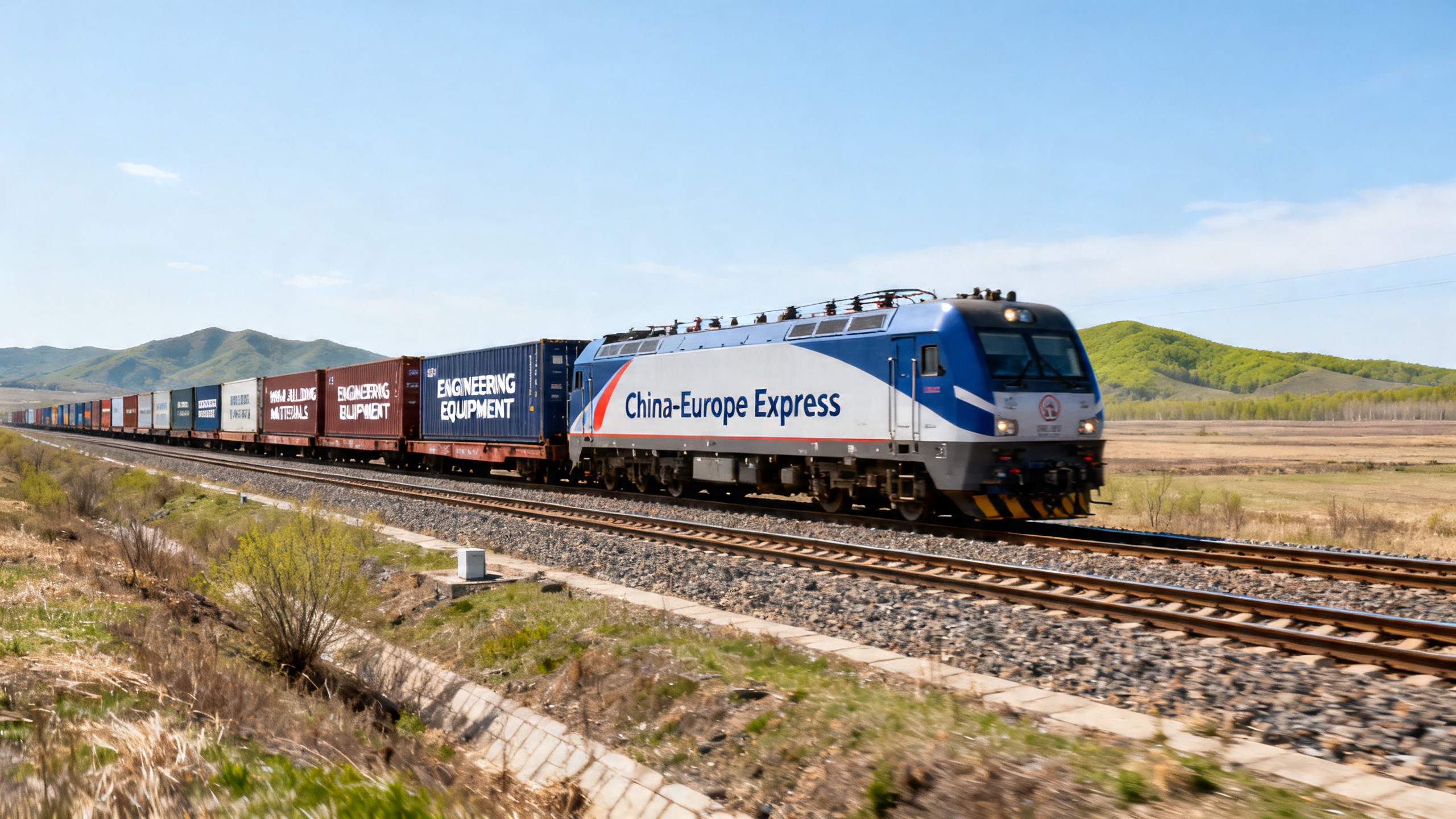
As of April 13, 2026, the China-Europe Express ‘East Corridor’—comprising the Manzhouli and Suifenhe border crossings—has operated 2,008 trains in the first quarter, carrying 200,800 TEUs, a 44.8% year-on-year increase. This acceleration signals growing reliability for land-based Eurasian freight, particularly for European distributors, engineering equipment importers, and home & building materials channel operators who prioritize delivery certainty.
Event Overview
According to publicly reported data released on April 13, 2026, the cumulative number of China-Europe Express trains operating via the East Corridor (Manzhouli and Suifenhe) reached 2,008 in Q1 2026. Total container volume amounted to 200,800 TEUs. The growth rate stood at 44.8% compared with the same period in 2025. The average transit time for the Harbin–Duisburg route stabilized at 18–20 days—12–15 days faster than Red Sea rerouted maritime shipping.
Industries Affected by This Development
European Distribution Companies
These firms rely on predictable replenishment cycles to maintain shelf availability and avoid stockouts. The improved schedule stability of the East Corridor directly reduces planning uncertainty. Impact manifests in lower safety stock requirements, reduced buffer time in demand forecasting models, and more responsive restocking from Chinese suppliers.
Engineering Equipment Importers
Importers handling large-scale machinery or project-critical components face high penalties for delays. With maritime alternatives increasingly vulnerable to geopolitical and climatic disruptions, the 18–20 day rail window offers a higher-certainty alternative for time-bound deployments. Impact includes revised lead-time assumptions in procurement contracts and potential rebalancing of multimodal routing strategies.
Home & Building Materials Channel Operators
These businesses often manage fragmented, seasonally sensitive inventories across multiple regional warehouses. The corridor’s throughput expansion supports more frequent, smaller-batch shipments—enabling just-in-time replenishment for regional showrooms or contractor hubs. Impact is seen in logistics cost modeling, warehouse slotting logic, and promotional campaign timing aligned to inbound rail schedules.
What Relevant Enterprises or Practitioners Should Monitor and Do Now
Track official updates on capacity allocation and seasonal clearance protocols
The 44.8% growth reflects both demand surge and infrastructure upgrades. Stakeholders should monitor announcements from China State Railway Group and local customs authorities regarding quota adjustments, peak-season documentation priorities, and pre-clearance pilot expansions—especially ahead of Q3/Q4 order surges.
Assess category-level suitability for rail shift—not just origin-destination pairs
Not all cargo types benefit equally. High-value, low-volume, or temperature-sensitive goods may still favor air or sea. Focus assessment on medium-weight, standard-containerized items with stable demand profiles—e.g., assembled furniture components, HVAC units, or prefabricated bathroom modules—where the 18–20 day window delivers measurable working-capital and inventory-turn advantages.
Distinguish between policy intent and operational readiness
While throughput numbers are confirmed, real-world consistency depends on cross-border coordination (e.g., Russian rail handover efficiency, EU customs pre-notification compliance). Verify actual on-time departure/arrival rates over the past 60 days—not just quarterly totals—before adjusting long-term procurement commitments.
Update contingency planning to reflect dual-path feasibility
Rather than full substitution, treat the East Corridor as a calibrated backup: allocate 15–30% of key SKUs to rail while retaining ocean as primary for bulk, non-urgent lines. This requires revising internal SLA definitions, updating ERP shipment routing rules, and aligning with forwarders on hybrid booking workflows.
Editorial Perspective / Industry Observation
From an industry perspective, this milestone is best understood not as a completed shift but as a strengthening signal: the East Corridor is transitioning from a niche contingency option toward a structurally viable leg within diversified Eurasian supply chains. Analysis来看, the 44.8% growth reflects both pent-up demand and deliberate capacity investment—but sustained reliability hinges on continued interoperability improvements beyond Chinese borders. Observation来看, the narrowing gap between rail and sea transit times (now under three weeks end-to-end) makes timing-based trade-offs more granular and decision-relevant. Current more appropriate interpretation is that this is an inflection point in route rationalization—not yet a wholesale replacement, but one that resets minimum acceptable thresholds for delivery certainty across multiple B2B sectors.
Conclusion
This development marks a measurable improvement in the operational maturity of the China-Europe Express East Corridor—not merely in volume, but in temporal predictability. For affected industries, it does not eliminate maritime dependence, but recalibrates risk exposure and expands the range of defensible, schedule-driven sourcing options. It is better understood today as a validated tactical lever, not a strategic overhaul.
Information Source
Main source: Official statistics released on April 13, 2026, covering Q1 2026 operations of the China-Europe Express East Corridor (Manzhouli and Suifenhe). No third-party verification or supplementary data were used. Ongoing observation is warranted for actual on-time performance metrics across the full Harbin–Duisburg journey, particularly at transshipment points in Russia and Belarus.
Related News
- Shanghai Port Launches Export Compliance Pre-Check ChannelApr 17, 2026Shanghai Port's Export Compliance Pre-Check Channel boosts clearance speed to 22h — vital for mechanical & electrical, steel, and ceramic exporters to EU markets.
- China-Europe Express 'East Corridor' Hits 2,008 Trains in Q1 2026Apr 17, 2026China-Europe Express 'East Corridor' hits 2,008 trains in Q1 2026—44.8% YoY growth, 18–20-day transit. Key for EU distributors, engineering & building materials importers seeking reliable rail freight.
- Red Sea Tensions Lift Asia-Europe Freight Costs 23% WeeklyApr 16, 2026Red Sea tensions spike Asia-Europe freight costs 23% weekly—impacting exporters, importers & supply chains. Key insights & mitigation strategies inside.
- Shanghai Port Launches Full Rollout of Export Compliance Pre-Inspection ChannelApr 16, 2026Shanghai Port's Export Compliance Pre-Inspection Channel now live—cut customs clearance to 22 hours for electromechanical & building materials exporters. Boost predictability, slash demurrage risk, and optimize EPC logistics today.
Related News
- 00
0000-00
Red Sea Tensions Lift Asia-Europe Freight Costs 23% Weekly - 00
0000-00
Shanghai Port Launches Export Compliance Pre-Check Channel - 00
0000-00
Vietnam Enforces Bilingual Energy Label for E&E Products from Apr 2026 - 00
0000-00
Indonesia Mandates CNAS Lab Reports for Imported Building Materials from July 2026 - 00
0000-00
USTR Launches Section 301 Review on Chinese Wearables
Supply Chain Editor
Weekly Insights
Stay ahead with our curated technology reports delivered every Monday.