





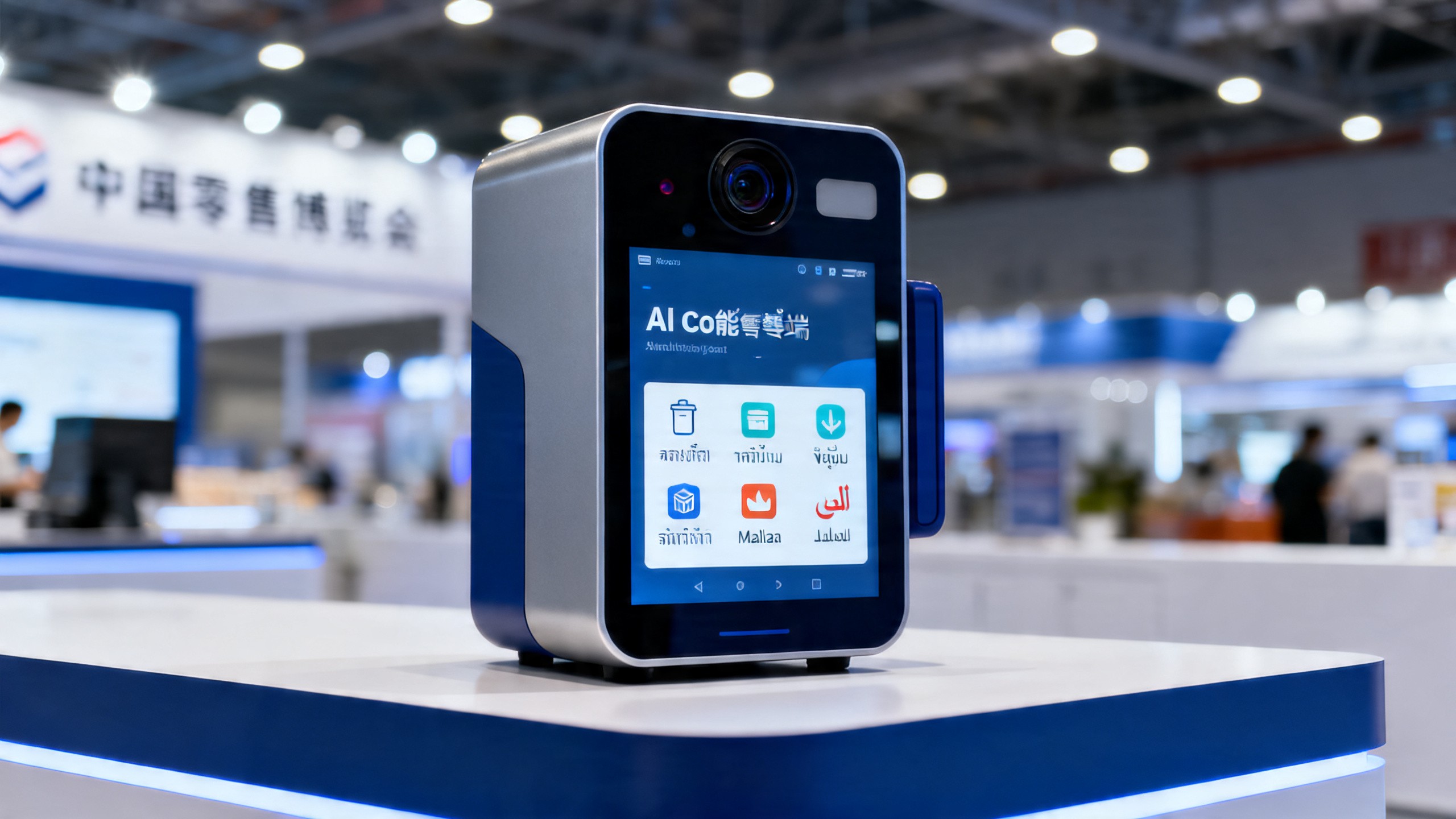
At the China Retail Expo on April 18, 2026, a domestically developed AI-powered ‘lobster clerk’ system—featuring vision-based recognition and multilingual (English, Thai, Vietnamese, Malay) interaction—drew attention from regional retail chains. The deployment signals emerging cross-border applicability for AI-driven in-store automation, particularly for food retail, quick-service F&B, and retail technology integration sectors.
Event Overview
On April 18, 2026, during the China Retail Expo, an AI system branded as the ‘AI小龙虾店员’ (AI Lobster Clerk) was showcased. It integrates domestic AI visual recognition and supports real-time voice interaction in English, Thai, Vietnamese, and Malay. Vietnamese retailer VinCommerce and Thai conglomerate CP All submitted formal technical parameter comparison sheets on-site, with specific focus on OCR accuracy (≥99.2%), offline speech response latency (<800ms), and API compatibility with existing POS systems.
Industries Affected
Direct Trade Enterprises
These firms engaged in B2B equipment export or technology licensing may face increased inbound technical inquiries from Southeast Asian retailers. The interest shown by VinCommerce and CP All reflects early-stage procurement evaluation—not purchase commitments—but suggests rising demand for interoperable, low-latency, multilingual retail AI modules tailored to fragmented regional POS ecosystems.
Food Processing & Packaging Manufacturers
Companies supplying pre-portioned, ready-to-cook, or branded seafood products—including those targeting retail-ready packaging—may encounter new integration requirements. If AI clerk systems gain adoption, visual recognition accuracy thresholds (e.g., ≥99.2% OCR) could indirectly raise expectations for label clarity, font consistency, and multilingual labeling compliance across export SKUs.
Retail Technology Integrators
Firms specializing in POS middleware, cloud-based store management platforms, or edge-AI deployment services are likely to see intensified scrutiny around API documentation quality, versioning transparency, and offline-capable response architecture—especially for markets with intermittent connectivity.
Supply Chain Service Providers
Logistics and localization service providers supporting hardware/software deployments in ASEAN may need to adjust support scope: multilingual UI testing, regional voice model validation, and offline inference benchmarking are now tangible pre-deployment checkpoints—not just post-sales add-ons.
What Relevant Enterprises or Practitioners Should Monitor and Do
Track official technical documentation releases
Neither performance metrics nor API specifications have been publicly published beyond on-site inquiry forms. Enterprises evaluating compatibility should await verified whitepapers or developer portals—not rely on expo-level claims.
Assess language-specific labeling and packaging readiness
OCR accuracy requirements (≥99.2%) imply stricter tolerances for printed text on packaging. Exporters to Thailand, Vietnam, and Malaysia should review current label fonts, contrast ratios, and bilingual/multilingual layout consistency—particularly where machine-readability impacts AI-assisted checkout or inventory scanning.
Distinguish between procurement interest and commercial deployment
VinCommerce and CP All’s submission of comparison sheets indicates technical due diligence—not confirmed orders or pilot timelines. Stakeholders should treat this as a signal of evolving evaluation criteria, not evidence of near-term market uptake.
Prepare for API integration scoping in regional POS environments
POS system fragmentation remains high across ASEAN. Companies offering compatible APIs should document version-specific endpoints, authentication flows, and error-handling conventions—ideally with reference implementations for common local platforms (e.g., Thai SaaS-based POS or Vietnamese Android-based terminals).
Editorial Perspective / Industry Observation
From industry perspective, this event is best understood as a procedural milestone—not a commercial inflection point. The presence of structured technical comparisons from major ASEAN retailers signals maturing evaluation frameworks for AI retail tools, especially around interoperability and linguistic adaptability. Analysis来看, it reflects growing institutional capacity to assess AI components on engineering merits (latency, OCR, offline resilience), rather than solely on brand or demo appeal. Observation来看, the emphasis on four specific languages—and not broader ‘multilingual’ claims—suggests targeted market-readiness assessment, not generic localization capability. Current more appropriate interpretation is that this marks the beginning of technical qualification cycles, not the start of volume deployment.
This development does not indicate immediate scalability, but it does suggest that AI retail automation vendors must now demonstrate measurable, auditable performance in operational conditions—not just controlled demos—to enter serious procurement consideration in key ASEAN markets.
Conclusion
The appearance of the AI Lobster Clerk at the 2026 China Retail Expo is a notable indicator of shifting technical evaluation standards among major Southeast Asian retailers—not yet evidence of widespread adoption. It highlights growing attention to real-world AI performance metrics (OCR accuracy, offline latency, API robustness) in multilingual, heterogeneous retail IT environments. For stakeholders, the event is better interpreted as a calibration point for future technical RFPs and integration benchmarks, rather than a signal of imminent market transformation.
Source Attribution
Main source: Official event reporting from the China Retail Expo (April 18, 2026); confirmed attendee actions (VinCommerce, CP All submissions) reported via on-site press briefings. No third-party performance validation or commercial terms disclosed. Ongoing observation required for official technical specification release and subsequent pilot announcements.
Related News
- AI Lobster Clerk Debuts at Retail Expo, Draws SEA Procurement InquiriesApr 19, 2026AI Lobster Clerk debuts at China Retail Expo—drawing SEA procurement interest with multilingual AI, 99.2% OCR accuracy & offline-ready retail automation.
- 2026 Humanoid Robot Half Marathon in BeijingApr 19, 20262026 Humanoid Robot Half Marathon in Beijing: First international robotics race sparks global procurement interest in Chinese motion control chips, joint modules & RTOS integration.
- PLC control system integration fails most often at protocol translation—not hardwareApr 16, 2026Cross border trade & direct factory sourcing? PLC control system failures stem from protocol translation—not hardware. Avoid delays in industrial control systems, solar panels, semiconductor devices & more. Get actionable protocol risk mitigation now!
- Why coating materials for label materials are shifting from solvent-based to UV-curable in 2026Apr 16, 2026Discover why coating materials for label materials are shifting to UV-curable solutions in 2026—driving innovation in rubber materials, plastic resins, specialty chemicals, and biodegradable packaging.
Related News
- 00
0000-00
AI Lobster Clerk Debuts at Retail Expo, Draws SEA Procurement Inquiries - 00
0000-00
Henan Brain-Computer Interface Rehab Tech Center Launched - 00
0000-00
Russia-China Talks: RUB-CNY Settlement & Standards Mutual Recognition Accelerated - 00
0000-00
Xiaomi Auto Appoints Hu Zhengnan CTO, Ex-Tesla Exec as Chief of Staff - 00
0000-00
China Launches First 100,000-Home Natural Gas Blending with Hydrogen Project
Technology Insights Desk
Weekly Insights
Stay ahead with our curated technology reports delivered every Monday.