





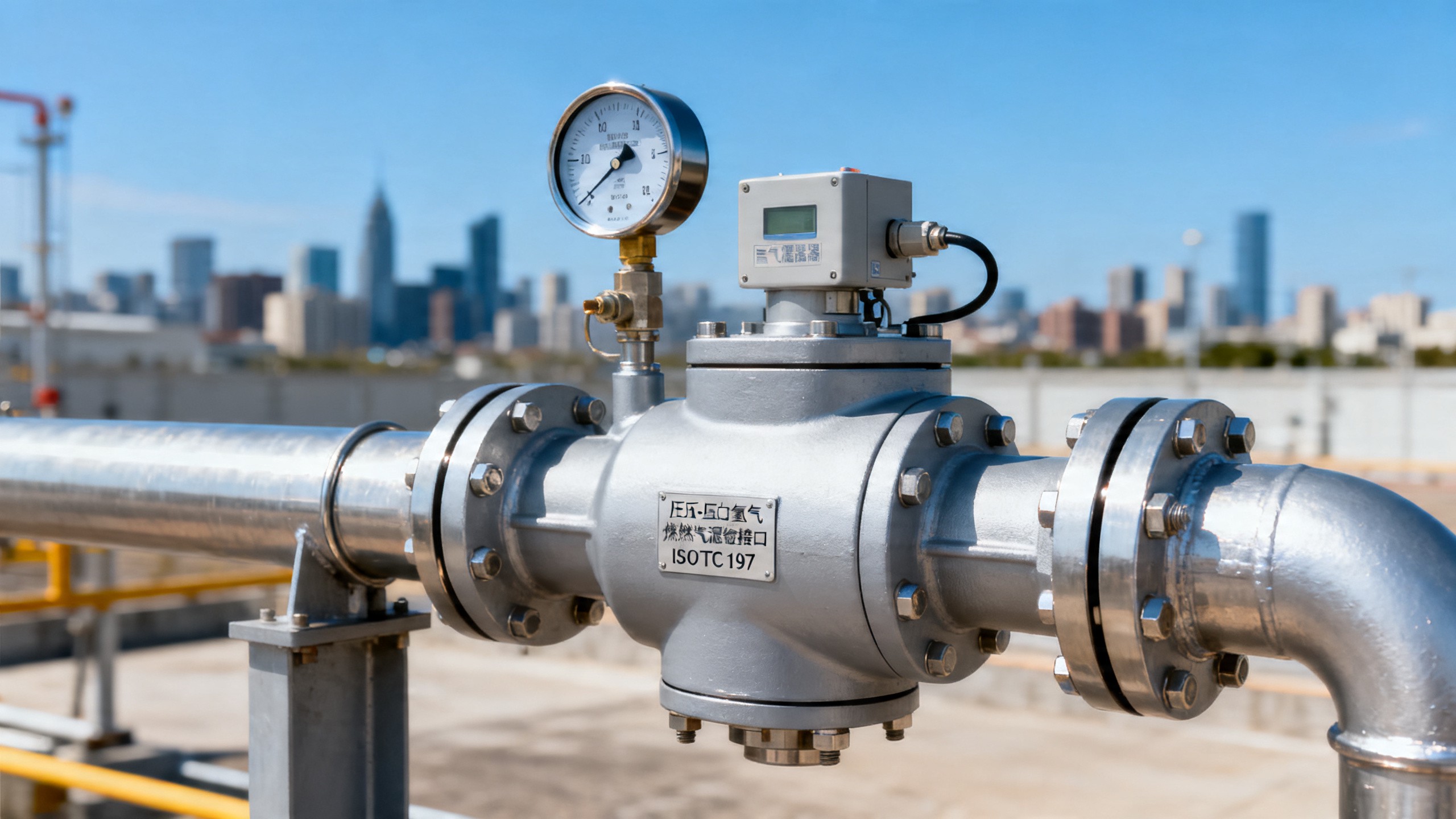
On April 19, 2026, China launched its first large-scale commercial natural gas blending with hydrogen project—covering 100,000 residential households. The initiative signals emerging opportunities for high-pressure hydrogen storage vessels and hydrogen-specific instrumentation exporters, particularly in markets adopting ISO/TC197-aligned standards.
Event Overview
On April 19, 2026, the National Energy Administration of China announced the official launch of the nation’s first natural gas blending with hydrogen project targeting 100,000 households. The initial hydrogen blending ratio is set at 5%. The project mandates supporting equipment including high-pressure hydrogen storage cylinders (rated ≥35 MPa), hydrogen embrittlement-resistant pressure gauges, and intrinsically safe hydrogen leakage sensors. Technical specifications developed for the project have been made available to ISO/TC197 for reference and alignment.
Which Subsectors Are Affected
Direct Exporters of Hydrogen Equipment
This project establishes a de facto domestic benchmark for performance and safety requirements of hydrogen-compatible pressure equipment and sensors. As the technical standard is shared with ISO/TC197, it may serve as a reference point for conformity assessments in international markets—especially where regulatory frameworks are still evolving. Exporters targeting regions with harmonized or developing hydrogen infrastructure policies may find early alignment beneficial.
Manufacturers of High-Pressure Vessels and Components
Suppliers of 35 MPa+ hydrogen storage cylinders face increased demand validation under real-world deployment conditions. The project’s scale implies potential volume ramp-up, but only for products certified to meet the specified anti-hydrogen embrittlement and leakage detection criteria. Manufacturers must ensure traceability of material selection, heat treatment protocols, and sensor integration compliance—not just nominal pressure rating.
Producers of Specialty Instrumentation
Pressure gauges and hydrogen leakage sensors meeting intrinsic safety and hydrogen compatibility requirements are explicitly named as mandatory components. This creates a narrow but high-barrier product category: devices must demonstrate resistance to hydrogen-induced degradation and operate reliably in mixed-gas environments. Suppliers lacking test data aligned with hydrogen service conditions—even if compliant with general industrial standards—may be excluded from qualification pathways.
What Enterprises or Practitioners Should Focus On Now
Monitor Official Technical Annex Updates and Certification Pathways
The project’s technical standard has been opened to ISO/TC197, but formal adoption into national or international certification schemes (e.g., PED, ASME BPVC Section VIII, or IECEx) remains pending. Stakeholders should track updates from CNCA (China National Certification and Accreditation Administration) and provincial energy bureaus on recognized testing labs and conformity assessment procedures.
Prioritize Validation for Specific Product Categories and Interfaces
Not all high-pressure vessels or sensors qualify—only those verified for 5% H₂-in-natural-gas service at system-level pressure and temperature profiles. Companies should focus validation efforts on interface compatibility (e.g., sealing materials, diaphragm alloys, sensor housing permeability) rather than standalone component ratings.
Distinguish Between Policy Signal and Near-Term Procurement Reality
While the project marks a significant policy milestone, procurement timelines, vendor selection mechanisms, and delivery schedules have not been publicly disclosed. Early engagement with EPC contractors or local gas utilities involved in implementation may yield more actionable intelligence than broad market assumptions.
Prepare Documentation Aligned with International Reference Use Cases
Since the standard is shared with ISO/TC197, companies preparing for export should document test reports, material certifications, and failure mode analyses in formats compatible with ISO/IEC 17025-accredited laboratories. Emphasis on reproducible hydrogen exposure testing (e.g., ASTM G142, ISO 15985) will strengthen cross-border acceptance.
Editorial Perspective / Industry Observation
From an industry perspective, this initiative is best understood not as an immediate procurement wave, but as a foundational alignment effort: it anchors domestic technical expectations to an internationally visible framework. Analysis来看, its primary value lies in standard-setting influence—not near-term volume. Observation来看, the choice to share specifications with ISO/TC197 suggests intent to shape interoperability norms, especially for mid-pressure blending applications in gas distribution networks. Current更值得关注的是 how quickly downstream certification bodies adopt these references—and whether parallel pilot projects in Europe or Southeast Asia begin referencing the same test parameters. It is more a signal of institutional coordination than a direct sales catalyst.
Concluding, this project represents a calibrated step toward hydrogen integration in existing gas infrastructure—not a wholesale transition. Its significance lies in codifying minimum technical thresholds for equipment in blended-gas service, thereby clarifying entry conditions for manufacturers and exporters. At present, it is more accurately interpreted as a reference anchor for future regulatory development than a standalone commercial opportunity.
Source: National Energy Administration of China (announced April 19, 2026).
Note: Details regarding vendor selection, procurement schedule, and regional rollout phases remain unconfirmed and require ongoing monitoring.
Related News
- China Launches First 100,000-Home Natural Gas Blending with Hydrogen ProjectApr 19, 2026China's first 100,000-home natural gas blending with hydrogen project launches—key opportunity for hydrogen equipment exporters, high-pressure vessels & specialty instrumentation.
- Renewable energy market analysis: How policy shifts in India reshaped solar module sourcing in 2026Apr 19, 2026Renewable energy market analysis meets real-world impact: How India’s 2026 ALMM+ policy reshapes solar module sourcing, supply chain risk management strategies, and made in China products list—key for clean energy investment opportunities & procurement teams.
- Clean energy investment opportunities: Why lithium iron phosphate battery recycling startups attracted VC funding in Q1 2026Apr 19, 2026Clean energy investment opportunities surge as LFP battery recycling startups attract record VC funding—explore supply chain risk management strategies, chemicals industry trends, and renewable energy market analysis insights.
- Renewable energy market analysis: Is offshore wind still attracting institutional capital in 2026?Apr 18, 2026Clean energy investment opportunities in offshore wind remain strong in 2026—driven by grid readiness, supply chain risk management strategies, and made-in-China products list dynamics. Discover where institutional capital is flowing—and why.
Related News
- 00
0000-00
AI Lobster Clerk Debuts at Retail Expo, Draws SEA Procurement Inquiries - 00
0000-00
Henan Brain-Computer Interface Rehab Tech Center Launched - 00
0000-00
Russia-China Talks: RUB-CNY Settlement & Standards Mutual Recognition Accelerated - 00
0000-00
Xiaomi Auto Appoints Hu Zhengnan CTO, Ex-Tesla Exec as Chief of Staff - 00
0000-00
China Launches First 100,000-Home Natural Gas Blending with Hydrogen Project
Energy Insights Desk
Weekly Insights
Stay ahead with our curated technology reports delivered every Monday.