





Are barcode labels or RFID tags better for tracking precast concrete? The answer depends on handling conditions, scanning discipline, system integration, and operational costs.
Barcode labels offer a practical starting point when workers can access each component. RFID becomes attractive when repeated manual scans constrain production or dispatch.
For manufacturers and project teams, tag price alone is misleading. Missed identifications can disrupt inventory records, delay deliveries, and complicate installation sequencing and quality investigations.
Dust, moisture, handling damage, and crowded storage yards challenge both technologies. RFID also requires careful tag selection and placement around concrete and steel reinforcement.
Many plants benefit from a hybrid approach: durable printed identification for visual checks, combined with RFID where faster scanning produces measurable operational value consistently.
This guide focuses on procurement and operating decisions: which conditions favor each option, what implementation requires, and how to verify benefits before wider deployment.
Which Tracking Method Fits Your Precast Operation?
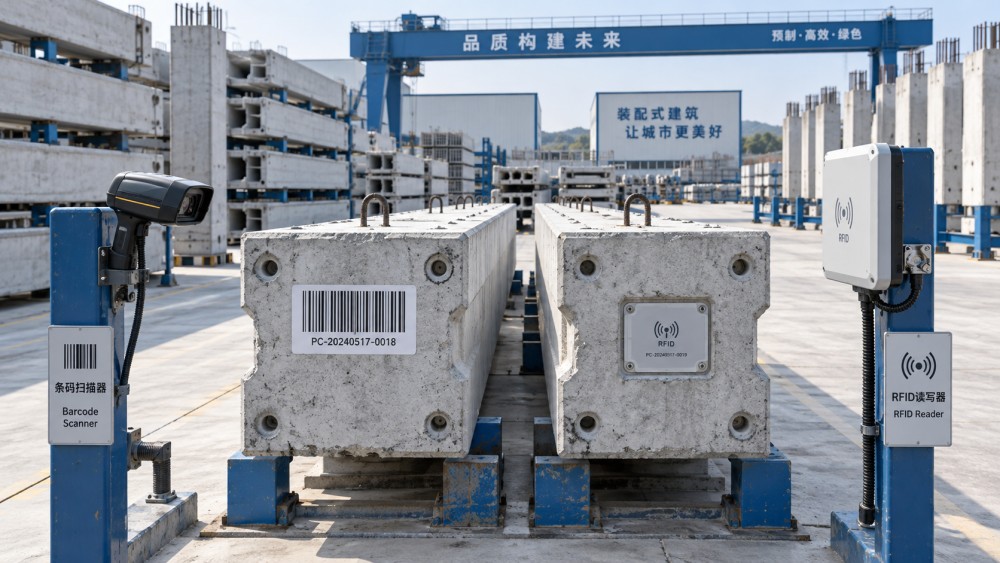
Start by identifying where tracking fails today. Missing yard locations, incorrect loading, and incomplete quality records require different solutions, even within the same plant.
Barcodes usually suit operations with manageable component volumes, accessible labels, and established scanning checkpoints. Their simplicity helps smaller manufacturers introduce traceability without extensive infrastructure.
RFID deserves evaluation when employees repeatedly walk around components, climb to reach labels, or spend substantial time identifying pieces during stock checks and loading.
However, RFID does not automatically solve location tracking. A tag read confirms detection; a trustworthy location also requires a defined zone or recorded movement.
Likewise, barcode tracking need not be slow or unreliable. Well-positioned labels, consistent scanning routines, and clear exception handling can support dependable production and dispatch.