
How Do You Restore Construction Batch Traceability After Label Damage?





How Do You Restore Construction Batch Traceability After Label Damage?
Rain, abrasion, and handling can turn a readable batch label into a costly traceability gap, delaying inspections and leaving construction teams unsure whether materials meet project specifications. How do we recover traceability when construction material batch labels are damaged? The answer starts with isolating affected stock and cross-checking delivery records, supplier batch data, test certificates, and site logs—not guessing from appearance.
The objective is not simply to print another label. It is to establish a defensible connection between the physical material, its production identity, the relevant quality documents, and its location or use on the project. Where that connection cannot be demonstrated, the material remains unidentified, even if it looks identical to approved stock.
Contain the uncertainty before investigating it
Stop issuing affected material and place it under a clearly recorded hold. Depending on site arrangements, this may require physical segregation, an inventory block, or both. Give each affected pallet, bundle, container, or storage group a temporary investigation reference. That reference tracks the investigation; it must not be presented as a recovered manufacturer batch number.
Photograph the damaged label, packaging, surviving markings, and storage position before cleaning or moving anything. Record quantities, product descriptions, discovery time, and the last known handling activity. Preserve label fragments. Do not use solvents or aggressive cleaning methods that could destroy remaining print or damage the material.
Check whether any stock from the affected group has already been installed. If it has, map the potential installation locations using issue records, daily reports, and inspection documentation. Notify the responsible quality and engineering personnel so they can determine whether an installation hold, further inspection, or another control is necessary under the project requirements.
Avoid expanding the hold unnecessarily, but do not define its boundary from memory alone. If several batches were stored together and movements were not recorded, the potentially affected population may be wider than the visibly damaged packages.
Reconstruct the link from material to delivery to batch
A purchase order confirms what was ordered. It does not necessarily identify what was delivered. Likewise, a certificate showing compliant properties does not prove that the unidentified stock belongs to the batch covered by that certificate. Recovery requires records that connect these separate facts.
Start with the receiving record and work in both directions: upstream toward supplier dispatch records and downstream toward storage movements and installation. The evidence chain should show how the shipment became the particular physical units now under investigation.
- Delivery evidence: delivery notes, packing lists, shipment references, container numbers where relevant, and receiving photographs.
- Production evidence: manufacturer batch or lot numbers, steel heat numbers where applicable, production dates, and package serial numbers.
- Quality evidence: batch-linked test reports, inspection certificates, declarations, and approved material submittals, as applicable.
- Site custody evidence: goods-received records, storage locations, stock transfers, repacking records, and material issue logs.
Look for identifiers that survived somewhere other than the main label. Individual components may carry permanent markings; inner packaging may retain a lot code; receiving photographs may show the original pallet label. However, a manufacturer's logo, product grade, or nominal dimension may identify a product family without identifying its production batch. Confirm what each marking actually means.
A useful investigation diagram shows the physical unit, its package identifier, the delivery line, the supplier's dispatch allocation, and the associated certificate. Any unsupported connection deserves attention.
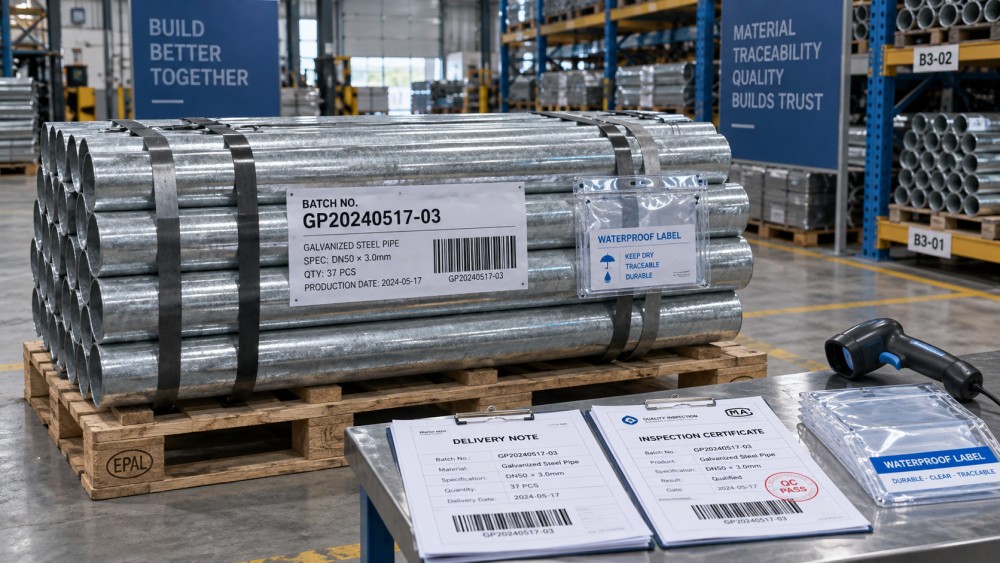
Reconcile quantities as well as identifiers. If a shipment contained several lots, a delivery note alone may not tell you which lot remains on site. Review what was received, issued, transferred, returned, and left in storage. Quantity agreement supports the investigation, but it cannot resolve an undocumented mixture of visually identical batches.
Ask the supplier for a verifiable mapping, not another certificate
Contact the supplier with a structured evidence package: order and delivery references, photographs, surviving characters, package descriptions, quantities, and receiving dates. Ask whether their dispatch system can link the affected package or shipment line to a specific manufacturer batch. Where a distributor supplied the goods, confirmation may need to come from the manufacturer through that distributor.
The distinction matters. A supplier may readily resend a certificate for the correct product, yet still be unable to demonstrate that it covers the unidentified material. Request written confirmation of the actual mapping, the records supporting it, and any limitations—for example, whether the shipment included multiple batches or whether packaging was changed before dispatch.
For imported materials, retain both the original identifier and any translated description. A freight forwarder's shipping label is not automatically a production identifier. Resolve discrepancies between packing lists, invoices, and technical certificates rather than assuming that different codes refer to the same lot.
Partial label text can help narrow the search. Barcode readers, alternative lighting, or image enlargement may recover surviving information, but the decoded result still needs verification. Image-enhancement tools should not be used to invent missing characters. A plausible batch number is not an established batch number.
Decide whether the evidence supports release
There is no universal document count that makes recovered traceability acceptable. The decision depends on the material, its intended use, the governing specification, contractual requirements, and applicable local rules. Structural or safety-critical applications generally demand closer scrutiny than uses where batch-specific evidence is not required.
A practical distinction is between confirmed identity, a narrowed set of possible batches, and unresolved identity. Confirmed identity requires evidence connecting the physical stock to a particular batch without an unexplained custody gap. A narrowed set may help assess risk, but it should not be relabeled as a single confirmed batch.
For example, an unopened package with a readable secondary serial number may be recoverable if the manufacturer can map that number to its production record. Loose items from several opened packages are harder to resolve when they have no individual batch markings and no recorded separation. Matching dimensions and appearance does not close that gap.
Record contradictory evidence as carefully as supporting evidence. A production date inconsistent with the claimed dispatch record, an unexplained quantity difference, or a certificate for a different grade should stop automatic release. The designated project authority—not the person reprinting labels—must approve the disposition.
Testing can establish properties without establishing provenance
Testing may help determine whether material meets specified performance requirements. It usually cannot, by itself, prove the original batch identity. A sample can pass a mechanical or chemical test while its relationship to a particular production record remains unknown.
Where identity cannot be recovered, additional testing may form part of an authorized acceptance route, if the project requirements permit one. The responsible technical authority should define sampling, laboratory requirements, acceptance criteria, and the population represented by the results. Do not assume that one tested item validates a mixed stockpile, or that passing results replace a mandatory traceability requirement.
Relabel only after the recovery decision is documented
Once identity has been verified and relabeling authorized, issue a controlled replacement label. Preserve the confirmed manufacturer identifier and link it to the investigation record. Keep internal tracking codes distinguishable from manufacturer lot numbers so future users do not confuse site administration with production identity.
The recovery file should contain the damaged-label photographs, affected quantities, supporting records, supplier correspondence, unresolved qualifications, disposition approval, and replacement-label details. Retain the original evidence rather than overwriting it with a clean new inventory entry. Record who made the change and when.
Separate identity recovery from condition assessment. A readable replacement label does not make rain-soaked bagged material, damaged coatings, or improperly stored chemicals acceptable. Storage history, shelf life, packaging integrity, and exposure limits may require a separate decision even after the batch has been identified.
Prevent the next loss at receiving and package splitting
The most useful preventive control is often a receiving photograph that captures both the batch label and enough surrounding context to identify the package. Store it against the goods-received entry, not in an unindexed phone gallery. Record batch allocations before splitting pallets or removing packaging.
When stock is divided, transfer its identity to every new controlled storage unit. Record the parent package, destination, quantity, and batch. Keeping different lots separated reduces ambiguity, especially for products that look identical across production runs.
Specify labels for the actual exposure: moisture, ultraviolet light, abrasion, dust, surface temperature, and handling conditions. Check adhesion and print durability on the intended packaging surface. A protected duplicate identifier can provide redundancy, while QR codes or RFID can simplify record retrieval. Neither compensates for inaccurate data or undocumented stock movements.
Procurement terms should also address batch allocation on delivery documents, certificate availability, and the supplier's process for verifying damaged identifiers. These are operational questions worth settling before delivery, when replacement stock and schedule pressure are not yet driving the discussion.
Hantecorg.com's coverage of building materials, packaging technology, supplier practices, and cross-border trade can help procurement teams understand the wider factors behind these controls. Industry intelligence supports better sourcing questions; it does not replace the project records needed to authorize a particular batch.
Before releasing affected stock, ask whether someone outside the investigation could follow the retained evidence from the physical material to its claimed production batch. If that path still depends on an assumption, keep the assumption visible and seek the required technical disposition rather than hiding it behind a new label.
Industries
Related News
- 00
0000-00
US Treasury Extends Russia Oil Sanctions Waiver by 30 Days - 00
0000-00
International Logistics Solutions for Heavy Machinery: Cost Risks and Route Planning in 2026 - 00
0000-00
Energy-saving home improvement ideas with faster payback - 00
0000-00
10 Smart Home Decoration Ideas to Make Small Rooms Look Bigger and Brighter - 00
0000-00
Shenyang Launches China's First 500,000-Ton Biomass Green Methanol/Ethanol Project
Weekly Insights
Stay ahead with our curated technology reports delivered every Monday.