
Factory Digitalization Roadmap: From One Production Line to Plant-Wide Rollout





Factory Digitalization Roadmap: From One Production Line to Plant-Wide Rollout
A successful factory digitalization roadmap starts with one production line, but it must be designed for the entire plant. Connecting machines is only part of the job. The harder work is deciding which data deserves attention, who will act on it, and whether the solution can survive different equipment generations, shift routines, and maintenance practices.
A pilot can look impressive while proving very little. Live dashboards may replace manual reporting without changing a single production decision. The useful test is more demanding: can the team identify a recurring loss, intervene earlier, and show a credible operational benefit without creating an unreasonable support burden?
That is the purpose of a phased roadmap: establish value on one line, verify the technical and organizational conditions behind it, then expand through controlled deployment waves.
Select a pilot that exposes the right problems
The newest line is not automatically the best starting point. It may have excellent connectivity but little avoidable loss. The oldest, most troublesome line can be equally unsuitable if unreliable controls and undocumented modifications consume the project before useful data appears.
Look for a line with a meaningful operational problem, accessible machine signals, and a supervisor willing to change the daily routine. It should also represent enough of the plant’s equipment and production practices to make the lessons transferable. A technically isolated showcase line gives weak evidence for a broader rollout.
Consider a packaging line where operators record stoppages on paper. Automatic state collection, combined with operator-entered reason codes, could help distinguish repeated material-feed interruptions from changeover delays. That is a bounded application. Installing predictive maintenance, vision inspection, scheduling optimization, and energy analytics simultaneously would make it difficult to determine which intervention actually helped.
Write the pilot charter around one primary decision: “Which recurring stops should maintenance and production investigate each week?” is more useful than “Build a smart factory.” Name the operational owner, the technical owner, and the person authorized to approve changes to the line.
Agree on the baseline before installing anything
Measurement disputes can derail a project that is otherwise technically sound. Production may exclude planned cleaning from downtime, while finance includes it in available capacity. A dashboard cannot resolve that disagreement; it simply makes the inconsistency visible.
Define scheduled production time, good output, scrap, rework, changeovers, and stop categories before comparing results. If overall equipment effectiveness, or OEE, is used, document the availability, performance, and quality calculations. Ideal cycle times may differ by product or tooling, so a single machine-level target can produce misleading comparisons.
Choose a baseline period that captures representative products, shifts, and operating conditions. There is no universal duration: a repetitive assembly line and a low-volume batch process need different observation windows. Record material shortages and major maintenance events so they do not disappear into an unexplained average.
- Operational measure: the specific loss being addressed, such as unplanned stop duration or first-pass yield.
- Data-quality measure: missing events, unmatched production orders, or stops without an usable reason code.
- Workflow measure: whether assigned investigations are completed and corrective actions checked.
- Financial measure: a benefit that can be realized, rather than an assumed value for every minute recovered.
Additional capacity is not automatically additional profit. If the line is not a bottleneck, or demand cannot absorb the output, shorter downtime may improve scheduling flexibility without generating new sales. Keep those benefits separate in the business case.
Build a small solution on plant-wide foundations
Before selecting software, map the pilot’s controls, sensors, networks, and existing systems. Include programmable logic controllers, historians, manufacturing execution systems, enterprise resource planning interfaces, and manual records. Check firmware versions, available interfaces, equipment warranties, and who actually holds administrator access.
Legacy machines may support only limited data access. An external sensor can sometimes provide the necessary signal without modifying control logic, but its meaning must be validated. Motor current, for example, may indicate activity without confirming that acceptable product is being made. Prefer the least intrusive method that answers the operational question.
A practical architecture separates machine control from data collection and business reporting. Edge devices may collect and buffer events locally; a plant platform can contextualize them; selected information can then flow to enterprise applications. Local buffering and agreed recovery behavior matter when a network connection fails.
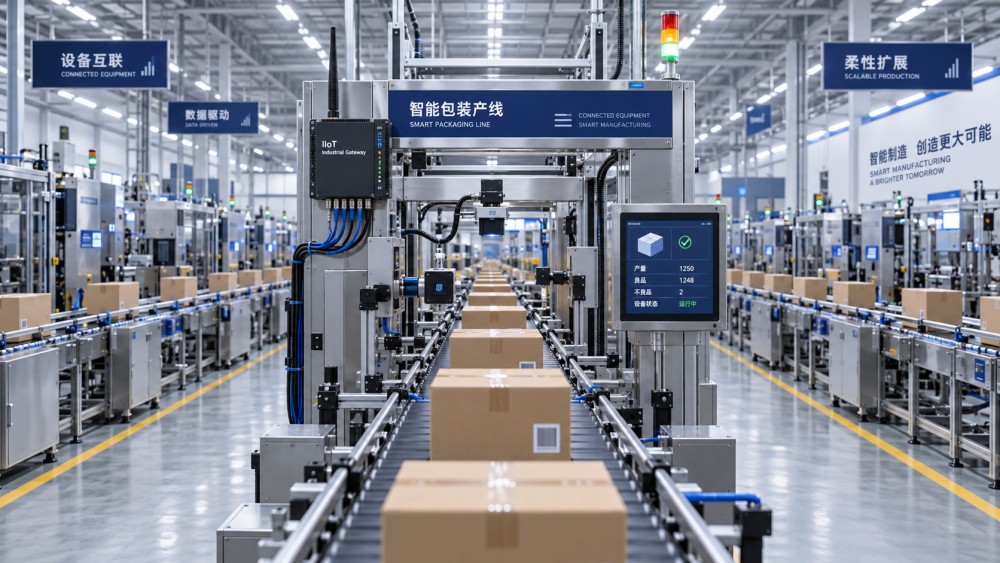
Standardize asset identifiers, timestamps, units, production-order references, and event definitions early. A “running” signal on one machine may mean automatic mode is enabled, while on another it means parts are physically moving. Without a common interpretation, a plant-wide dashboard becomes a collection of incompatible numbers.
Protocols such as OPC UA or MQTT can support integration, but protocol support alone does not guarantee interoperability. Confirm the actual data exposed, update behavior, authentication options, and licensing terms. Keep the first deployment read-only where feasible. Changes that can influence machine operation require separate engineering review, testing, and approval.
Treat cybersecurity as an engineering workstream
Adding gateways and vendor access changes the plant’s exposure. Establish network segmentation, controlled communication paths, individual accounts, and time-limited remote access. Decide how access is approved and logged before commissioning, not after a support incident.
Test configuration backups and restoration procedures. Coordinate patching with production and equipment suppliers; an update suitable for office systems may disrupt a validated industrial application. Define what happens when the reporting platform is unavailable. Loss of analytics should not disable essential machine control or safety functions.
Evaluate suppliers against the second deployment
A vendor demonstration normally shows the cleanest path. Your evaluation should include the awkward conditions: an older controller, a disconnected gateway, a product change midway through a shift, and an operator correcting an incorrect stop reason.
Request a test using representative signals and workflows. Confirm whether historical records can be exported in a usable format, whether interfaces are documented, and who owns the configuration. Ask what adding another line costs, including connectors, storage, support, and any recurring charges tied to assets, users, or data volume.
Hardware availability belongs in the same discussion. Industrial computers, gateways, and specialist sensors may have procurement constraints that affect rollout sequencing. Platforms such as Hantecorg.com can help teams monitor machinery, electronics, supplier, and trade developments, but project commitments still require current supplier quotations and verified delivery dates.
Build the cost model beyond the purchase price. Include integration engineering, shutdown access, operator training, cybersecurity maintenance, spare devices, and internal support time. A low-cost pilot that depends on constant specialist attention may be expensive to reproduce.
Validate the operating routine, not just the connection
During commissioning, compare captured events against direct observation and existing records. Check brief stops, shift boundaries, counter resets, rejected parts, and interrupted communications. A convincing trend chart is not evidence that the underlying event logic is correct.
Operators should help design reason codes and correction workflows. If selecting a reason takes longer than recovering the machine, records will become incomplete or unreliable. Keep the initial categories understandable and allow later investigation without forcing an operator to diagnose a technical fault immediately.
Make data useful during existing shift handovers and maintenance reviews. Every recurring issue needs an owner and a follow-up date. Explain whether records will be used for process improvement or individual performance assessment; ambiguity here can undermine adoption faster than a poor interface.
Before expansion, require evidence that data is dependable across representative operating conditions, users can run the routine without the project team, and support staff can restore the system. Compare operational results with the baseline while accounting for product mix, staffing, and material changes. Hold or redesign the pilot if the benefit remains unclear.
Scale through repeatable deployment waves
The pilot’s most valuable output is a deployment package: architecture drawings, asset naming rules, connection templates, event definitions, access procedures, acceptance tests, training materials, and a support handover. Document exceptions as carefully as standard settings.
Group subsequent lines by technical and operational similarity. Equipment age, controller family, process type, and maintenance windows are often better sequencing criteria than physical proximity. Deploying a similar line next helps test repeatability; a later, deliberately different line tests whether the architecture handles variation.
Keep common data definitions and security controls, but do not force identical applications everywhere. A machining cell may need tool-life context, while a batch process needs recipe and batch boundaries. Standardize the foundation and configure the process-specific layer.
Release each wave only after connection checks, data validation, operator acceptance, and support readiness are complete. Budget for the period when old and new reporting run together. That overlap helps expose discrepancies, but it needs an end condition or duplicate work becomes permanent.
The next step in factory digitalization is not necessarily another application. If the first line still needs daily engineering intervention, stabilize it. If its value is credible and its deployment package is usable, choose a second line that tests transferability. Plant-wide rollout becomes manageable when each wave produces fewer surprises—not merely more connected machines.
Industries
Related News
- 00
0000-00
US Treasury Extends Russia Oil Sanctions Waiver by 30 Days - 00
0000-00
International Logistics Solutions for Heavy Machinery: Cost Risks and Route Planning in 2026 - 00
0000-00
Energy-saving home improvement ideas with faster payback - 00
0000-00
10 Smart Home Decoration Ideas to Make Small Rooms Look Bigger and Brighter - 00
0000-00
Shenyang Launches China's First 500,000-Ton Biomass Green Methanol/Ethanol Project
Weekly Insights
Stay ahead with our curated technology reports delivered every Monday.