
How Do You Test a New Production System with Custom Cabinet Orders?





Testing a new production system with custom cabinet orders requires a controlled pilot that follows each order from approved design to shipment-ready cabinets. Select orders that reflect your normal product mix, compare performance with the existing process, and check whether improvements survive design changes, material shortages, and rework. Faster machining is useful only if complete, correct orders reach dispatch sooner without creating extra work elsewhere.
The practical question—“How do we test a new production system with custom cabinet orders?”—therefore starts with choosing the right trial method. A software simulation, a sample build, and a live production pilot reveal different problems. Combining them in stages provides stronger evidence than relying on a successful demonstration or moving all orders immediately.
Compare the testing methods before choosing your pilot
A new production system may involve design software, production scheduling, CNC equipment, barcode tracking, or an integrated workflow. The test should cover the functions being changed and their connections to the rest of production. Replacing a nesting program requires different checks from introducing a system that controls order release, material allocation, and shop-floor reporting.
Use historical order replay when data conversion or configuration is the main uncertainty. Move to physical builds once outputs are consistent. A limited live pilot then tests whether the process works under ordinary operating conditions. Shadow operation is particularly useful for comparing schedules, provided only one system controls actual production instructions.
A demonstration using identical cabinets can confirm basic repeatability, but custom production needs a broader challenge. Variation in dimensions, hardware, finishes, and order sequence exposes weaknesses that repeated standard units may conceal.
Select cabinet orders that expose meaningful differences
Choose the pilot mix from recent order history. Include common cabinet configurations alongside less frequent features that create distinct production requirements. The aim is to cover the ways work changes, rather than simply include a large number of cabinets.
A useful selection might contain standard base and wall cabinets, an unusual-depth unit, a drawer cabinet with different hardware, and an order requiring visible grain alignment. Include different materials or finishes only where they belong to the intended rollout scope. Introducing unfamiliar products at the same time as unfamiliar software makes failures harder to diagnose.
- Geometry: Vary width, height, depth, handing, and relevant construction details.
- Materials: Cover thicknesses, surface treatments, and grain directions used in regular production.
- Hardware: Include hinges, drawer runners, and fittings with different drilling or clearance requirements.
- Order structure: Test multiple cabinets that must remain grouped through assembly and packing.
- Change handling: Include a controlled revision after initial release to test version management.
Keep a straightforward reference order in the trial. It helps distinguish a general system problem from an issue affecting one configuration. If both standard and complex orders receive incorrect labels, investigate the shared data path. If only a particular drawer configuration fails, examine its construction rules and hardware settings.
Pilot size should follow coverage and repeatability. A single successful order is weak evidence, while numerous near-identical orders may add little. Continue until the important configurations and handoffs have been exercised, corrected where necessary, and repeated successfully.
Make the old-versus-new comparison fair
Before the trial, record how the existing process handles comparable work. Capture engineering effort, setup time, material use, waiting time, assembly labor, defects, and completion dates. Include routine manual corrections; excluding them would make the baseline appear more efficient than it is.
Exact duplicate builds provide a direct comparison but can consume unnecessary materials. Historical comparisons are cheaper, although differences in complexity, staffing, and material availability can distort the result. Matched live orders offer a practical compromise: compare jobs with similar construction, material, hardware, and routing requirements.
Avoid using cabinet count alone to judge throughput. A plain carcass and a cabinet with multiple drawers place different demands on production. Compare results within relevant product groups or use consistently estimated work content to account for complexity. Record any differences that could explain an apparent gain.
Separate active processing time from elapsed order time. A CNC operation may become faster while assembly waits longer for missing parts. Equally, machining time may remain unchanged while better scheduling reduces queues. Both findings matter, but they support different investment decisions.
Agree on acceptance conditions before seeing results. These should reflect approved drawings, existing quality requirements, delivery commitments, and the purpose of the investment. If the goal is less manual intervention, a faster pilot that depends on constant specialist support has not yet demonstrated the intended improvement.
Follow the order through every handoff
Custom cabinet production depends on information remaining accurate as it moves between departments and machines. Follow selected parts through the complete route, checking how design intent becomes manufacturing instructions and how finished components become a complete order.
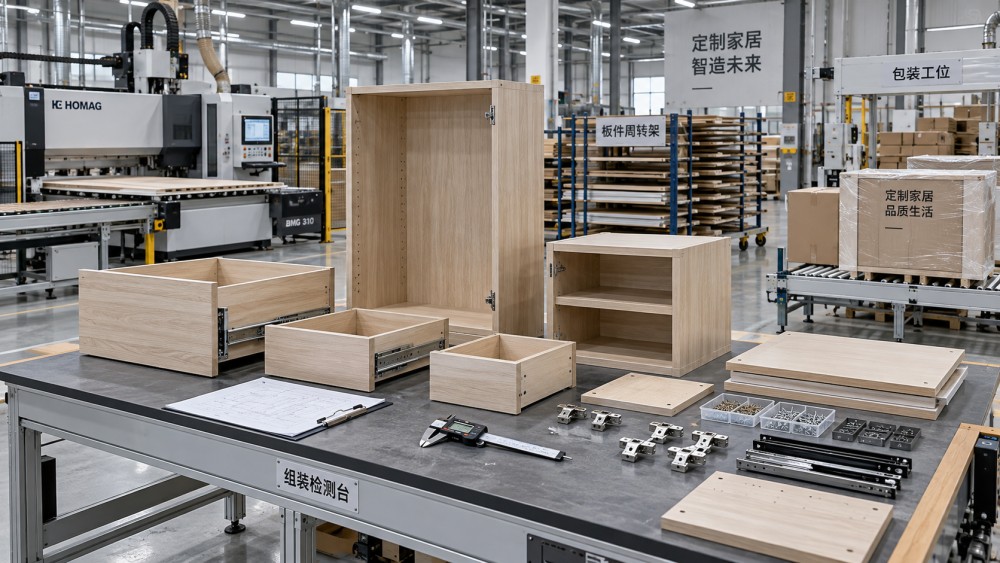
Design approval and material planning
Start with an approved drawing and revision. Check that dimensions, quantities, materials, edge treatments, hardware, and finish requirements transfer correctly into the bill of materials and cut list. Confirm how the system distinguishes purchased components from parts made in-house.
Compare calculated demand with actual stock and purchasing requirements. A system may generate correct cutting instructions yet release an order before essential fittings are available. Test reservations, shortages, and permitted substitutions, including who can authorize a change and how it reaches production.
Machining and part identification
Inspect representative parts against the approved specifications. Check dimensions, hole positions, orientation, edge treatment, and any visible grain requirements. Use the shop’s defined tolerances and inspection methods; machine output alone does not establish conformity.
Part labels should connect each component to its cabinet, order, and relevant revision. Verify that identification remains usable after cutting, edge banding, and handling. Similar-looking panels are a useful test because an incorrect label can cause assembly errors even when machining is accurate.
Check the nesting and cutting results against downstream needs. Improved sheet utilization may require extra sorting or create vulnerable narrow components. Evaluate material savings together with handling effort, component quality, and the ability to keep orders organized.
Assembly, finishing, and packing
At assembly, assess whether operators can complete the cabinet using the issued components and instructions. Record extra drilling, trimming, fitting adjustments, drawing interpretation, and time spent locating parts. These interventions reveal work transferred downstream from engineering or machining.
Inspect the finished cabinet for squareness, alignment, hardware operation, appearance, and completeness. Where finishing is included, examine whether the new sequence supports preparation, curing, and handling requirements. At packing, verify that cabinets, loose fittings, fillers, and installation information belong to the correct order.
Use shipment-ready completion as the end point when the system affects the whole workflow. Reporting success when cutting finishes leaves assembly queues and incomplete orders outside the measurement.
Compare results that affect delivery and cost
A compact scorecard makes the decision clearer than a long list of machine statistics. Use consistent definitions in both processes and retain order-level detail so averages do not hide difficult configurations.
Count support effort explicitly. Vendor engineers or experienced supervisors may help the pilot succeed, but their interventions should be visible in the results. Keep training and configuration effort separate from recurring production labor so the decision reflects both implementation demands and ongoing operating cost.
Record each failure’s cause, affected orders, correction, and retest outcome. “Operator error” is too broad to guide improvement. An unclear screen prompt, missing instruction, incorrect default, and insufficient training require different responses.
Test revisions and disruptions before expanding
A clean pilot proves that the planned route can work. Controlled exceptions reveal whether the system can recover. Use test orders, held components, or simulated shortages where necessary to protect delivery commitments.
For a design revision, check whether obsolete instructions are withdrawn and replacement parts remain traceable. Determine what happens to work already cut or assembled. For a damaged panel, test whether the replacement receives the correct identity and machining instructions without unnecessarily reproducing the entire cabinet.
Introduce a scheduling change to see how priorities move through cutting, assembly, and packing. An urgent order can appear successful while delaying several existing jobs, so review the effect on the wider queue. Also test a short interruption to a relevant device or connection: operators need clear instructions for recording work and reconciling it when service resumes.
A recovery route through the existing process can protect the pilot, but it needs a defined authority and cutoff point. Identify released orders, current revisions, and work already completed before switching. Running conflicting instructions creates uncertainty precisely when the team needs control.
Decide whether to expand, refine, or pause
Expand when representative orders meet quality requirements, completion is dependable, exceptions can be resolved, and trained operators can run the process with normal support. Increase volume gradually and watch the next constraint: higher cutting output may expose limited assembly space, finishing capacity, or packing labor.
Refine the system when problems are isolated and understood. Incorrect drilling for one hardware family may call for a configuration correction and targeted retesting. Widespread revision confusion or missing part identification calls for broader validation because many orders may be affected.
Pause expansion when defects escape inspection, completed work cannot be reconciled reliably, or improvements depend on repeated manual intervention. The next decision should follow the evidence: correct the failure, repeat the affected tests, and demonstrate that the workflow produces complete orders consistently before committing more production to it.
Industries
Related News
- 00
0000-00
US Treasury Extends Russia Oil Sanctions Waiver by 30 Days - 00
0000-00
International Logistics Solutions for Heavy Machinery: Cost Risks and Route Planning in 2026 - 00
0000-00
Energy-saving home improvement ideas with faster payback - 00
0000-00
10 Smart Home Decoration Ideas to Make Small Rooms Look Bigger and Brighter - 00
0000-00
Shenyang Launches China's First 500,000-Ton Biomass Green Methanol/Ethanol Project
Weekly Insights
Stay ahead with our curated technology reports delivered every Monday.