
Are Machine Trials Needed Before Switching to Thinner Packaging Film?





Do we need machine trials before switching to thinner packaging film? Usually, yes. A lower film gauge can reduce material consumption, but the saving only holds if the film runs reliably and the finished package still protects its contents. Film breaks, weak seals, slower production, and transport damage can quickly outweigh a lower material bill.
The more useful question is how much testing the change needs. A thinner version of an already qualified film may justify a focused verification run. A new resin blend, multilayer structure, supplier, or demanding application calls for broader testing. The decision should reflect what changes in the material and how much operating margin the existing process has.
Supplier specifications and machine trials answer different questions
A technical data sheet helps establish whether a film is a plausible candidate. Thickness, tensile properties, puncture resistance, friction, sealing characteristics, and barrier performance can all matter. However, these properties are measured under defined conditions. They do not establish how a particular roll will behave through your unwind, rollers, forming section, sealing jaws, or wrapping cycle.
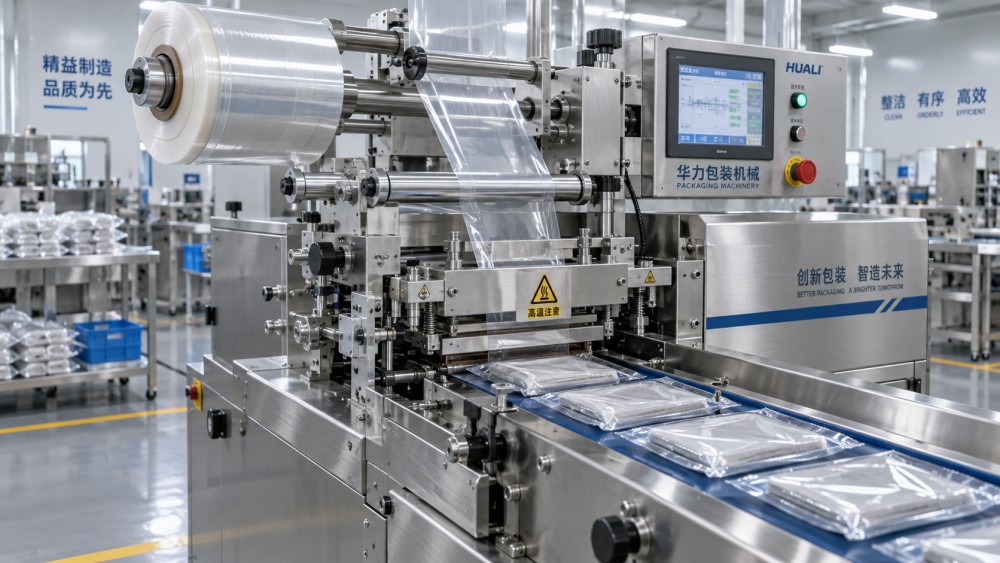
A machine trial connects the material to the actual process. It shows whether the film tracks correctly, tolerates acceleration, separates cleanly, and produces acceptable packages at the required output. It also reveals whether the equipment needs adjustments that are practical to maintain during routine production.
These checks complement each other. A successful run cannot establish food-contact suitability or prove shelf life. Equally, suitable documentation cannot prove that a film will run consistently on a worn sealing system or a tension control setup designed around thicker material.
When a short verification run is enough—and when it is not
A limited trial can be reasonable when the proposed film remains within a previously validated material and operating range. Supporting evidence might include experience with the same structure at a nearby gauge, stable equipment performance, and an application with generous strength and sealing margins. Even then, the actual candidate should be run and its packages checked before routine release.
The trial should expand when the change introduces uncertainty. Switching supplier at the same time as reducing thickness makes it harder to isolate the cause of any problem. Changes in additives, sealant layers, recycled content, or surface treatment may affect performance independently of gauge.
Application demands also matter. Sharp product edges, heavy contents, high line speeds, tightly controlled shelf life, and difficult distribution conditions all increase the consequences of a marginal result. A line already experiencing intermittent seal failures or film breaks needs particular care: thinner film may expose existing equipment problems rather than create entirely new ones.
Trial scope should follow risk, not a fixed percentage reduction in thickness. There is no universal gauge reduction below which testing becomes unnecessary. A small change can matter on a sensitive process, while a larger reduction may work with a suitably engineered film and compatible equipment.
Compare the films by their job, not thickness alone
“Thinner packaging film” covers several applications with different failure mechanisms. A heat-sealed pouch, a shrink-wrapped bundle, and a stretch-wrapped pallet should not share one generic approval checklist.
On form-fill-seal and flow-wrapping equipment, the main concerns often include film tracking, forming behavior, cut quality, and seal integrity. For shrink film, the trial also needs to examine tunnel behavior, shrink uniformity, holes, and product distortion. For stretch film, attention shifts toward applied stretch, puncture resistance, film breaks, and load containment after wrapping.
Film formulation can compensate for some effects of reduced thickness. A thinner engineered structure may perform better in a particular application than a thicker conventional film. That does not make thickness irrelevant: it means thickness must be assessed alongside material design and package performance.
Tension and film handling
For an otherwise comparable film, reducing its cross-sectional area increases stress at the same pulling force. Existing tension settings may therefore stretch or damage the candidate film. Different stiffness and friction can also change how it passes over rollers, follows guides, and forms around the product.
Watch for edge damage, wrinkles, tracking drift, registration errors, and breaks during acceleration. Evaluate starts and restarts as well as steady running. A film that behaves well once the machine settles may still create substantial waste during normal interruptions.
Heat sealing and package strength
Thinner film can respond differently to heating, but simply lowering the sealing temperature is not a dependable rule. Sealant chemistry, dwell time, jaw pressure, cooling, and film structure all influence the result. The aim is a usable sealing window: a range of settings that produces acceptable seals despite normal process variation.
Check the seal while it is still warm if filling, dropping, or downstream handling loads it before cooling. This early strength is often called hot tack. A cooled sample can look satisfactory even though the seal was vulnerable immediately after leaving the jaws.
Finished-package strength needs separate attention. A visually neat package may still puncture at a product corner, split at a fold, or fail during stacking. Where moisture or oxygen protection determines shelf life, assess the proposed structure’s barrier performance at its actual thickness.
Build a comparison that reflects normal production
Start by measuring the current film under representative conditions. Record actual output, film consumption, scrap, breaks, seal defects, and stops attributable to packaging. Use the same definitions for the candidate. Without a baseline, an apparently successful trial may conceal slower operation or higher waste.
Use the current setup as a reference, then adjust the candidate within safe equipment limits. Requiring identical settings can unfairly reject a suitable film. However, unlimited adjustment can hide a poor fit. Record every change and whether it requires additional labor, equipment work, or an unusually narrow operating window.
A useful trial should cover the conditions most likely to expose weakness:
- Required production speed: Include normal output and any higher rate routinely needed to meet demand.
- Starts and interruptions: Observe acceleration, planned stops, restarts, and normal roll changes or splices where applicable.
- Challenging products: Include relevant extremes in weight, dimensions, edges, fill level, or seal-area contamination.
- Sustained running: Continue long enough to observe stable equipment temperature, roll behavior, and recurring defects.
- Downstream handling: Check conveying, case packing, stacking, palletizing, and the handling conditions the package will actually face.
No single trial duration suits every line. A brief run may establish basic compatibility, but it cannot show performance through operating events that never occurred. Choose the run length around those events and the variability being evaluated.
Use representative production rolls rather than relying entirely on a specially prepared sample. Roll winding quality, width, core condition, and thickness consistency can influence results. Where batch variation matters, a controlled follow-up across additional rolls or lots provides stronger evidence than one extended run from a single roll.
Set acceptance criteria before seeing the results
Define what must remain acceptable before the trial begins. Otherwise, a lower quoted film price can encourage approval despite compromises that would normally trigger rejection.
Some requirements are firm limits: package integrity, product protection, required barrier performance, and applicable material suitability. Other results involve commercial tradeoffs. A modest setup change may be acceptable; recurring intervention or a sustained loss of throughput may undermine the switch.
Compare equivalent conditions wherever possible. If the candidate runs with an easier product or at a lower speed, describe the result as approval for that condition. It does not establish suitability for the full production range.
Calculate savings per acceptable package
Price per kilogram and price per roll can both mislead. A thinner film may provide more usable length for a given mass, but roll dimensions, material density, formulation, and purchasing terms affect the comparison. The useful commercial measure is the total packaging cost required to produce an acceptable package or stable wrapped load.
Total packaging cost includes film consumption, packaging waste, attributable downtime and labor, and expected losses from inadequate protection. Use measured trial consumption and production results wherever possible. Keep hypothetical damage costs clearly separate from losses actually observed.
Consider a proposed film that uses less material per package but requires slower operation to avoid seal failures. The material saving may be attractive on a line with spare capacity. On a constrained line, reduced output can create overtime or missed production. The same film can therefore be economical in one operating context and unsuitable in another.
Stretch wrapping presents another trap. A thinner film that needs more revolutions to achieve adequate containment may offer little reduction in actual consumption. Compare completed loads and retained stability, rather than assuming lower gauge automatically means lower cost.
Approve the conditions that passed, then control the rollout
A good result supports a defined approval: a specific film, thickness range, machine, product group, and operating setup. It should not automatically authorize substitution across every line or package format. Similar machines can differ in tension control, sealing condition, guides, and maintenance.
Document the approved settings, quality checks, and limits. Include supplier specifications and roll requirements so later deliveries remain comparable to the material tested. For products whose protection depends on storage time or distribution exposure, complete those evaluations before unrestricted release.
If the trial fails, classify the cause before rejecting the film. Tracking problems may respond to tension or guide adjustments. A narrow sealing window may require a different structure. Insufficient puncture resistance or barrier performance may make the candidate unsuitable regardless of machine settings.
The next practical step is to agree on a baseline and acceptance criteria before ordering trial material. That turns the decision into a comparison of measurable performance and cost, and gives a thinner film a fair opportunity to prove that it can deliver the required package consistently.
Industries
Related News
- 00
0000-00
US Treasury Extends Russia Oil Sanctions Waiver by 30 Days - 00
0000-00
International Logistics Solutions for Heavy Machinery: Cost Risks and Route Planning in 2026 - 00
0000-00
Energy-saving home improvement ideas with faster payback - 00
0000-00
10 Smart Home Decoration Ideas to Make Small Rooms Look Bigger and Brighter - 00
0000-00
Shenyang Launches China's First 500,000-Ton Biomass Green Methanol/Ethanol Project
Weekly Insights
Stay ahead with our curated technology reports delivered every Monday.