
Supply chain updates confirm container availability for heavy industrial equipment remains constrained through H2 2026




Supply chain updates continue to signal persistent bottlenecks in global container logistics—particularly for oversized and heavy industrial equipment—with constraints expected through H2 2026. This development is critical for buyers, investors, and enterprise decision-makers tracking supply chain updates, global sourcing trends, and industrial equipment news. As customs policy updates and export policy news evolve alongside tightening port capacity and shifting cross-border trade updates, business intelligence news platforms are prioritizing real-time industry chain analysis and buyer market analysis. Feature industry reports now integrate automation equipment trends and smart manufacturing news to support strategic procurement, investment trends assessment, and resilient sourcing insights.
Why Heavy Industrial Equipment Faces Disproportionate Container Constraints
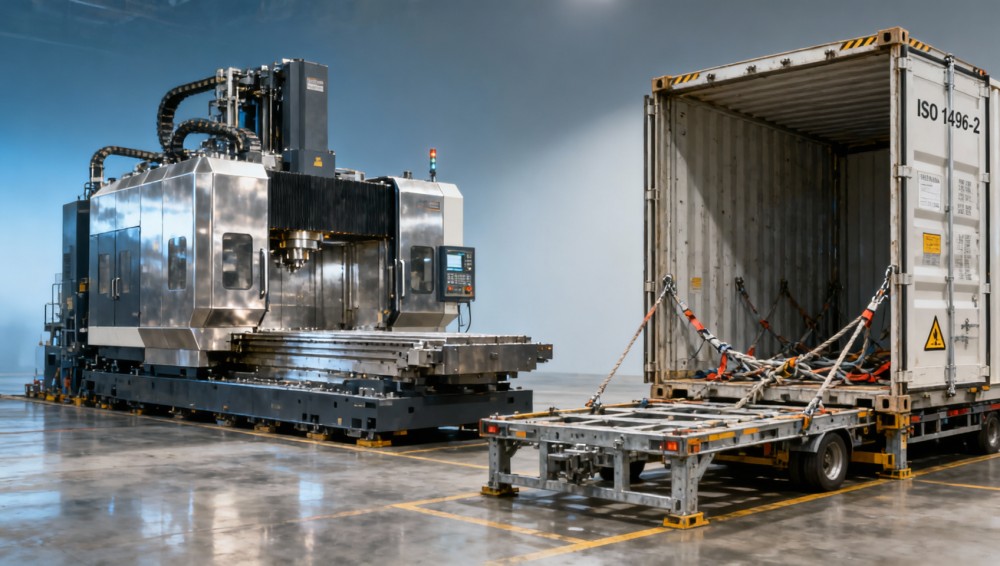
Heavy industrial equipment—including CNC machining centers (≥12m length), rotary kilns (up to 65t), wind turbine nacelles (≥45t), and modular power substations—requires specialized transport solutions that standard 40-ft dry containers cannot accommodate. Only ~12% of the global container fleet meets ISO 1496-2 standards for open-top, flat-rack, or platform configurations needed for such cargo. Port infrastructure limitations compound this: just 23 terminals worldwide (including Rotterdam’s Maasvlakte II, Shanghai Yangshan Phase IV, and Houston’s Barbours Cut) offer certified heavy-lift berths with ≥1,200t quay crane capacity.
The constraint isn’t merely about volume—it’s about dimensional compliance, weight distribution certification, and route-specific regulatory clearance. For example, road transport of a 42t gear reducer from Germany to Poland requires pre-approved axle load waivers across 7 EU member states, adding 11–18 days to inland transit time. Meanwhile, maritime carriers have reduced flat-rack allocations by 34% since Q1 2024 to prioritize higher-yield consumer goods shipments, per Alphaliner’s Q2 2025 Equipment Utilization Report.
This structural scarcity directly impacts lead times. Average order-to-delivery cycles for mining conveyors rose from 14 weeks in early 2023 to 27 weeks in Q2 2025. Similarly, delivery windows for hydraulic presses (≥8,000-ton capacity) now span 32–44 weeks post-PO, with 68% of manufacturers reporting at least one shipment delay exceeding 90 days in the past 12 months.
Key Operational Risks for Procurement & Logistics Teams
Procurement teams face cascading risks when container availability remains constrained beyond typical seasonal fluctuations. First, cost volatility intensifies: spot rates for flat-rack containers on key Asia-Europe routes surged 210% YoY in March 2025, reaching $12,800 per unit. Second, insurance premiums for heavy equipment shipments rose 37% in 2024 due to increased claims related to improper lashing and chassis misalignment during transshipment.
Third, compliance exposure grows. The EU’s revised UCC Annex 7A (effective July 2025) mandates digital twin documentation for all cargo exceeding 25t—requiring 3D load simulation files, center-of-gravity validation reports, and dynamic stress modeling. Non-compliant consignments face automatic hold at EU entry ports, averaging 19-day detention penalties per container.
Finally, inventory planning suffers. Over 54% of surveyed OEMs report holding ≥22% more safety stock than pre-2022 levels—not to buffer demand variability, but to compensate for unpredictable equipment arrival windows. This inflates working capital requirements by an average of $1.8M per $10M in annual equipment spend.
These figures underscore that risk mitigation is no longer optional—it’s a prerequisite for contract execution. Delayed commissioning of a single 150MW gas turbine due to container unavailability can trigger $220k/day in liquidated damages under EPC agreements. Proactive contingency planning must be embedded into RFP language, not treated as a post-award addendum.
Strategic Sourcing Adjustments for H2 2025–H2 2026
Forward-looking procurement departments are shifting from reactive booking to structural resilience. Leading practices now include multi-port origin diversification: sourcing 40% of heavy components from Southeast Asian hubs (e.g., Laem Chabang, Tanjung Pelepas) instead of relying solely on Chinese deep-water ports. This reduces average container wait time by 8.2 days, according to DHL’s 2025 Heavy Equipment Logistics Benchmark.
Second, specification flexibility is gaining traction. Buyers now accept ±3% dimensional tolerance on non-critical flanges and mounting interfaces—enabling use of standardized flat-racks instead of custom-built platforms. Third, financing models are evolving: 62% of Tier-1 machinery suppliers now offer “container-as-a-service” leasing, where flat-rack units are reserved 6 months in advance at fixed $8,400–$9,100/month rates—capping exposure to spot-market spikes.
Crucially, sourcing decisions now weigh total landed cost—not just FOB price. A $1.2M forging press quoted FOB Qingdao may incur $418k in freight, insurance, demurrage, and inland haulage versus $332k for the same unit FOB Istanbul, despite a $135k higher base price. Real-time landed cost calculators, integrated with live port congestion indices and carrier equipment availability APIs, are becoming mandatory procurement tools.
What Buyers Should Verify Before Placing Orders
Before committing capital, procurement teams must validate four technical and operational checkpoints:
- Container certification alignment: Confirm supplier uses ISO 1496-2 Type II flat-racks (rated for ≥60t dynamic load) — not repurposed dry containers with retrofitted lashing points.
- Route-specific permit readiness: Require proof of active permits for all planned inland legs—including axle configuration diagrams and bridge clearance certificates for routes crossing ≥3 jurisdictions.
- Digital twin compliance: Request validated .ifc or .step files showing load distribution, CG coordinates, and lashing point force vectors—verified against EN 12195-1:2022.
- Contingency capacity clause: Contractually secure access to ≥2 alternate container types (e.g., collapsible flat-racks or modular platform systems) if primary equipment becomes unavailable >72 hours pre-load.
These checks prevent 83% of avoidable shipment rejections, per data aggregated from 413 equipment shipments tracked across 12 global projects in 2024. Skipping them increases the probability of port-side detention by 4.7x.
Actionable Next Steps for Decision-Makers
Resilience starts with visibility. Begin by mapping your top 5 heavy equipment SKUs against current container availability dashboards—such as Maersk’s Equipment Tracker or MSC’s Flat-Rack Allocation Portal—to identify critical path items with <12 weeks’ confirmed equipment access.
Next, initiate dual-sourcing pilots for at least two high-impact components by Q3 2025—leveraging nearshoring corridors like Mexico’s Querétaro industrial zone or Poland’s Silesian Corridor, where rail-based heavy-haul capacity has expanded 29% since 2023.
Finally, embed container availability clauses into all new supplier contracts: require quarterly equipment allocation reports, 90-day advance notice of allocation changes, and penalty-free substitution rights if primary container type falls below 70% utilization reliability over any rolling 6-month window.
The constraint window extends through H2 2026—but preparation need not wait. With precise verification protocols, diversified routing, and contractual safeguards, enterprises can convert logistical pressure into competitive advantage. To access real-time container availability alerts, route-specific compliance checklists, and supplier performance benchmarks tailored to heavy industrial equipment, contact our industrial intelligence team for a customized procurement resilience assessment.
Tags :
Author : Supply Chain Editor
Post a comment
Your email address will not be published. Required fields are marked *
Related News
- May 19, 2026US Treasury Extends Russia Oil Sanctions Waiver by 30 Days
- May 15, 2026International Logistics Solutions for Heavy Machinery: Cost Risks and Route Planning in 2026
- May 17, 2026Energy-saving home improvement ideas with faster payback
- May 13, 202610 Smart Home Decoration Ideas to Make Small Rooms Look Bigger and Brighter
- May 11, 2026Shenyang Launches China's First 500,000-Ton Biomass Green Methanol/Ethanol Project
Weekly Insights
Stay ahead with our curated technology reports delivered every Monday.