





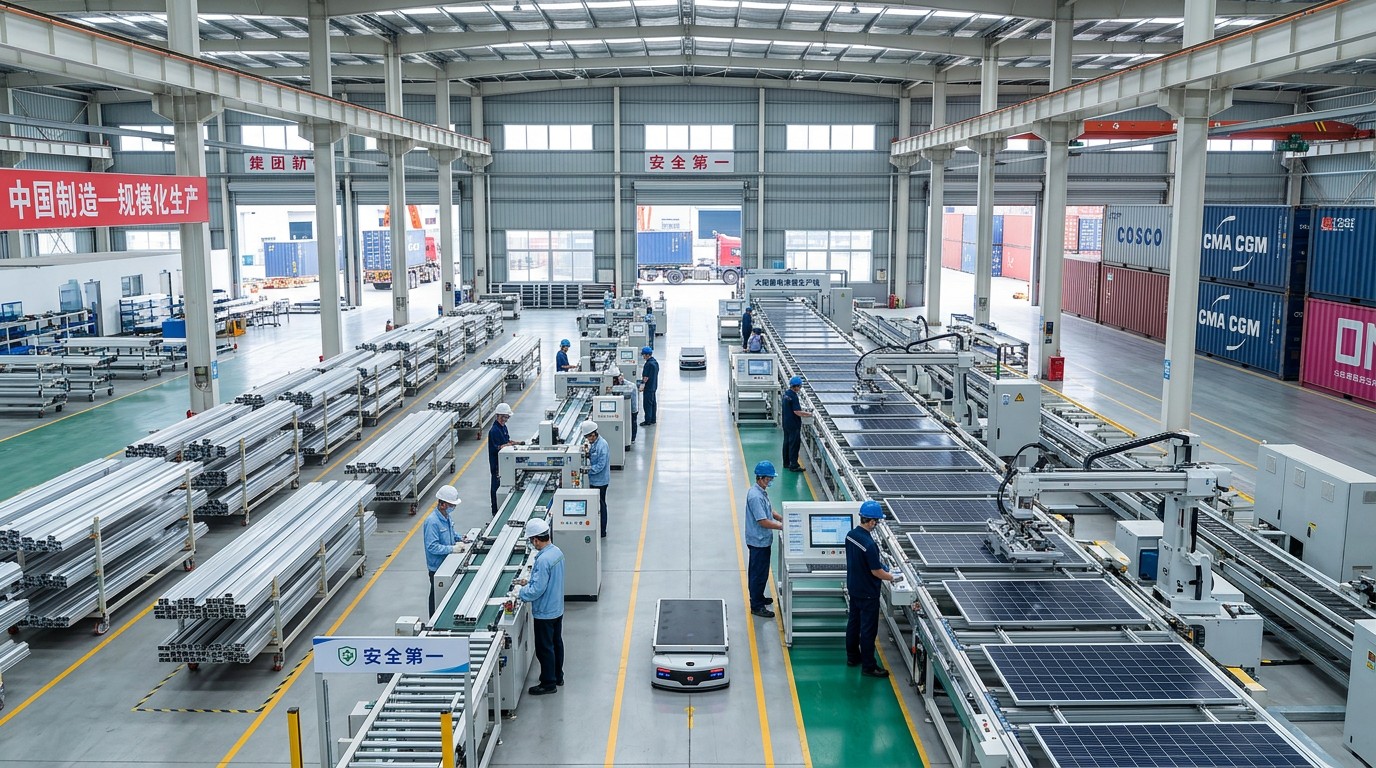
‘Made in China’ isn’t just a label—it’s a dynamic sourcing ecosystem shaped by cross border trade realities, procurement management complexity, and real-world trade-offs between ex factory price, FOB price, and CIF price. From direct factory sourcing of aluminum products and ceramic materials to wholesale sourcing of solar panels, PCB boards, and sanitary ware, global buyers navigate container shipping logistics, industrial energy efficiency demands, and B2B e commerce platforms—including independent foreign trade websites. Whether you’re an enterprise decision-maker optimizing supply chains or a buyer evaluating flooring materials versus structural profiles, understanding these levers is critical for overseas marketing, cost control, and resilient procurement.
What Does “Made in China” Really Mean for Sourcing Decisions?
“Made in China” reflects neither a monolithic production standard nor a static cost advantage. It represents a layered, adaptive ecosystem—comprising over 300,000 active export-oriented manufacturers across 28 provincial-level regions, supported by 12,000+ certified industrial parks and integrated with more than 70 national-level B2B e-commerce platforms (e.g., Alibaba.com, Made-in-China.com, GlobalSources). This infrastructure enables rapid prototyping cycles (typically 7–15 days), flexible MOQs (from 10 units for electronics components to 500+ tons for steel profiles), and multi-tiered compliance pathways—from GB/T national standards to ISO 9001, CE, UL, and REACH alignment.
For information researchers and procurement professionals, the label signals access—not to uniformity, but to calibrated variability. A single aluminum extrusion supplier may offer three distinct service tiers: standard-grade profiles (lead time: 2–4 weeks; tolerance: ±0.3mm), premium architectural series (lead time: 5–6 weeks; surface finish: 6063-T5 + powder coating; certification: EN 12020-2), and custom-engineered solutions (NDA-required design review; 3D CAD file integration; 6-month warranty). Recognizing this spectrum prevents misaligned expectations and supports accurate TCO modeling.
Enterprise decision-makers increasingly treat “Made in China” as a strategic node—not a destination. Leading multinationals now deploy hybrid sourcing models: 60% of base components sourced from Tier-1 OEMs in Guangdong and Jiangsu (for scale and consistency), 25% from specialized SME clusters in Zhejiang (for agility and niche innovation), and 15% via nearshoring partnerships with Chinese-invested facilities in Vietnam and Mexico (for tariff mitigation and regional responsiveness).
How Pricing Structures Shape Real-World Procurement Trade-Offs
Price terms are not interchangeable—they encode distinct risk allocations, cash flow implications, and operational responsibilities. Ex-factory pricing excludes all logistics and documentation costs; FOB includes loading onto the vessel at the port of origin (e.g., Ningbo or Shenzhen) but shifts marine insurance and destination handling to the buyer; CIF bundles freight and insurance to the named port of discharge—but introduces valuation uncertainty if customs duties apply ad valorem.
Misreading these distinctions leads to cost leakage: CIF quotes often embed conservative freight estimates (+12–18% above spot rates), while ex-factory offers may omit critical export license processing time (3–5 working days for dual-use chemical additives or PCB substrates). Our platform tracks real-time term-specific benchmarks across 14 major commodity categories—updated daily via verified supplier feeds and port authority data.
Which Sourcing Channels Deliver Verified Transparency?
Not all B2B platforms deliver equal visibility. Independent foreign trade websites (e.g., those hosted on .cn domains with ICP licenses) typically provide factory verification documents, live production floor video links, and third-party audit reports (SGS, BV, Intertek)—but require manual due diligence. Cross-border marketplaces like Alibaba.com offer Trade Assurance coverage (up to USD $2M per order), but only for transactions meeting strict eligibility criteria: minimum 3 years in operation, annual export volume >USD $500K, and ≥95% on-time delivery rate over 6 months.
- Direct factory visits remain the gold standard—especially for high-value capital goods (e.g., CNC machining centers, solar panel laminators). We recommend scheduling during Q2 or Q4 to avoid peak holiday production halts (Chinese New Year in Feb; National Day in Oct).
- Industry-specific vertical platforms (e.g., Hc360.com for chemicals, 1688.com for domestic wholesale) often list tiered certifications: “Verified Supplier” (basic business license check), “Gold Supplier” (annual audit + sample testing), and “Assessed Supplier” (on-site inspection + process capability analysis).
- Our intelligence dashboard aggregates over 2,400 verified supplier profiles across 11 sectors, tagging each with 6 trust indicators: export license validity, latest audit date, average response time (<2 hrs for Gold-tier), product compliance scope (GB/ISO/EN/UL), MOQ flexibility, and lead-time variance (±7% vs. quoted).
Why Rely on Real-Time Intelligence—Not Static Databases?
Static directories become outdated within 48 hours. Regulatory changes (e.g., China’s updated VOC emission limits for architectural coatings, effective Jan 2024), raw material price spikes (aluminum ingot +11.3% MoM in April 2024), and port congestion events (Yantian terminal backlog up 22% in Q2) directly impact landed cost, compliance status, and delivery certainty.
Our platform delivers actionable intelligence—not just headlines. For example, when sourcing ceramic tiles for EU residential projects, users receive automated alerts on: GB/T 4100–2015 compliance gaps vs. EN 14411 requirements, real-time kiln energy consumption data (average 3.2 kWh/m² vs. EU benchmark of 2.8 kWh/m²), and comparative lead times across 7 verified suppliers in Guangdong and Fujian (ranging from 22–38 days depending on glaze complexity and packaging specs).
We support your next move with precision: request a customized supplier shortlist (filtered by certification, capacity, export experience, and language capability), validate technical specifications against latest GB/ISO/IEC updates, compare FOB vs. CIF total landed cost scenarios, or access quarterly trend reports on 12 key commodity groups—including granular breakdowns by province, port, and HS code.
Ready to Optimize Your Sourcing Strategy?
Contact our industry intelligence team for: supplier vetting reports, real-time pricing dashboards, regulatory compliance mapping (EU/US/ASEAN), or tailored market entry briefings—including localized procurement playbooks for solar, building materials, electronics, and home improvement sectors.
- supply chain
- PCB board
- solar panels
- industrial energy efficiency
- aluminum products
- structural profiles
- ceramic materials
- sanitary ware
- flooring materials
- chemical additives
- B2B e commerce
- foreign trade website
- overseas marketing
- container shipping
- procurement management
- wholesale sourcing
- direct factory sourcing
- FOB price
- CIF price
- importers
- distributors
- ex factory price
- made in china
- foreign trade
- cross border trade
- home improvement
- chemicals
- electronics
- e-commerce
- energy
Related News
- Made in China products list: What’s newly export-compliant for EU markets in 2026?Apr 18, 2026Made in China products list updated for EU 2026 compliance—covering home decoration ideas, semiconductor industry news, clean energy investment opportunities, and supply chain risk management strategies.
- RCEP e-CO Platform Launched for China-ASEAN Building Materials & MachineryApr 17, 2026RCEP e-CO Platform launched: Fast-track China-ASEAN building materials & machinery exports with 3-day digital origin certification and tariff preferences.
- China’s Q1 2026 Exports Hit Record High, New Energy Goods Surpass 58% ShareApr 17, 2026China’s Q1 2026 exports hit record high—new energy goods (lithium batteries, solar cells,机电 products) now exceed 58% share. Key insights for importers, OEMs & supply chain leaders.
- Made in China isn’t just a label—it’s a sourcing ecosystem with real trade-offsApr 18, 2026Master cross border trade & Made in China sourcing: compare ex factory, FOB, CIF prices; optimize direct factory sourcing, container shipping & B2B e commerce for solar panels, industrial gases, flooring, sanitary ware & more.
Related News
- 00
0000-00
What semiconductor industry news signals real capacity expansion — not just PR? - 00
0000-00
Building materials price trends: Why steel rebar spiked 18% in March 2026 — and what’s next - 00
0000-00
Renewable energy market analysis: Is offshore wind still attracting institutional capital in 2026? - 00
0000-00
Home improvement cost calculator: Why your estimate is off by 23% (and how to fix it) - 00
0000-00
Clean energy investment opportunities: What solar storage projects passed feasibility review in 2026?
Export Insights Desk
Weekly Insights
Stay ahead with our curated technology reports delivered every Monday.