





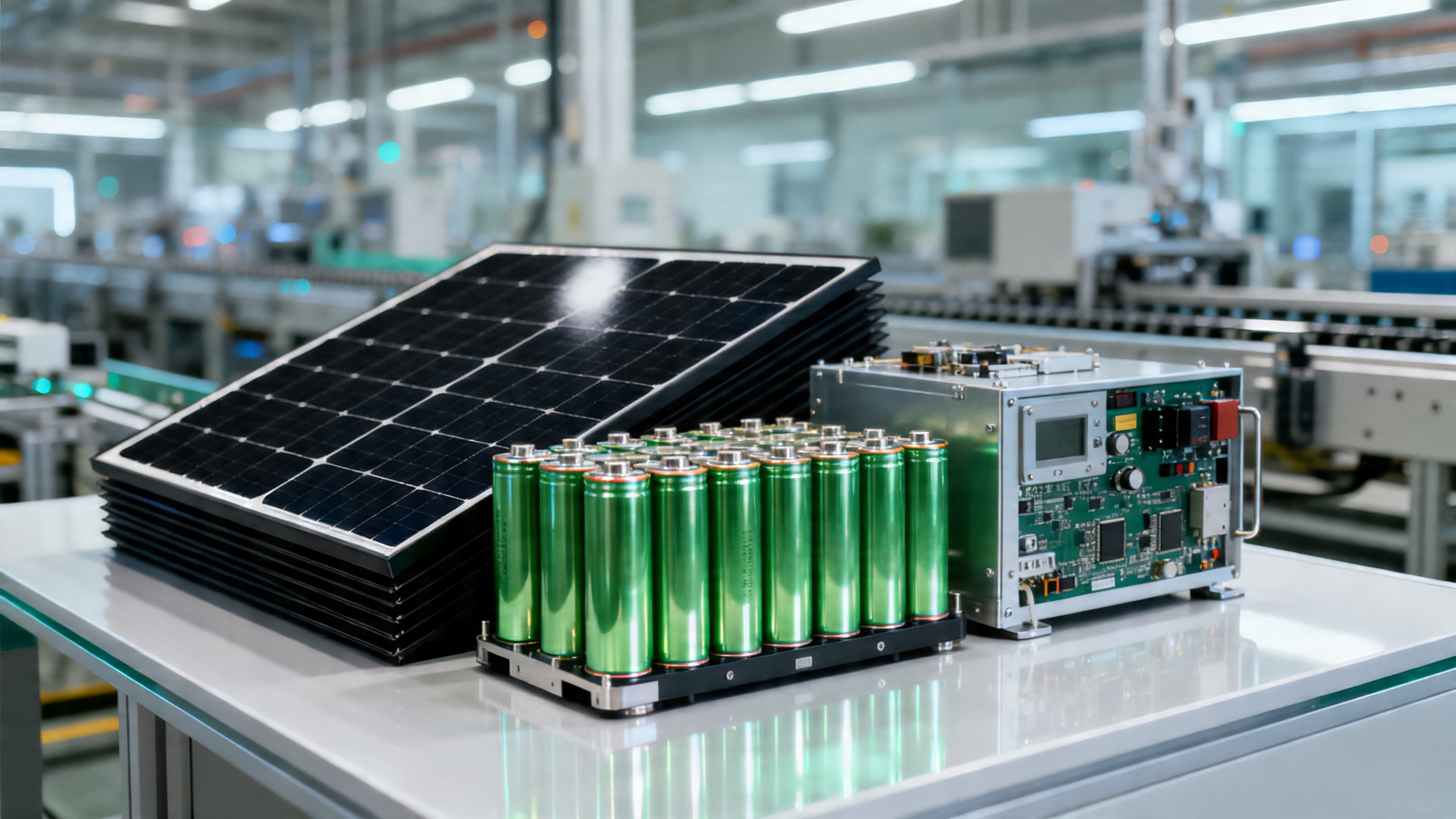
On April 14, 2026, China’s General Administration of Customs reported that the country’s total goods trade imports and exports reached RMB 11.84 trillion in Q1 2026 — a 15% year-on-year increase, the highest in five years. With mechanical and electrical products, lithium batteries, and solar cells collectively accounting for over 58% of total exports for the first time, this milestone signals heightened global demand for Chinese-made green energy solutions and advanced manufacturing — directly relevant to importers, OEMs, procurement managers, and supply chain planners operating in energy, electronics, and industrial equipment sectors.
Event Overview
According to data released by China’s General Administration of Customs on April 14, 2026, China’s total merchandise trade imports and exports in Q1 2026 amounted to RMB 11.84 trillion, up 15% year-on-year — the strongest quarterly growth in the past five years. Exports of mechanical and electrical products, lithium batteries, and solar cells — collectively referred to as the ‘New Three’ — accounted for more than 58% of total export value, the first time this threshold has been exceeded.
Industries Affected
Direct Trading Enterprises
These enterprises — especially those exporting or importing electromechanical equipment, battery systems, or photovoltaic components — face shifting buyer expectations. The rising share of high-value, technically integrated exports suggests overseas buyers are increasingly prioritizing technical compliance, certification readiness (e.g., IEC, UL, CE), and traceability over pure cost competitiveness.
Raw Material Procurement Enterprises
Firms sourcing critical minerals (e.g., lithium, cobalt, polysilicon) or specialty materials for battery and solar panel production may experience tighter regional supply dynamics. As export volumes rise, upstream material demand intensifies — potentially affecting lead times and pricing stability, particularly for internationally certified grades.
Contract Manufacturing & OEM Enterprises
Manufacturers serving global brands in power electronics, EV components, or solar inverters face growing scrutiny on production consistency, quality documentation, and delivery predictability. The 58%+ share reflects not just volume, but cumulative improvements in process control and international standard alignment — raising benchmark expectations for new partners.
Distribution & Channel Operators
Importers and regional distributors handling ‘New Three’ goods must reassess inventory planning models. Higher export concentration in fewer, higher-complexity categories increases exposure to regulatory updates (e.g., EU Battery Regulation, CBAM-related reporting), customs classification accuracy, and after-sales service infrastructure requirements.
Supply Chain Service Providers
Freight forwarders, customs brokers, and logistics technology platforms supporting cross-border movement of batteries and solar modules need to prioritize compliance-aware routing — including adherence to IMDG Code for lithium shipments and updated solar panel labeling standards across key markets (e.g., U.S. UFLPA, EU Ecodesign).
What Relevant Enterprises or Practitioners Should Focus On
Monitor official follow-up releases and sectoral guidance
Current data is macro-level. Subsequent monthly breakdowns from Customs — especially by product HS code, destination market, and enterprise type (SOEs vs. private exporters) — will clarify whether the 58%+ share reflects broad-based strength or concentration among a few large players. Track upcoming Ministry of Commerce briefings for potential export facilitation measures.
Assess exposure to top-performing categories and markets
Identify direct or indirect involvement in lithium battery cells/modules, PV wafers/modules, or industrial automation systems — all key contributors to the ‘New Three’. Prioritize due diligence on key destinations showing disproportionate growth (e.g., Southeast Asia, Mexico, Türkiye), where local content rules or tariff adjustments may soon follow.
Distinguish policy signal from operational reality
The 58% figure reflects realized export value — not yet a formal policy target. While it indicates structural progress, it does not imply automatic preferential treatment or reduced scrutiny. Compliance obligations (e.g., origin verification, environmental disclosures) remain unchanged unless formally amended.
Prepare for intensified documentation and audit readiness
Given the strategic visibility of these exports, expect increased customs audits and third-party verification requests — especially for battery recycling claims, solar panel carbon footprint declarations, and factory-level energy use reporting. Proactively align internal records with ISO 14067, IEC 62443, or equivalent frameworks.
Editorial Perspective / Industry Observation
From an industry perspective, this data point is best understood as a validation signal — not a turning point already fully embedded in operations. It confirms that Chinese manufacturers have achieved scalable, globally accepted execution in targeted green tech segments. However, analysis来看, sustained share growth beyond 58% will depend less on export volume expansion and more on demonstrable progress in areas like battery second-life management, solar panel recyclability rates, and real-time supply chain transparency — metrics now actively tracked by major importers and regulators. Current momentum reflects accumulated capability; the next phase hinges on verifiable sustainability performance.
It is more accurate to interpret this milestone as evidence of maturing export capacity rather than an immediate shift in trade policy or market access conditions. The 15% growth rate and 58% share are outcomes — not drivers. Industry participants should treat them as reference benchmarks against which to calibrate their own technical readiness, compliance posture, and partner evaluation criteria.
Observation来看, the convergence of strong export figures with concentrated category performance underscores how deeply global decarbonization agendas are reshaping sourcing hierarchies — elevating suppliers who combine manufacturing scale with standardized environmental and digital traceability.
Conclusion: This record Q1 performance reflects structural progress in China’s export composition — particularly in high-tech, low-carbon goods — but does not alter near-term operational requirements for foreign buyers or domestic suppliers. It serves best as a contextual indicator: one that validates current trends in global green procurement while highlighting where technical and regulatory preparedness matters most.
Information Source: General Administration of Customs of the People’s Republic of China (data release dated April 14, 2026). Note: Monthly product-level and destination-specific breakdowns remain pending and are subject to official revision; ongoing monitoring is recommended.
Related News
- RCEP e-CO Platform Launched for China-ASEAN Building Materials & MachineryApr 17, 2026RCEP e-CO Platform launched: Fast-track China-ASEAN building materials & machinery exports with 3-day digital origin certification and tariff preferences.
- China’s Q1 2026 Exports Hit Record High, New Energy Goods Surpass 58% ShareApr 17, 2026China’s Q1 2026 exports hit record high—new energy goods (lithium batteries, solar cells,机电 products) now exceed 58% share. Key insights for importers, OEMs & supply chain leaders.
- Ceramic materials export volumes dipped in Q1 2026—was it demand or documentation?Apr 17, 2026Cross border trade in ceramic materials dipped in Q1 2026—discover if demand shifts or documentation gaps (FOB/CIF/ex factory price clarity) drove the slump. Get actionable procurement management & B2B e commerce insights now.
- Steel products reclassification in Vietnam opens new tariff categories—and risksApr 17, 2026Cross border trade in steel products faces new risks and opportunities after Vietnam’s 2024 reclassification—impacting FOB price, CIF price, ex factory price, direct factory sourcing, and procurement management across B2B e commerce and container shipping.
Related News
- 00
0000-00
Red Sea Tensions Lift Asia-Europe Freight Costs 23% Weekly - 00
0000-00
Shanghai Port Launches Export Compliance Pre-Check Channel - 00
0000-00
Vietnam Enforces Bilingual Energy Label for E&E Products from Apr 2026 - 00
0000-00
Indonesia Mandates CNAS Lab Reports for Imported Building Materials from July 2026 - 00
0000-00
USTR Launches Section 301 Review on Chinese Wearables
Export Insights Desk
Weekly Insights
Stay ahead with our curated technology reports delivered every Monday.