





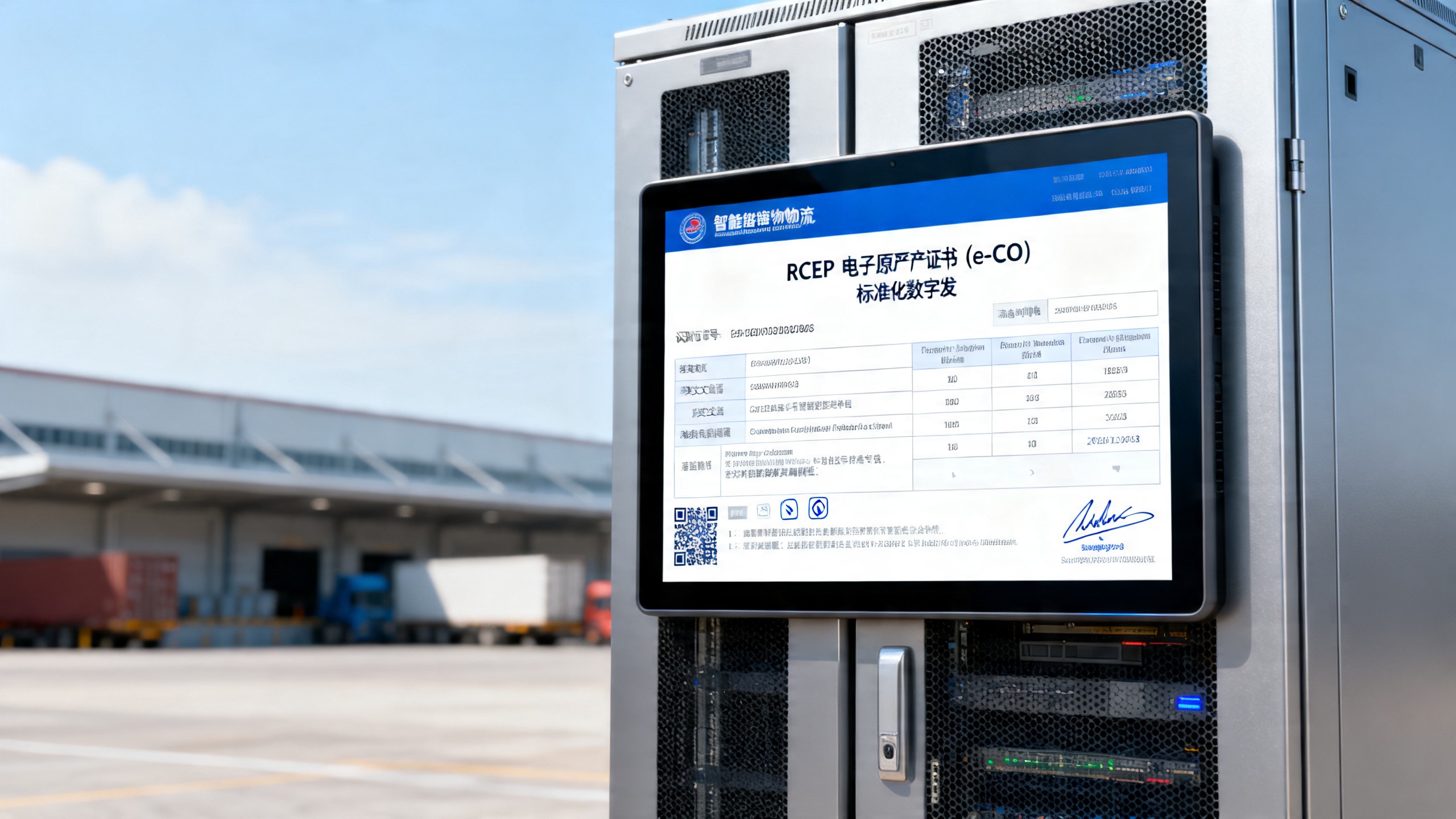
On April 10, 2026, the RCEP unified electronic Certificate of Origin (e-CO) cross-border mutual recognition platform went live across all 15 member countries. This development significantly affects exporters of building ceramics, structural steel components, and construction machinery from China to ASEAN markets—where customs clearance and tariff preference processing time has been reduced to within three working days, a more than 40% improvement over paper-based certification.
Event Overview
Effective April 10, 2026, the RCEP electronic Certificate of Origin (e-CO) platform is fully operational among all 15 RCEP member states. The system enables digital issuance, transmission, and verification of origin certificates for goods traded under RCEP rules. For Chinese exports to ASEAN—including architectural ceramics, steel structural elements, and complete construction machinery units—the full process of origin certification and customs verification is now completed in no more than three working days. Vietnam, Thailand, and Indonesia have adopted e-CO as a mandatory document for expedited customs clearance and preferential tariff application; suppliers not connected to the platform face increased risk of clearance delays and buyer complaints.
Industries Affected
Direct Exporters (China-based)
Exporters of building ceramics, steel structures, and construction machinery to ASEAN are directly impacted because e-CO is now required for tariff preferences and fast-track clearance in key markets. Delays in certificate issuance or non-compliance with platform integration may result in customs hold-ups, missed delivery windows, and contractual penalties.
Manufacturers with Integrated Supply Chains
Producers supplying finished goods—including structural steel fabricators and machinery OEMs—must ensure their internal documentation systems can generate and transmit valid e-CO data. Their ability to meet buyer requirements depends on seamless integration with certified origin declaration platforms, especially where buyers require pre-shipment e-CO submission.
Importers and Distributors (ASEAN-based)
Importers in Vietnam, Thailand, and Indonesia now treat e-CO as a de facto prerequisite for RCEP tariff treatment. Those sourcing from Chinese suppliers lacking e-CO capability may experience extended customs processing times, inventory planning disruptions, and pressure to switch vendors.
Logistics and Trade Facilitation Providers
Cargo agents, customs brokers, and trade compliance service providers must update their client onboarding and documentation workflows to include e-CO validation and platform interoperability checks. Failure to verify e-CO readiness before shipment may expose them to liability for clearance failures.
What Enterprises and Practitioners Should Focus On Now
Confirm platform integration status with local customs authorities
Chinese exporters should verify whether their regional customs authority (e.g., GACC sub-offices) has completed technical integration with the RCEP e-CO platform—and whether their current origin declaration software supports automated e-CO generation and submission. Manual uploads or offline processes may still trigger verification delays.
Prioritize high-volume, high-tariff-rate product lines for e-CO onboarding
Building ceramics and structural steel components face relatively high MFN tariffs in ASEAN markets; thus, these categories offer the largest immediate tariff savings under RCEP. Companies should prioritize e-CO setup for SKUs with proven demand and clear origin eligibility before expanding to lower-priority lines.
Review contracts and Incoterms for e-CO responsibility clauses
Many existing export contracts do not specify who bears responsibility for e-CO issuance or technical failure. Sellers should assess current agreements—especially those using FOB or CIF terms—to clarify whether origin certification is the seller’s obligation, and whether backup documentation provisions exist for platform outages.
Monitor ASEAN national implementation timelines beyond Vietnam, Thailand, and Indonesia
While Vietnam, Thailand, and Indonesia have mandated e-CO use, other ASEAN members (e.g., Malaysia, Philippines, Cambodia) may follow at different paces. Exporters should track official announcements from each country’s customs administration to anticipate phased enforcement and avoid premature assumptions about universal adoption.
Editorial Perspective / Industry Observation
From an industry perspective, the launch of the RCEP e-CO platform is better understood as an operational milestone—not just a policy announcement. It marks the transition from RCEP’s theoretical tariff advantages to enforceable, digitized trade facilitation. Analysis来看, this shift raises the baseline expectation for digital readiness among exporters: paper-based origin certification is no longer functionally competitive in priority markets. Observation来看, the 40% efficiency gain reflects underlying infrastructure upgrades—not merely procedural change—and signals that future RCEP enhancements (e.g., automated rules-of-origin verification) will likely build upon this platform. Current more appropriate interpretation is that e-CO is now a structural requirement for market access, not an optional convenience.
This development does not yet represent full harmonization—national customs systems still vary in interface standards and verification logic—but it establishes a shared digital foundation. Industry stakeholders should therefore treat it as both a near-term compliance checkpoint and a medium-term signal of deeper digital integration across RCEP supply chains.
Conclusion
The activation of the RCEP e-CO platform is a concrete step toward digitized trade governance in Asia-Pacific. Its primary significance lies not in introducing new tariff rates, but in enforcing a standardized, time-bound digital workflow for accessing existing preferences. For affected enterprises, the event is best understood as a hardening of procedural expectations—not a one-time opportunity, but a new operational baseline requiring sustained technical and contractual alignment.
Source Attribution
Main source: Official RCEP Secretariat announcement dated April 10, 2026, confirming full platform deployment across 15 members. Additional confirmation from customs authorities of Vietnam, Thailand, and Indonesia regarding mandatory e-CO use for RCEP tariff claims. Ongoing implementation status in other RCEP members remains subject to national customs notifications and requires continued monitoring.
Related News
- RCEP e-CO Platform Launched for China-ASEAN Building Materials & MachineryApr 17, 2026RCEP e-CO Platform launched: Fast-track China-ASEAN building materials & machinery exports with 3-day digital origin certification and tariff preferences.
- China’s Q1 2026 Exports Hit Record High, New Energy Goods Surpass 58% ShareApr 17, 2026China’s Q1 2026 exports hit record high—new energy goods (lithium batteries, solar cells,机电 products) now exceed 58% share. Key insights for importers, OEMs & supply chain leaders.
- Ceramic materials export volumes dipped in Q1 2026—was it demand or documentation?Apr 17, 2026Cross border trade in ceramic materials dipped in Q1 2026—discover if demand shifts or documentation gaps (FOB/CIF/ex factory price clarity) drove the slump. Get actionable procurement management & B2B e commerce insights now.
- Steel products reclassification in Vietnam opens new tariff categories—and risksApr 17, 2026Cross border trade in steel products faces new risks and opportunities after Vietnam’s 2024 reclassification—impacting FOB price, CIF price, ex factory price, direct factory sourcing, and procurement management across B2B e commerce and container shipping.
Related News
- 00
0000-00
Red Sea Tensions Lift Asia-Europe Freight Costs 23% Weekly - 00
0000-00
Shanghai Port Launches Export Compliance Pre-Check Channel - 00
0000-00
Vietnam Enforces Bilingual Energy Label for E&E Products from Apr 2026 - 00
0000-00
Indonesia Mandates CNAS Lab Reports for Imported Building Materials from July 2026 - 00
0000-00
USTR Launches Section 301 Review on Chinese Wearables
Export Insights Desk
Weekly Insights
Stay ahead with our curated technology reports delivered every Monday.