





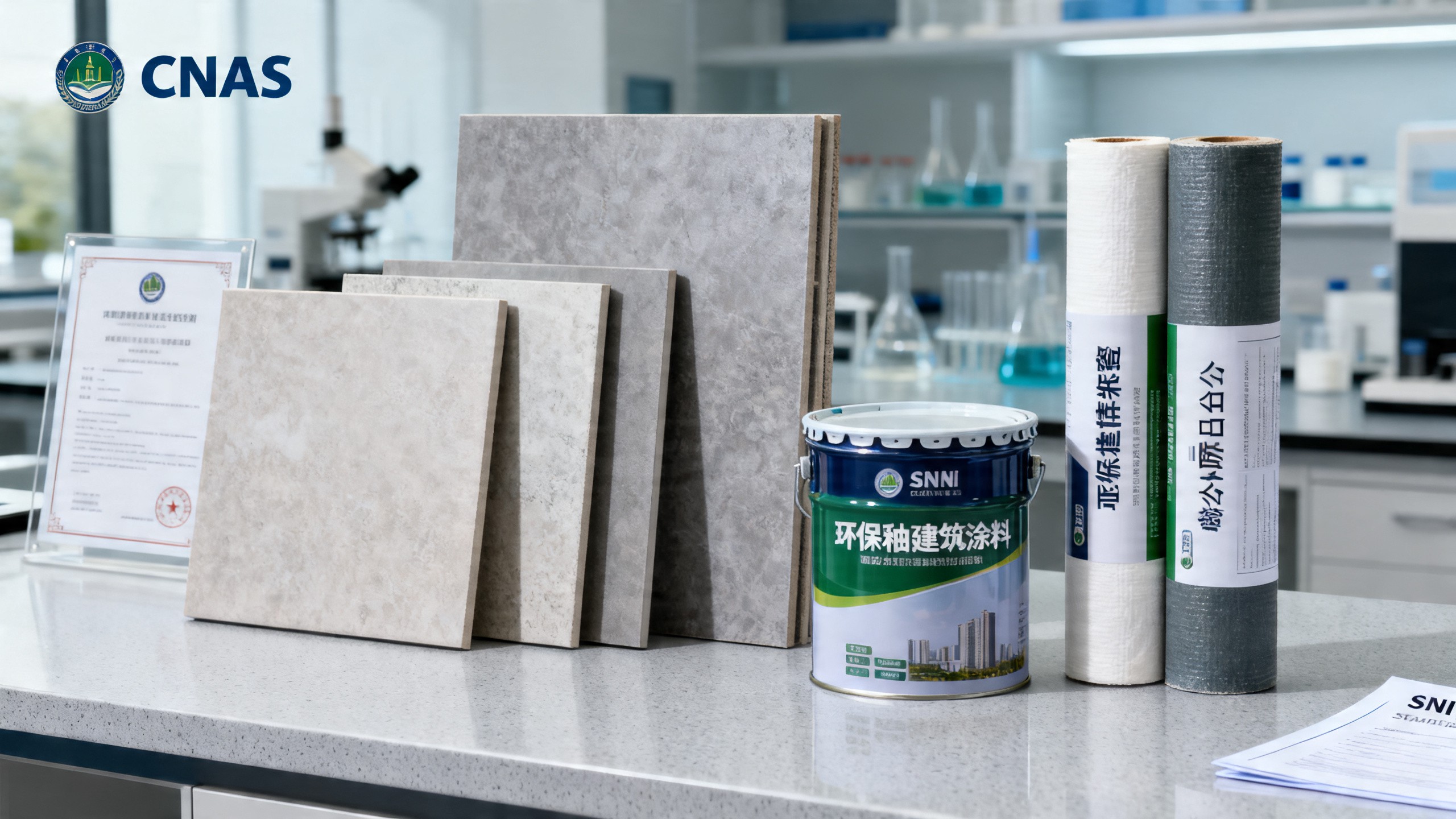
Indonesia’s National Standardization Agency (BSN) announced on April 15, 2026, that all imported building materials—including tiles, paints, and waterproofing products—must be accompanied by test reports issued by laboratories accredited by China’s National Accreditation Service for Conformity Assessment (CNAS) and demonstrating compliance with Indonesian National Standards (SNI). This requirement takes effect on July 1, 2026. Exporters and supply chain stakeholders in the Chinese building materials sector should take note, as the policy directly affects market access, certification timelines, and documentation workflows.
Event Overview
On April 15, 2026, Indonesia’s National Standardization Agency (BSN) issued a formal notification stating that, effective July 1, 2026, all imported tiles, paints, and waterproofing materials must be accompanied by test reports from CNAS-accredited laboratories confirming conformity with SNI standards. The BSN cited enhanced quality control of imported construction products as the stated objective. No further implementation details—such as accepted report formats, validity periods, or transitional arrangements—were published at the time of announcement.
Which Subsectors Are Affected
Direct Exporters (Trading Enterprises)
Companies exporting finished building materials from China to Indonesia will face mandatory pre-shipment testing. Since CNAS-accredited labs are required—and not just any ISO/IEC 17025 lab—the scope of eligible testing providers is constrained. Impact includes extended lead times (4–6 weeks per batch), added cost for testing, and potential delays if reports lack full alignment with SNI test parameters.
Manufacturers (Processing & Production Firms)
Domestic manufacturers supplying export-oriented trading firms must ensure product formulations and performance meet SNI requirements—not just GB or industry standards. This may necessitate reformulation validation, updated technical documentation, and internal quality checks aligned with SNI test methods before submitting samples to CNAS labs.
Distribution & Logistics Providers
Import agents, customs brokers, and freight forwarders handling Indonesian-bound building materials will need to verify the presence and authenticity of valid CNAS reports prior to customs clearance. Absence or non-compliance may result in shipment rejection or detention, increasing documentation review workload and requiring staff familiarization with CNAS lab credentials and SNI reference numbers.
Supply Chain Support Services
Certification consultants, lab coordination platforms, and testing logistics intermediaries may see increased demand for services supporting CNAS report procurement—but only those with verified experience in SNI-aligned testing protocols will be operationally relevant. Generic lab referral services lacking SNI-specific capability may not meet practical needs.
What Relevant Companies or Practitioners Should Focus On Now
Monitor official BSN communications for implementation clarifications
The April 15 notice is an initial regulatory signal; no detailed enforcement guidance (e.g., acceptable report templates, list of SNI clauses applicable per product category, or recognition status of specific CNAS labs) has been published. Stakeholders should track BSN’s official portal and Indonesian customs circulars for updates ahead of the July 2026 deadline.
Identify priority product categories and validate SNI test requirements
Tiles, paints, and waterproofing materials are explicitly named—but subcategories (e.g., ceramic vs. porcelain tiles, interior vs. exterior paints) may carry distinct SNI clauses. Exporters should cross-reference their SKUs against the latest SNI standards (e.g., SNI 03-2922 for ceramic tiles, SNI 03-6508 for architectural paints) and confirm which tests (e.g., water absorption, adhesion, VOC content) CNAS labs are authorized to perform.
Engage CNAS-accredited labs early and confirm testing capacity
Not all CNAS-accredited labs cover SNI-related test methods. Companies should contact labs directly to verify: (1) current CNAS scope includes the relevant SNI standard(s); (2) turnaround time for the required tests; and (3) whether reports include bilingual (Chinese–English) or trilingual (including Indonesian) elements preferred by BSN. Reserve slots at least 6 weeks ahead of planned shipments.
Review and update internal documentation workflows
Export documentation packages must now integrate CNAS reports as a core compliance component—not supplementary evidence. Quality assurance teams should revise checklists, ERP system fields, and shipping instruction templates to flag CNAS report submission as mandatory before release.
Editorial Perspective / Industry Observation
From an industry perspective, this measure is better understood as a procedural tightening rather than a market access barrier—at least at present. It does not introduce new technical requirements beyond existing SNI standards, but shifts verification responsibility upstream to China-based labs under a defined accreditation framework. Analysis来看, the policy reflects Indonesia’s broader trend toward strengthening post-import oversight through traceable, third-party-verified data—similar to earlier moves in food and electronics sectors. Observation来看, it signals growing emphasis on documentation integrity over physical inspection alone. Current more appropriate interpretation is that this is a compliance process upgrade, not a technical trade restriction—yet its operational impact depends heavily on how consistently and transparently BSN implements it across ports and product lines.
In summary, the BSN’s CNAS reporting requirement marks a shift toward standardized, lab-verified conformity for key building material imports into Indonesia. Its significance lies less in introducing novel safety or performance thresholds, and more in institutionalizing documentation rigor within the export workflow. For stakeholders, it is best approached as a procedural milestone—one demanding advance coordination with accredited labs and close attention to official implementation guidance, rather than a fundamental change in product specifications or market eligibility.
Information Source: Official notification issued by Indonesia’s National Standardization Agency (BSN), dated April 15, 2026. Pending clarification: BSN has not yet published detailed enforcement guidelines, including accepted report formats, validity duration, or transitional provisions for shipments booked before July 2026.
Related News
- Indonesia Mandates CNAS Lab Reports for Imported Building Materials from July 2026Apr 16, 2026Indonesia mandates CNAS lab reports for imported building materials from July 2026—key for tiles, paints & waterproofing. Stay compliant & avoid delays!
- Building materials news: Steel-reinforced concrete specs are changing faster than testing standards — is compliance still meaningful?Apr 15, 2026Building materials news meets real-world risk: Discover how product innovation news, supply chain updates, and industry chain analysis reshape compliance—before delays cost you six figures.
- Building materials market consolidation accelerated in 2025 — who gained share outside China?Apr 12, 2026Explore global trade trends, policy updates & clean energy integration reshaping the building materials market—discover who gained share outside China in 2025.
- Renovation materials shortages eased in early 2026 — yet delivery reliability remains below pre-pandemic levelsApr 12, 2026Renovation materials shortages eased in early 2026 — explore global trade trends, policy updates, clean energy impacts, and e-commerce shifts affecting building materials market reliability.
Related News
- 00
0000-00
Indonesia Mandates CNAS Lab Reports for Imported Building Materials from July 2026 - 00
0000-00
China's CPO Optical Module Exports Up 41%; Eoptolink First Global Vendor on US AI Infrastructure White List - 00
0000-00
IEC 62368-1:2026 Published — AV/IT Exporters Must Comply by Q1 2027 - 00
0000-00
Red Sea Tensions Lift Asia-Europe Freight Costs 23% Weekly - 00
0000-00
RCEP e-CO Platform Launches for Faster Export Clearance
Building Materials Desk
Weekly Insights
Stay ahead with our curated technology reports delivered every Monday.